




Gynoecium is made up of
a. Stigma
b. Style
c. Ovary
d. All of these
Answer
 Verified
636k+ views
Hint: the female part of a flower, consisting of one or more carpels is known as gynoecium.
Gynoecium is the female reproductive organ of a plant. It holds an ovary, which is transformed into fruit after fertilization. The ovules within the ovary are modified into seeds.
If carpels are free the gynoecium is known as apocarpous
If carpels are united the gynoecium is known as syncarpous.
Gynoecium consists of a female reproductive unit known as carpels.
Gynoecium is made up of three parts namely stigma, style, ovary.
Complete answer:
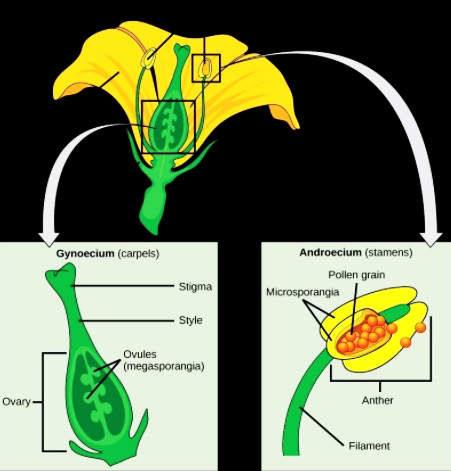
> STIGMA: - the stigma is very important to the process of reproduction in flowering plants. It provides a receptacle for pollen to land on and be rehydrated before entering the style to travel to the ovary. Without stigmas, flowering plants would not exist. So, this option is correct
> STYLE: - The style is a hollow tube in some plants such as lilies, or has transmitting tissue through which the pollen tubes grow. So, this option is also correct.
> OVARY: - The ovary, is the enlarged basal portion which contains placentas, ridges of tissue bearing one or more ovules. So, this option is also correct
> ALL OF THESE: - As above stated all the options are correct. So, they all are correct
Our correct option is d that is all of these as three of the parts are present in gynoecium.
Note: Gynoecium is the female reproductive part of the flower and is made up of one or more carpels. A carpel consists of three parts namely stigma, style, ovary. Each ovary bears one or more ovules attached to a flattened, cushion like placenta.
The arrangement of ovules within the ovary is known as placentation.
Gynoecium is the female reproductive organ of a plant. It holds an ovary, which is transformed into fruit after fertilization. The ovules within the ovary are modified into seeds.
If carpels are free the gynoecium is known as apocarpous
If carpels are united the gynoecium is known as syncarpous.
Gynoecium consists of a female reproductive unit known as carpels.
Gynoecium is made up of three parts namely stigma, style, ovary.
Complete answer:
> STIGMA: - the stigma is very important to the process of reproduction in flowering plants. It provides a receptacle for pollen to land on and be rehydrated before entering the style to travel to the ovary. Without stigmas, flowering plants would not exist. So, this option is correct
> STYLE: - The style is a hollow tube in some plants such as lilies, or has transmitting tissue through which the pollen tubes grow. So, this option is also correct.
> OVARY: - The ovary, is the enlarged basal portion which contains placentas, ridges of tissue bearing one or more ovules. So, this option is also correct
> ALL OF THESE: - As above stated all the options are correct. So, they all are correct
Our correct option is d that is all of these as three of the parts are present in gynoecium.
Note: Gynoecium is the female reproductive part of the flower and is made up of one or more carpels. A carpel consists of three parts namely stigma, style, ovary. Each ovary bears one or more ovules attached to a flattened, cushion like placenta.
The arrangement of ovules within the ovary is known as placentation.
Recently Updated Pages
Master Class 12 Business Studies: Engaging Questions & Answers for Success

Master Class 12 Chemistry: Engaging Questions & Answers for Success
Master Class 12 Biology: Engaging Questions & Answers for Success
Class 12 Question and Answer - Your Ultimate Solutions Guide
Master Class 11 English: Engaging Questions & Answers for Success
Master Class 11 Social Science: Engaging Questions & Answers for Success
Trending doubts
Which are the Top 10 Largest Countries of the World?
Draw a labelled sketch of the human eye class 12 physics CBSE
Differentiate between homogeneous and heterogeneous class 12 chemistry CBSE
Differentiate between Pyramid of energy and pyramid class 12 biology CBSE
Why is the cell called the structural and functional class 12 biology CBSE
Draw the diagram of the pyramid of energy Explain In class 12 biology CBSE