




Greenville is 1,200 miles west and 90 miles north of Johnson City. How long is a direct straight-line route from Greenville to Johnson City?
Answer
 Verified
575.4k+ views
Hint: The right approach to the above numerical is to sketch the route map. The problem is solved according to the geometrical figure we get upon the sketch. In this problem, we get a right-angle triangle. The third side of a right-angled triangle can be found out by the Pythagoras theorem.
Complete step by step solution:
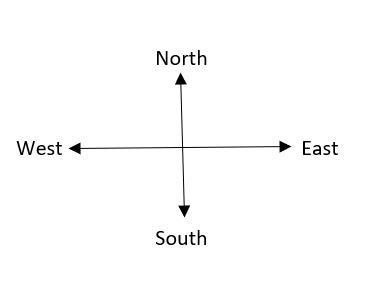
Using the cardinal directions listed below,
We draw the diagram.
According to our question,
Greenville is 1200 miles west and is 90 miles from Johnson City. we are asked to find the distance between Greenville and Johnson.
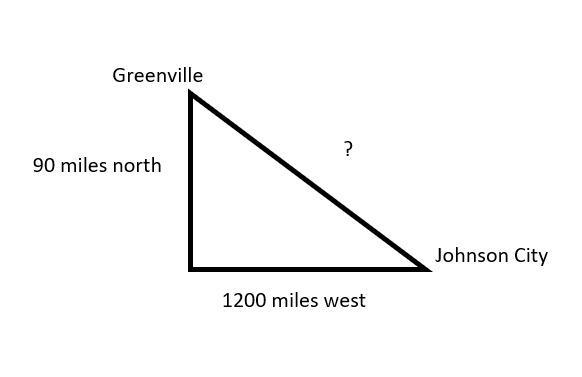
The diagram has one right angle and is a right-angled triangle.
Given that the 2 sides of the triangle are known.
The length of the first side of the triangle is 1200 miles.
The length of the second side of the triangle is 90 miles.
We need to find out the length of the third side of the triangle.
The length of the third side of a right-angled triangle can be found out by Pythagoras Theorem.
Pythagoras Theorem:
This Theorem defines the relationship between the three sides of a triangle.
It states that the square of the hypotenuse of the right-angled triangle is equal to the sum of the squares of the other two sides of a triangle.
The other two sides of a triangle are designated as base and height of a triangle, respectively.
According to Pythagoras Theorem,
${{\left( hypotenuse \right)}^{2}}={{\left( base \right)}^{2}}+{{\left( height \right)}^{2}}$
In the given question,
base = 1200 miles
height = 90 miles
hypotenuse = x?
$\Rightarrow {{\left( x \right)}^{2}}={{\left( 1200 \right)}^{2}}+{{\left( 90 \right)}^{2}}$
Now start evaluating,
$\Rightarrow {{\left( x \right)}^{2}}=1440000+8100$
$\Rightarrow {{\left( x \right)}^{2}}=1448100$
Now apply root on both sides of the equation.
$\Rightarrow x=\sqrt{1448100}$
hypotenuse = 1203.37 miles.
Thus, the length of the direct straight-line route from Greenville to Johnson City is 1203.37 miles.
Note: We must mark the directions and routes very precisely while making a sketch or drawing a diagram. For any right-angled triangle, the hypotenuse is the length of the longest side of the triangle. Pythagoras theorem is valid only in the case of the right-angled triangle.
Complete step by step solution:
Using the cardinal directions listed below,
We draw the diagram.
According to our question,
Greenville is 1200 miles west and is 90 miles from Johnson City. we are asked to find the distance between Greenville and Johnson.
The diagram has one right angle and is a right-angled triangle.
Given that the 2 sides of the triangle are known.
The length of the first side of the triangle is 1200 miles.
The length of the second side of the triangle is 90 miles.
We need to find out the length of the third side of the triangle.
The length of the third side of a right-angled triangle can be found out by Pythagoras Theorem.
Pythagoras Theorem:
This Theorem defines the relationship between the three sides of a triangle.
It states that the square of the hypotenuse of the right-angled triangle is equal to the sum of the squares of the other two sides of a triangle.
The other two sides of a triangle are designated as base and height of a triangle, respectively.
According to Pythagoras Theorem,
${{\left( hypotenuse \right)}^{2}}={{\left( base \right)}^{2}}+{{\left( height \right)}^{2}}$
In the given question,
base = 1200 miles
height = 90 miles
hypotenuse = x?
$\Rightarrow {{\left( x \right)}^{2}}={{\left( 1200 \right)}^{2}}+{{\left( 90 \right)}^{2}}$
Now start evaluating,
$\Rightarrow {{\left( x \right)}^{2}}=1440000+8100$
$\Rightarrow {{\left( x \right)}^{2}}=1448100$
Now apply root on both sides of the equation.
$\Rightarrow x=\sqrt{1448100}$
hypotenuse = 1203.37 miles.
Thus, the length of the direct straight-line route from Greenville to Johnson City is 1203.37 miles.
Note: We must mark the directions and routes very precisely while making a sketch or drawing a diagram. For any right-angled triangle, the hypotenuse is the length of the longest side of the triangle. Pythagoras theorem is valid only in the case of the right-angled triangle.
Recently Updated Pages
Master Class 12 Economics: Engaging Questions & Answers for Success

Master Class 12 English: Engaging Questions & Answers for Success
Master Class 12 Social Science: Engaging Questions & Answers for Success
Master Class 12 Maths: Engaging Questions & Answers for Success
Master Class 12 Physics: Engaging Questions & Answers for Success
Master Class 9 General Knowledge: Engaging Questions & Answers for Success
Trending doubts
Explain the Treaty of Vienna of 1815 class 10 social science CBSE
Why is it 530 pm in india when it is 1200 afternoon class 10 social science CBSE
What is the full form of POSCO class 10 social science CBSE
Define Potential, Developed, Stock and Reserved resources
Which Country Has the Largest Border with India?
Complete the sentence with the most appropriate word class 10 english CBSE