




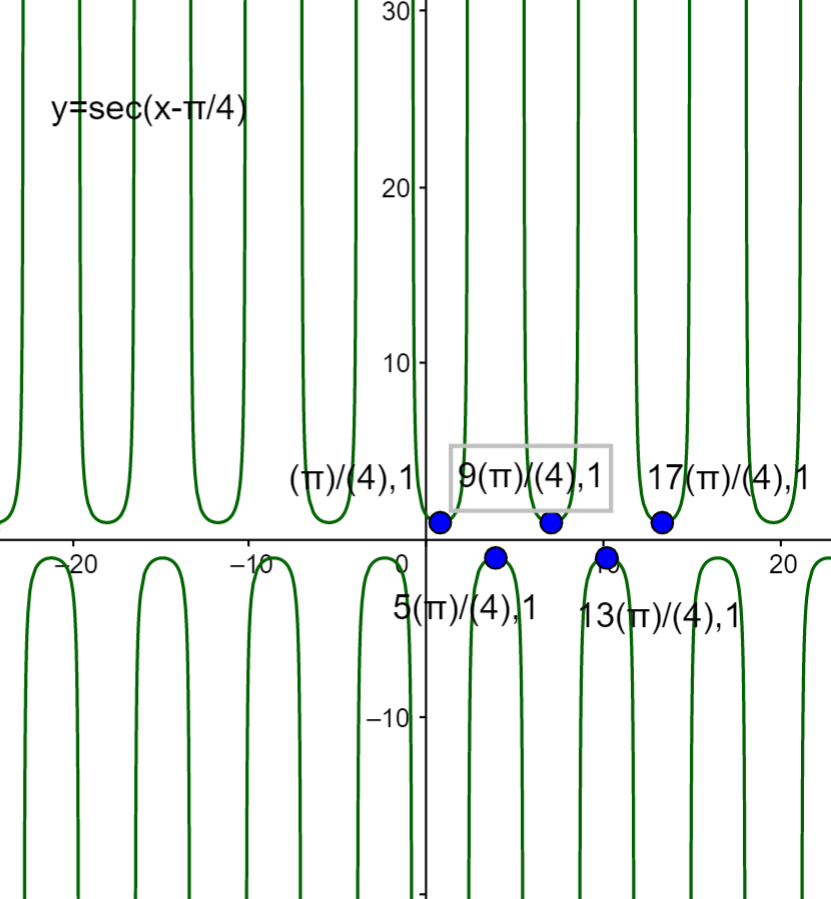
How do you graph \[y=\sec \left( x-\dfrac{\pi }{4} \right)\]?
Answer
 Verified
553.5k+ views
Hint: to find the graph for the given equation, we have to use \[y=a\sec \left( bx-c \right)+d\] for finding the amplitude, period, phase shift, vertical shift. After finding these values we have to find some points to plot on the graph. Now, based on the amplitude, period, vertical shift and phase shift and some more points we will draw a graph for the given equation.
Complete step by step answer:
From the given question we are given a graph for the equation \[y=\sec \left( x-\dfrac{\pi }{4} \right)\].
To draw a graph for the equation let us consider the above equation as equation (1).
Let us consider
\[y=\sec \left( x-\dfrac{\pi }{4} \right).........\left( 1 \right)\]
To draw the graph for equation (1), we have to use the equation \[y=a\sec \left( bx-c \right)+d\] to find the variables used to find the amplitude, period, phase shift, and vertical shift.
So let us consider the equation as equation (2).
\[y=a\sec \left( bx-c \right)+d...........\left( 2 \right)\]
By comparing equation (1) and (2), we get
\[\begin{align}
& \Rightarrow a=1.............\left( 3 \right) \\
& \Rightarrow b=1..............\left( 4 \right) \\
& \Rightarrow c=\dfrac{\pi }{4}.............\left( 5 \right) \\
& \Rightarrow d=0..............\left( 6 \right) \\
\end{align}\]
Now let us consider the above equations as equation (3), equation (4), equation (5) and equation (6) respectively.
Since the graph of the function \[\sec \] does not have a maximum or minimum value, therefore we can say that amplitude will become none.
Amplitude: None
Now let us find the period using the formula \[\dfrac{2\pi }{\left| b \right|}\].
Now from the equation (4) let us find the period for equation (1)
Therefore,
Period of equation (1) is \[2\pi \]
Let us consider
Period = \[2\pi ...............\left( 7 \right)\]
Let us find the phase shift using the formula \[\dfrac{c}{x}\].
Now from the equation (5) let us find the vertical shift for equation (1).
Therefore,
Phase shift of equation (1) is \[\dfrac{\pi }{4}\].
Let us consider
Phase shift = \[\dfrac{\pi }{4}..............\left( 8 \right)\].
Let us find a vertical shift from the formula d.
As we know from equation (6) we can say that vertical shift is equal to \[0\].
Therefore, let us consider
Vertical shift = \[0.................\left( 9 \right)\].
Now we can say that graphs of equation (1) can be graphed using amplitude, period, phase shift, vertical shift, and the points.
Selecting a few points to graph,
Therefore from equation (7), (8), (9) and above points we get
Note:
To find a graph for the equation \[y=\sec \left( x-\dfrac{\pi }{4} \right)\], we should be aware of graphs concept in trigonometry. We should be careful while comparing the given equation with \[y=a\sec \left( bx-c \right)+d\]. Students should avoid calculation mistakes while doing this problem.
Complete step by step answer:
From the given question we are given a graph for the equation \[y=\sec \left( x-\dfrac{\pi }{4} \right)\].
To draw a graph for the equation let us consider the above equation as equation (1).
Let us consider
\[y=\sec \left( x-\dfrac{\pi }{4} \right).........\left( 1 \right)\]
To draw the graph for equation (1), we have to use the equation \[y=a\sec \left( bx-c \right)+d\] to find the variables used to find the amplitude, period, phase shift, and vertical shift.
So let us consider the equation as equation (2).
\[y=a\sec \left( bx-c \right)+d...........\left( 2 \right)\]
By comparing equation (1) and (2), we get
\[\begin{align}
& \Rightarrow a=1.............\left( 3 \right) \\
& \Rightarrow b=1..............\left( 4 \right) \\
& \Rightarrow c=\dfrac{\pi }{4}.............\left( 5 \right) \\
& \Rightarrow d=0..............\left( 6 \right) \\
\end{align}\]
Now let us consider the above equations as equation (3), equation (4), equation (5) and equation (6) respectively.
Since the graph of the function \[\sec \] does not have a maximum or minimum value, therefore we can say that amplitude will become none.
Amplitude: None
Now let us find the period using the formula \[\dfrac{2\pi }{\left| b \right|}\].
Now from the equation (4) let us find the period for equation (1)
Therefore,
Period of equation (1) is \[2\pi \]
Let us consider
Period = \[2\pi ...............\left( 7 \right)\]
Let us find the phase shift using the formula \[\dfrac{c}{x}\].
Now from the equation (5) let us find the vertical shift for equation (1).
Therefore,
Phase shift of equation (1) is \[\dfrac{\pi }{4}\].
Let us consider
Phase shift = \[\dfrac{\pi }{4}..............\left( 8 \right)\].
Let us find a vertical shift from the formula d.
As we know from equation (6) we can say that vertical shift is equal to \[0\].
Therefore, let us consider
Vertical shift = \[0.................\left( 9 \right)\].
Now we can say that graphs of equation (1) can be graphed using amplitude, period, phase shift, vertical shift, and the points.
Selecting a few points to graph,
| \[x\] | \[\text{f(x)}\] |
| \[\dfrac{\pi }{4}\text{ }\] | \[1\] |
| \[\dfrac{5\pi }{4}\] | \[-1\] |
| \[\dfrac{9\pi }{4}\text{ }\] | \[1\] |
| \[\dfrac{13\pi }{4}\] | \[-1\] |
| \[\dfrac{17\pi }{4}\] | \[1\] |
Therefore from equation (7), (8), (9) and above points we get
Note:
To find a graph for the equation \[y=\sec \left( x-\dfrac{\pi }{4} \right)\], we should be aware of graphs concept in trigonometry. We should be careful while comparing the given equation with \[y=a\sec \left( bx-c \right)+d\]. Students should avoid calculation mistakes while doing this problem.
Recently Updated Pages
Master Class 11 Business Studies: Engaging Questions & Answers for Success

Master Class 11 Economics: Engaging Questions & Answers for Success
Master Class 11 Computer Science: Engaging Questions & Answers for Success
Master Class 11 English: Engaging Questions & Answers for Success
Master Class 11 Maths: Engaging Questions & Answers for Success
Master Class 11 Biology: Engaging Questions & Answers for Success
Trending doubts
One Metric ton is equal to kg A 10000 B 1000 C 100 class 11 physics CBSE
Discuss the various forms of bacteria class 11 biology CBSE
Draw a diagram of a plant cell and label at least eight class 11 biology CBSE
State the laws of reflection of light
Explain zero factorial class 11 maths CBSE
10 examples of friction in our daily life