




How do you graph \[y=\dfrac{x-1}{x+5}\] using asymptotes, intercepts, end behaviour.
Answer
 Verified
547.8k+ views
Hint: In this problem, we are given an equation of a curve for which we have to draw a graph using asymptotes, intercepts and end behaviour. We can first write the given equation in the form of \[\dfrac{n\left( x \right)}{d\left( x \right)}\]. We can then find the asymptotes as the vertical asymptotes are obtained by \[y\to \infty \] and horizontal asymptotes are obtained by \[x\to \infty \]. We can then find the x-intercept where the value of y is zero and the y-intercept where the value of x is zero. To find the behaviour of the curve, we can substitute \[x=\infty ,y=\infty \].
Complete step-by-step solution:
We know that the given equation is,
\[y=\dfrac{x-1}{x+5}\]
We can write the above equation in the form of \[\dfrac{n\left( x \right)}{d\left( x \right)}\], we get
\[\dfrac{n\left( x \right)}{d\left( x \right)}=\dfrac{x-1}{x+5}\]
Now we can find the vertical and the horizontal asymptote.
We know that vertical asymptotes are obtained by \[y\to \infty \].
We can see that when \[y\to \infty \], \[d\left( x \right)=0\], we can now substitute, we get
\[\Rightarrow x+5=0\]
We can now equate the above step, we get
\[\Rightarrow x=-5\]
The vertical asymptote of the curve is at x = -5.
Now we can determine the horizontal asymptote.
We know that, we can find the horizontal asymptote, if the degree of the denominator is equal to the degree of the numerator, there is a horizontal asymptote at \[y=\dfrac{{{a}_{n}}}{{{b}_{n}}}\], where \[{{a}_{n}}\]and \[{{b}_{n}}\] are the leading coefficient of the given numerator and the denominator and \[{{b}_{n}}\ne 0\]
We can now write the leading coefficient of the given equation \[y=\dfrac{x-1}{x+5}\], we get
\[\Rightarrow y=\dfrac{x}{x}=1\]
So, the horizontal asymptote of the curve is at y = 1.
We can now find the x-intercept and the y-intercept.
We know that at x-intercept, y = 0.
\[\begin{align}
& \Rightarrow 0=\dfrac{x-1}{x+5} \\
& \Rightarrow 0=x-1 \\
& \Rightarrow x=1 \\
\end{align}\]
Therefore, the x-intercept of the curve is at \[\left( 1,0 \right)\].
We know that at y-intercept, x = 0.
\[\Rightarrow y=\dfrac{0+1}{0-5}=-\dfrac{1}{5}\]
Therefore, the y-intercept of the curve is at \[\left( 0,-\dfrac{1}{5} \right)\].
We can now find the behaviour of the curve.
An odd end behaviour around the vertical asymptotes indicates that the end behaviour is “opposite” around the vertical asymptotes. So, as you approach the Vertical asymptotes from the left, y approaches positive infinity.
Therefore, the vertical asymptote of the curve is at x = -5, the horizontal asymptote of the curve is at y = 1. The y-intercept of the curve is at \[\left( 0,-\dfrac{1}{5} \right)\], the x-intercept of the curve is at \[\left( 1,0 \right)\].
We can now draw the graph for the above values.
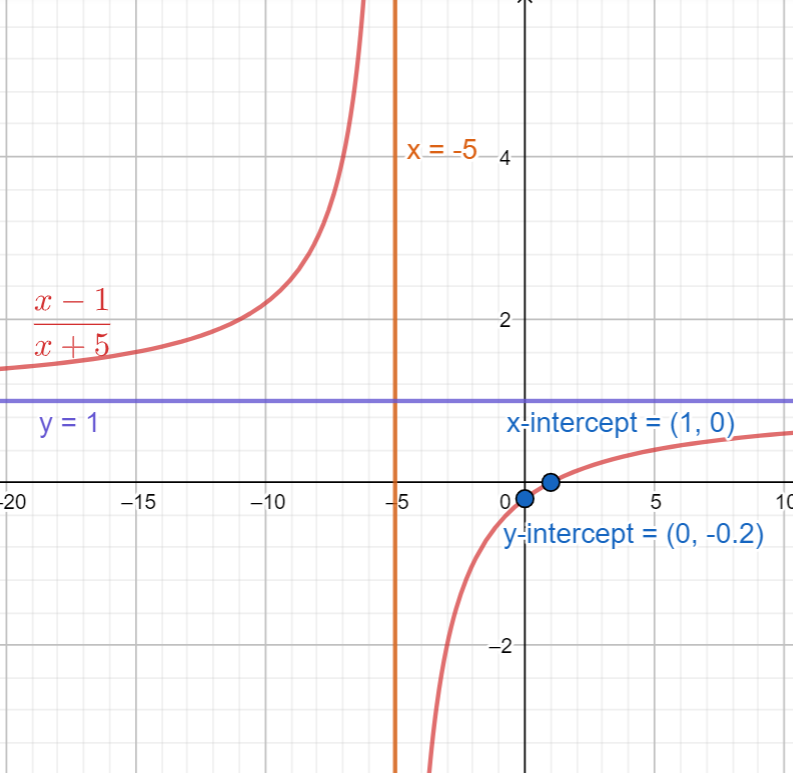
Note:We should remember that asymptotes of the curve is a line such that the distance between the line and the curve approaches towards zero as one or both of the x or y coordinates tends to infinity. We should also remember that as the vertical asymptotes are obtained by \[y\to \infty \] and horizontal asymptotes are obtained by \[x\to \infty \].
Complete step-by-step solution:
We know that the given equation is,
\[y=\dfrac{x-1}{x+5}\]
We can write the above equation in the form of \[\dfrac{n\left( x \right)}{d\left( x \right)}\], we get
\[\dfrac{n\left( x \right)}{d\left( x \right)}=\dfrac{x-1}{x+5}\]
Now we can find the vertical and the horizontal asymptote.
We know that vertical asymptotes are obtained by \[y\to \infty \].
We can see that when \[y\to \infty \], \[d\left( x \right)=0\], we can now substitute, we get
\[\Rightarrow x+5=0\]
We can now equate the above step, we get
\[\Rightarrow x=-5\]
The vertical asymptote of the curve is at x = -5.
Now we can determine the horizontal asymptote.
We know that, we can find the horizontal asymptote, if the degree of the denominator is equal to the degree of the numerator, there is a horizontal asymptote at \[y=\dfrac{{{a}_{n}}}{{{b}_{n}}}\], where \[{{a}_{n}}\]and \[{{b}_{n}}\] are the leading coefficient of the given numerator and the denominator and \[{{b}_{n}}\ne 0\]
We can now write the leading coefficient of the given equation \[y=\dfrac{x-1}{x+5}\], we get
\[\Rightarrow y=\dfrac{x}{x}=1\]
So, the horizontal asymptote of the curve is at y = 1.
We can now find the x-intercept and the y-intercept.
We know that at x-intercept, y = 0.
\[\begin{align}
& \Rightarrow 0=\dfrac{x-1}{x+5} \\
& \Rightarrow 0=x-1 \\
& \Rightarrow x=1 \\
\end{align}\]
Therefore, the x-intercept of the curve is at \[\left( 1,0 \right)\].
We know that at y-intercept, x = 0.
\[\Rightarrow y=\dfrac{0+1}{0-5}=-\dfrac{1}{5}\]
Therefore, the y-intercept of the curve is at \[\left( 0,-\dfrac{1}{5} \right)\].
We can now find the behaviour of the curve.
An odd end behaviour around the vertical asymptotes indicates that the end behaviour is “opposite” around the vertical asymptotes. So, as you approach the Vertical asymptotes from the left, y approaches positive infinity.
Therefore, the vertical asymptote of the curve is at x = -5, the horizontal asymptote of the curve is at y = 1. The y-intercept of the curve is at \[\left( 0,-\dfrac{1}{5} \right)\], the x-intercept of the curve is at \[\left( 1,0 \right)\].
We can now draw the graph for the above values.
Note:We should remember that asymptotes of the curve is a line such that the distance between the line and the curve approaches towards zero as one or both of the x or y coordinates tends to infinity. We should also remember that as the vertical asymptotes are obtained by \[y\to \infty \] and horizontal asymptotes are obtained by \[x\to \infty \].
Recently Updated Pages
Master Class 11 Social Science: Engaging Questions & Answers for Success

Master Class 11 Physics: Engaging Questions & Answers for Success
Master Class 11 Maths: Engaging Questions & Answers for Success
Master Class 11 Economics: Engaging Questions & Answers for Success
Master Class 11 Computer Science: Engaging Questions & Answers for Success
Master Class 11 Chemistry: Engaging Questions & Answers for Success
Trending doubts
One Metric ton is equal to kg A 10000 B 1000 C 100 class 11 physics CBSE
There are 720 permutations of the digits 1 2 3 4 5 class 11 maths CBSE
1 Quintal is equal to a 110 kg b 10 kg c 100kg d 1000 class 11 physics CBSE
State and prove Bernoullis theorem class 11 physics CBSE
Difference Between Prokaryotic Cells and Eukaryotic Cells
Discuss the various forms of bacteria class 11 biology CBSE