




How do you graph $y=\csc \left( 2x-\dfrac{\pi }{2} \right)$?
Answer
 Verified
543.3k+ views
Hint: In this question we have the trigonometric expression in terms of cosecant. We will use the general equation of a secant function. the general cosecant function is in the form of $y=a\csc (bx+c)+d$, where $a$ is the amplitude of the function, $b$ is to found the period of the function which has the formula $\dfrac{2\pi }{\left| b \right|}$, $c$ represents the shift of the function and $d$ represents the baseline of the function.
Complete step by step answer:
We have the given function as:
$\Rightarrow y=\csc \left( 2x-\dfrac{\pi }{2} \right)$
Now on comparing the given function with the general form of a secant function which is $y=a\csc (bx+c)+d$, we get:
$a=1$, which means there is no change in the amplitude.
The period of the graph can be calculated as $\dfrac{2\pi }{\left| b \right|}$.
On substituting, we get $\dfrac{2\pi }{2}$.
On simplifying, we get the period as $\pi $.
On using the scientific calculator to calculate the value of $\pi $, we get $3.142$ which is the period.
The shift of the function $c=-\dfrac{\pi }{2}$ and the baseline of the function $d=0$.
Therefore, given all the values the graph can be plotted as:
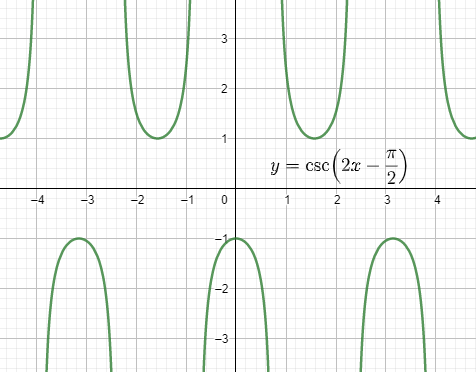
Which is the required cosecant function $y=\csc \left( 2x-\dfrac{\pi }{2} \right)$.
Note: In this question we are using the cosecant function. There also exists the sine function and cosine function which is represented as: $y=a\sin (bx+c)+d$ and $y=a\cos (bx+c)+d$, which have the same properties that of a tangent function.
The sign of the shift $c$ represents in which direction the shift is taking place, it could be negative or positive for right and left respectively.
Complete step by step answer:
We have the given function as:
$\Rightarrow y=\csc \left( 2x-\dfrac{\pi }{2} \right)$
Now on comparing the given function with the general form of a secant function which is $y=a\csc (bx+c)+d$, we get:
$a=1$, which means there is no change in the amplitude.
The period of the graph can be calculated as $\dfrac{2\pi }{\left| b \right|}$.
On substituting, we get $\dfrac{2\pi }{2}$.
On simplifying, we get the period as $\pi $.
On using the scientific calculator to calculate the value of $\pi $, we get $3.142$ which is the period.
The shift of the function $c=-\dfrac{\pi }{2}$ and the baseline of the function $d=0$.
Therefore, given all the values the graph can be plotted as:
Which is the required cosecant function $y=\csc \left( 2x-\dfrac{\pi }{2} \right)$.
Note: In this question we are using the cosecant function. There also exists the sine function and cosine function which is represented as: $y=a\sin (bx+c)+d$ and $y=a\cos (bx+c)+d$, which have the same properties that of a tangent function.
The sign of the shift $c$ represents in which direction the shift is taking place, it could be negative or positive for right and left respectively.
Recently Updated Pages
Master Class 11 English: Engaging Questions & Answers for Success

Master Class 11 Maths: Engaging Questions & Answers for Success
Master Class 11 Biology: Engaging Questions & Answers for Success
Master Class 11 Physics: Engaging Questions & Answers for Success
Master Class 11 Accountancy: Engaging Questions & Answers for Success
Class 11 Question and Answer - Your Ultimate Solutions Guide
Trending doubts
One Metric ton is equal to kg A 10000 B 1000 C 100 class 11 physics CBSE
Discuss the various forms of bacteria class 11 biology CBSE
Draw a diagram of a plant cell and label at least eight class 11 biology CBSE
State the laws of reflection of light
Explain zero factorial class 11 maths CBSE
10 examples of friction in our daily life