




How do you graph \[y=\arccos \left( \dfrac{x}{3} \right)\]?
Answer
 Verified
612.9k+ views
Hint: In order to find the graph of the given equation in the question that is \[y=\arccos \left( \dfrac{x}{3} \right)\], find the points that satisfy this equation and then plot them in the graph.
Complete step by step solution:
Given equation in the question is as follows
\[y=\arccos \left( \dfrac{x}{3} \right)\]
Consider the above equation as the function\[f\left( x \right)=\arccos \left( \dfrac{x}{3} \right)\]
To find the points that satisfy this equation first consider the point at \[x=-3\]
Replace the variable \[x\] with \[-3\] in the expression, we get:
\[\Rightarrow f\left( -3 \right)=\arccos \left( \dfrac{-3}{3} \right)=\pi \]
\[\Rightarrow f\left( -3 \right)=\pi \]
Now consider the point at \[x=\dfrac{-3}{2}\]
Replace the variable \[x\] with \[\dfrac{-3}{2}\]in the expression, we get:
\[\Rightarrow f\left( \dfrac{-3}{2} \right)=\arccos \left( \dfrac{-\dfrac{3}{2}}{3} \right)\]
Simplify it further and multiply the numerator by the reciprocal of the denominator.
\[\Rightarrow f\left( \dfrac{-3}{2} \right)=\arccos \left( -\dfrac{3}{2}\cdot \dfrac{1}{3} \right)\]
Cancel the common factor of \[3\] to do this follow the following steps:
Move the leading negative in \[\dfrac{-3}{2}\]into the numerator.
\[\Rightarrow f\left( \dfrac{-3}{2} \right)=\arccos \left( -\dfrac{3}{2}\cdot \dfrac{1}{3} \right)\]
Factor \[3\] out of \[-3\].
\[\Rightarrow f\left( -\dfrac{3}{2} \right)=\arccos \left( \dfrac{3\left( -1 \right)}{2}\cdot \dfrac{1}{3} \right)\]
Cancel the common factor.
\[\Rightarrow f\left( -\dfrac{3}{2} \right)=\arccos \left( \dfrac{{3}\cdot -1}{2}\cdot \dfrac{1}{{{3}}} \right)\]
Rewrite the expression, we get:
\[\Rightarrow f\left( -\dfrac{3}{2} \right)=\arccos \left( \dfrac{-1}{2} \right)\]
Move the negative in front of the fraction.
\[\Rightarrow f\left( -\dfrac{3}{2} \right)=\arccos \left( -\dfrac{1}{2} \right)\]
The exact value of \[\arccos \left( -\dfrac{1}{2} \right)\] is \[\dfrac{2\pi }{3}\].
\[\Rightarrow f\left( -\dfrac{3}{2} \right)=\dfrac{2\pi }{3}\]
After this consider the point at \[x=0\]
Replace the variable \[x\] with \[0\] in the expression, we get:
\[\Rightarrow f\left( 0 \right)=\arccos \left( \dfrac{0}{3} \right)\]
Simplify it further and divide \[0\] by \[3\], we get:
\[\Rightarrow f\left( 0 \right)=\arccos \left( 0 \right)\]
The exact value of \[\arccos \left( 0 \right)\] is \[\dfrac{\pi }{2}\].
\[\Rightarrow f\left( 0 \right)=\dfrac{\pi }{2}\]
Now find for the point at \[x=\dfrac{3}{2}\].
Replace the variable \[x\] with \[\dfrac{3}{2}\] in the expression, we get:
\[\Rightarrow f\left( \dfrac{3}{2} \right)=\arccos \left( \dfrac{\dfrac{3}{2}}{3} \right)\]
Simplify it further and multiply the numerator by the reciprocal of the denominator.
\[\Rightarrow f\left( \dfrac{3}{2} \right)=\arccos \left( \dfrac{3}{2}\cdot \dfrac{1}{3} \right)\]
Cancel the common factor of \[3\], we get
\[\Rightarrow f\left( \dfrac{3}{2} \right)=\arccos \left( \dfrac{1}{2} \right)\]
The exact value of \[\arccos \left( \dfrac{1}{2} \right)\]is \[\dfrac{\pi }{3}\].
\[\Rightarrow f\left( \dfrac{3}{2} \right)=\dfrac{\pi }{3}\]
Now at last find the point at \[x=3\]
Replace the variable \[x\]with \[3\] in the expression, we get:
\[\Rightarrow f\left( 3 \right)=\arccos \left( \dfrac{3}{3} \right)\]
Simplify it further and divide \[3\] by \[3\], we get:
\[\Rightarrow f\left( 3 \right)=\arccos \left( 1 \right)\]
The exact value of \[\arccos \left( 1 \right)\]is \[0\].
\[\Rightarrow f\left( 3 \right)=0\]
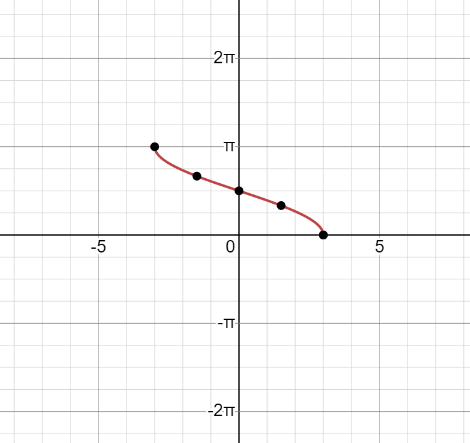
Now list all the points in a table and this trigonometric function can be graphed by plotting these points.
\[\begin{matrix}
x & f\left( x \right) \\
-3 & \pi \\
-\dfrac{3}{2} & \dfrac{2\pi }{3} \\
0 & \dfrac{\pi }{2} \\
\dfrac{3}{2} & \dfrac{\pi }{3} \\
3 & 0 \\
\end{matrix}\]
The graph of the function \[f\left( x \right)=\arccos \left( \dfrac{x}{3} \right)\] is as follows:
Note: Students generally make calculation mistakes while calculating the points that satisfy the graph. It's important to remember the trigonometric values and recheck the calculations once done.
Complete step by step solution:
Given equation in the question is as follows
\[y=\arccos \left( \dfrac{x}{3} \right)\]
Consider the above equation as the function\[f\left( x \right)=\arccos \left( \dfrac{x}{3} \right)\]
To find the points that satisfy this equation first consider the point at \[x=-3\]
Replace the variable \[x\] with \[-3\] in the expression, we get:
\[\Rightarrow f\left( -3 \right)=\arccos \left( \dfrac{-3}{3} \right)=\pi \]
\[\Rightarrow f\left( -3 \right)=\pi \]
Now consider the point at \[x=\dfrac{-3}{2}\]
Replace the variable \[x\] with \[\dfrac{-3}{2}\]in the expression, we get:
\[\Rightarrow f\left( \dfrac{-3}{2} \right)=\arccos \left( \dfrac{-\dfrac{3}{2}}{3} \right)\]
Simplify it further and multiply the numerator by the reciprocal of the denominator.
\[\Rightarrow f\left( \dfrac{-3}{2} \right)=\arccos \left( -\dfrac{3}{2}\cdot \dfrac{1}{3} \right)\]
Cancel the common factor of \[3\] to do this follow the following steps:
Move the leading negative in \[\dfrac{-3}{2}\]into the numerator.
\[\Rightarrow f\left( \dfrac{-3}{2} \right)=\arccos \left( -\dfrac{3}{2}\cdot \dfrac{1}{3} \right)\]
Factor \[3\] out of \[-3\].
\[\Rightarrow f\left( -\dfrac{3}{2} \right)=\arccos \left( \dfrac{3\left( -1 \right)}{2}\cdot \dfrac{1}{3} \right)\]
Cancel the common factor.
\[\Rightarrow f\left( -\dfrac{3}{2} \right)=\arccos \left( \dfrac{{3}\cdot -1}{2}\cdot \dfrac{1}{{{3}}} \right)\]
Rewrite the expression, we get:
\[\Rightarrow f\left( -\dfrac{3}{2} \right)=\arccos \left( \dfrac{-1}{2} \right)\]
Move the negative in front of the fraction.
\[\Rightarrow f\left( -\dfrac{3}{2} \right)=\arccos \left( -\dfrac{1}{2} \right)\]
The exact value of \[\arccos \left( -\dfrac{1}{2} \right)\] is \[\dfrac{2\pi }{3}\].
\[\Rightarrow f\left( -\dfrac{3}{2} \right)=\dfrac{2\pi }{3}\]
After this consider the point at \[x=0\]
Replace the variable \[x\] with \[0\] in the expression, we get:
\[\Rightarrow f\left( 0 \right)=\arccos \left( \dfrac{0}{3} \right)\]
Simplify it further and divide \[0\] by \[3\], we get:
\[\Rightarrow f\left( 0 \right)=\arccos \left( 0 \right)\]
The exact value of \[\arccos \left( 0 \right)\] is \[\dfrac{\pi }{2}\].
\[\Rightarrow f\left( 0 \right)=\dfrac{\pi }{2}\]
Now find for the point at \[x=\dfrac{3}{2}\].
Replace the variable \[x\] with \[\dfrac{3}{2}\] in the expression, we get:
\[\Rightarrow f\left( \dfrac{3}{2} \right)=\arccos \left( \dfrac{\dfrac{3}{2}}{3} \right)\]
Simplify it further and multiply the numerator by the reciprocal of the denominator.
\[\Rightarrow f\left( \dfrac{3}{2} \right)=\arccos \left( \dfrac{3}{2}\cdot \dfrac{1}{3} \right)\]
Cancel the common factor of \[3\], we get
\[\Rightarrow f\left( \dfrac{3}{2} \right)=\arccos \left( \dfrac{1}{2} \right)\]
The exact value of \[\arccos \left( \dfrac{1}{2} \right)\]is \[\dfrac{\pi }{3}\].
\[\Rightarrow f\left( \dfrac{3}{2} \right)=\dfrac{\pi }{3}\]
Now at last find the point at \[x=3\]
Replace the variable \[x\]with \[3\] in the expression, we get:
\[\Rightarrow f\left( 3 \right)=\arccos \left( \dfrac{3}{3} \right)\]
Simplify it further and divide \[3\] by \[3\], we get:
\[\Rightarrow f\left( 3 \right)=\arccos \left( 1 \right)\]
The exact value of \[\arccos \left( 1 \right)\]is \[0\].
\[\Rightarrow f\left( 3 \right)=0\]
Now list all the points in a table and this trigonometric function can be graphed by plotting these points.
\[\begin{matrix}
x & f\left( x \right) \\
-3 & \pi \\
-\dfrac{3}{2} & \dfrac{2\pi }{3} \\
0 & \dfrac{\pi }{2} \\
\dfrac{3}{2} & \dfrac{\pi }{3} \\
3 & 0 \\
\end{matrix}\]
The graph of the function \[f\left( x \right)=\arccos \left( \dfrac{x}{3} \right)\] is as follows:
Note: Students generally make calculation mistakes while calculating the points that satisfy the graph. It's important to remember the trigonometric values and recheck the calculations once done.
Recently Updated Pages
If x a + bt + ct2 where x is in meters and t is in class 11 physics CBSE

A car covers the first half distance between two places class 11 physics CBSE
The resultant of two vectors overrightarrow P and overrightarrow class 11 physics CBSE
Find the value of cos 135 class 11 maths CBSE
A mass M is held in place by an applied force F and class 11 physics CBSE
A solution of glucose in water is labelled as 10 dfracwv class 11 chemistry CBSE
Trending doubts
One Metric ton is equal to kg A 10000 B 1000 C 100 class 11 physics CBSE
Find the value of the expression given below sin 30circ class 11 maths CBSE
Draw a diagram of nephron and explain its structur class 11 biology CBSE
10 examples of friction in our daily life
Proton was discovered by A Thomson B Rutherford C Chadwick class 11 chemistry CBSE
Bond order ofO2 O2+ O2 and O22 is in order A O2 langle class 11 chemistry CBSE