




How do you graph $y = {\left( {\dfrac{1}{5}} \right)^x}$ ?
Answer
 Verified
551.4k+ views
Hint: In this question, we are given an equation and we have to plot that equation on the graph. So, I suggest you find the intercepts first and plot those points on the graph. To find the intercepts, first, put $x = 0$, and then put $y = 0$. This will give you two points and then, you can plot them on the graph. After plotting the points, just connect the two points with a free hand and you will get the curve.
Complete step by step answer:
We are given an equation and we have to plot that equation on the graph. So, we will start by finding the points.
Point 1: We will put $x = 0$ and then we will find its $y$ coordinate.
$ \Rightarrow y = {\left( {\dfrac{1}{5}} \right)^x}$
Putting$x = 0$, we will get –
$ \Rightarrow y = {\left( {\dfrac{1}{5}} \right)^0} = 1$ (Any number raised to the power 0 is 1.)
Therefore, our point is $(0,1)$. Let us name this point as A.
Point 2: If we put $y = 0$, it won’t give us any point as our curve does not exist at $y = 0$.
So, what shall we do?
If we put $x = \infty $, what will we get?
$ \Rightarrow y = {\left( {\dfrac{1}{5}} \right)^\infty }$
This value is undefined or we take it as $0$. This indicates that when $x$ is moving towards $\infty $, the value of y becomes very small (smaller than $1$ as y is equal to $1$ at $x = 0$). Thus, the graph will look like this –
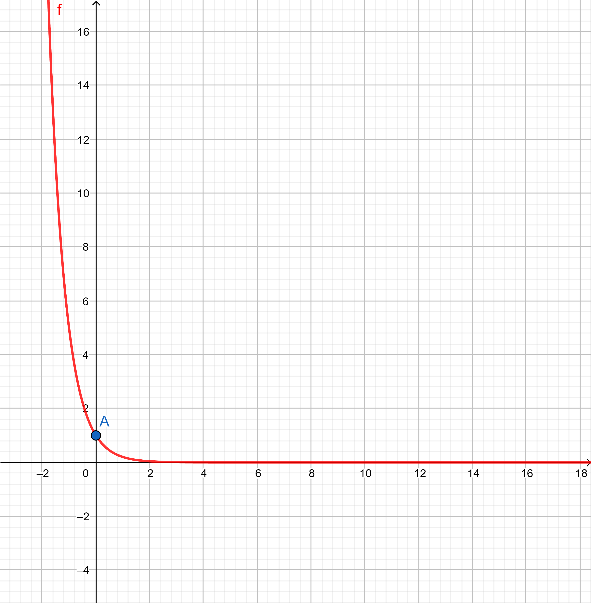
Note: Infinity is not a number, it’s a concept. When a number or a limit becomes so large that it is not possible to write it down or when it becomes undefined, we call it infinity
Same goes with the negative of infinity. When a number becomes too small to be defined, we call it negative infinity $\left( { - \infty } \right)$.
Complete step by step answer:
We are given an equation and we have to plot that equation on the graph. So, we will start by finding the points.
Point 1: We will put $x = 0$ and then we will find its $y$ coordinate.
$ \Rightarrow y = {\left( {\dfrac{1}{5}} \right)^x}$
Putting$x = 0$, we will get –
$ \Rightarrow y = {\left( {\dfrac{1}{5}} \right)^0} = 1$ (Any number raised to the power 0 is 1.)
Therefore, our point is $(0,1)$. Let us name this point as A.
Point 2: If we put $y = 0$, it won’t give us any point as our curve does not exist at $y = 0$.
So, what shall we do?
If we put $x = \infty $, what will we get?
$ \Rightarrow y = {\left( {\dfrac{1}{5}} \right)^\infty }$
This value is undefined or we take it as $0$. This indicates that when $x$ is moving towards $\infty $, the value of y becomes very small (smaller than $1$ as y is equal to $1$ at $x = 0$). Thus, the graph will look like this –
Note: Infinity is not a number, it’s a concept. When a number or a limit becomes so large that it is not possible to write it down or when it becomes undefined, we call it infinity
Same goes with the negative of infinity. When a number becomes too small to be defined, we call it negative infinity $\left( { - \infty } \right)$.
Recently Updated Pages
Master Class 11 Business Studies: Engaging Questions & Answers for Success

Master Class 11 Economics: Engaging Questions & Answers for Success
Master Class 11 Computer Science: Engaging Questions & Answers for Success
Master Class 11 English: Engaging Questions & Answers for Success
Master Class 11 Maths: Engaging Questions & Answers for Success
Master Class 11 Biology: Engaging Questions & Answers for Success
Trending doubts
One Metric ton is equal to kg A 10000 B 1000 C 100 class 11 physics CBSE
Discuss the various forms of bacteria class 11 biology CBSE
Draw a diagram of a plant cell and label at least eight class 11 biology CBSE
State the laws of reflection of light
Explain zero factorial class 11 maths CBSE
10 examples of friction in our daily life