




How do you graph $y = 2x - 1$by plotting points ?
Answer
 Verified
595.5k+ views
Hint:
Since this is a graphical numerical, the student has to find the coordinates by substituting either $x$ or $y$ or both as $0$. The first step in solving the sum is to analyze the equation of the curve and figure out which curve it is, i.e. a circle, parabola, or a line. From the given equation we can see that it is an equation of a line. To plot the line on a graph, a student has to mark $2$points on the graph. For the first point he has to substitute $x = 0$ & for the second point substituting $y = 0$. Once the student has $2$ points, he can join the points to form the line. Also just to make sure the plotting has been done correctly, students have to find the third point by putting$x = 1$. Thus after plotting if all the points lie on the same line then we can say plotting has been done correctly.
Complete Step by Step Solution:
Let's start plotting points one after the other. First point can be plotted after substituting $x = 0$.
So the equation becomes$y = - 1$.
Therefore, the first point is $(0, - 1)...........(1)$
In order to find the second point, let us substitute $y = 0$.
So the coordinate of Point $x$is $\dfrac{1}{2}$.
Second Point is $(\dfrac{1}{2},0$)
Since we have two coordinates we can plot a line on the graph paper.
To make sure that our points are correct we need to plot the third point by substituting $x = 1$.
Third point becomes $(1,1)$.
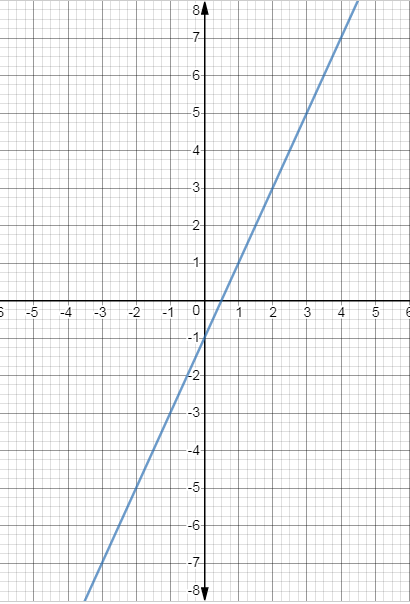
Since all the points lie on the same plane, we can say that the coordinates are proper and we have plotted the line correctly on the graph
Note:
Since this is a graphical sum, the student should always cross-check his/her answer by picking up any point from the $x - axis$ and substituting its value in the equation. If the value of the $y$ obtained is the same as that on the graph, he can say that the line is plotted correctly. It is always necessary to cross-check as the student may go wrong while substituting values for a complex curve like a parabola, hyperbola, or a circle. So if the student verifies his answer by this method he will never go wrong.
Since this is a graphical numerical, the student has to find the coordinates by substituting either $x$ or $y$ or both as $0$. The first step in solving the sum is to analyze the equation of the curve and figure out which curve it is, i.e. a circle, parabola, or a line. From the given equation we can see that it is an equation of a line. To plot the line on a graph, a student has to mark $2$points on the graph. For the first point he has to substitute $x = 0$ & for the second point substituting $y = 0$. Once the student has $2$ points, he can join the points to form the line. Also just to make sure the plotting has been done correctly, students have to find the third point by putting$x = 1$. Thus after plotting if all the points lie on the same line then we can say plotting has been done correctly.
Complete Step by Step Solution:
Let's start plotting points one after the other. First point can be plotted after substituting $x = 0$.
So the equation becomes$y = - 1$.
Therefore, the first point is $(0, - 1)...........(1)$
In order to find the second point, let us substitute $y = 0$.
So the coordinate of Point $x$is $\dfrac{1}{2}$.
Second Point is $(\dfrac{1}{2},0$)
Since we have two coordinates we can plot a line on the graph paper.
To make sure that our points are correct we need to plot the third point by substituting $x = 1$.
Third point becomes $(1,1)$.
Since all the points lie on the same plane, we can say that the coordinates are proper and we have plotted the line correctly on the graph
Note:
Since this is a graphical sum, the student should always cross-check his/her answer by picking up any point from the $x - axis$ and substituting its value in the equation. If the value of the $y$ obtained is the same as that on the graph, he can say that the line is plotted correctly. It is always necessary to cross-check as the student may go wrong while substituting values for a complex curve like a parabola, hyperbola, or a circle. So if the student verifies his answer by this method he will never go wrong.
Recently Updated Pages
Master Class 12 Economics: Engaging Questions & Answers for Success

Master Class 12 English: Engaging Questions & Answers for Success
Master Class 12 Social Science: Engaging Questions & Answers for Success
Master Class 12 Maths: Engaging Questions & Answers for Success
Master Class 12 Physics: Engaging Questions & Answers for Success
Master Class 11 Social Science: Engaging Questions & Answers for Success
Trending doubts
One Metric ton is equal to kg A 10000 B 1000 C 100 class 11 physics CBSE
Difference Between Prokaryotic Cells and Eukaryotic Cells
Find the value of the expression given below sin 30circ class 11 maths CBSE
Two of the body parts which do not appear in MRI are class 11 biology CBSE
Draw a diagram of nephron and explain its structur class 11 biology CBSE
10 examples of friction in our daily life