




How do you graph ${x^2} + {y^2} - 4x + 6y - 12 = 0$?
Answer
 Verified
605.1k+ views
Hint: Given an equation. We have to graph the equation. First, rewrite the equation in standard form of the circle equation. Then, determine the points of the centre and the radius of the circle from the equation. Then, we will draw the graph.
The standard form of equation of a circle is given by:
${\left( {x - h} \right)^2} + {\left( {y - k} \right)^2} = {r^2}$
Where $\left( {h,k} \right)$ is the centre of the circle and r is the radius
Complete step by step solution:
We are given an equation, ${x^2} + {y^2} - 4x + 6y - 12 = 0$.
Now, we will group the similar terms on the left hand side of the equation and shift the constant terms on the right hand side.
$ \Rightarrow \left( {{x^2} - 4x} \right) + \left( {{y^2} + 6y} \right) = 12$
Now, complete the square to form the equation on left hand side by adding numbers to each group.
Here, the third term added must be square of the coefficient of x divided by 2.
Thus, we will add ${\left( {\dfrac{4}{2}} \right)^2} = 4$ and ${\left( {\dfrac{6}{2}} \right)^2} = 9$ to both sides of the equation.
\[ \Rightarrow \left( {{x^2} - 4x + 4} \right) + \left( {{y^2} + 6y + 9} \right) = 12 + 4 + 9\]
\[ \Rightarrow \left( {{x^2} - 4x + 4} \right) + \left( {{y^2} + 6y + 9} \right) = 25\]
Now, apply the algebraic identity ${\left( {a - b} \right)^2} = {a^2} - 2ab + {b^2}$ to the left hand side of the equation.
$ \Rightarrow {\left( {x - 2} \right)^2} + {\left( {y + 3} \right)^2} = {5^2}$
Rewrite the equation in the standard form of equation of circle.
$ \Rightarrow {\left( {x - 2} \right)^2} + {\left( {y - \left( { - 3} \right)} \right)^2} = {5^2}$
Now, we will compare the obtained equation by the standard equation of circle.
$ \Rightarrow \left( {h,k} \right) = \left( {2, - 3} \right)$
$ \Rightarrow r = 5$
Therefore, the centre of the circle is $\left( {2, - 3} \right)$ and radius of the circle is $5$.
Now, we will plot the circle on the graph as:
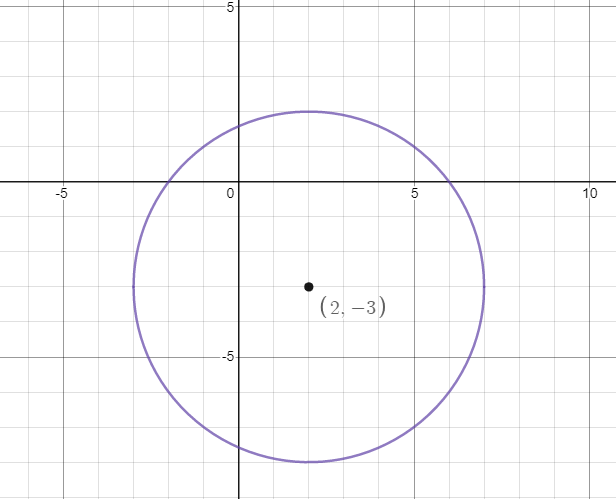
Note: Please note that the equation of the circle whose centre if the origin will have the equation ${x^2} + {y^2} = {r^2}$. Also, the general form of the equation of the circle is ${x^2} + {y^2} + 2gx + 2fy + c = 0$ where the centre is $\left( { - g, - f} \right)$ and the radius of the circle is the square root of ${g^2} + {f^2} - c$
The standard form of equation of a circle is given by:
${\left( {x - h} \right)^2} + {\left( {y - k} \right)^2} = {r^2}$
Where $\left( {h,k} \right)$ is the centre of the circle and r is the radius
Complete step by step solution:
We are given an equation, ${x^2} + {y^2} - 4x + 6y - 12 = 0$.
Now, we will group the similar terms on the left hand side of the equation and shift the constant terms on the right hand side.
$ \Rightarrow \left( {{x^2} - 4x} \right) + \left( {{y^2} + 6y} \right) = 12$
Now, complete the square to form the equation on left hand side by adding numbers to each group.
Here, the third term added must be square of the coefficient of x divided by 2.
Thus, we will add ${\left( {\dfrac{4}{2}} \right)^2} = 4$ and ${\left( {\dfrac{6}{2}} \right)^2} = 9$ to both sides of the equation.
\[ \Rightarrow \left( {{x^2} - 4x + 4} \right) + \left( {{y^2} + 6y + 9} \right) = 12 + 4 + 9\]
\[ \Rightarrow \left( {{x^2} - 4x + 4} \right) + \left( {{y^2} + 6y + 9} \right) = 25\]
Now, apply the algebraic identity ${\left( {a - b} \right)^2} = {a^2} - 2ab + {b^2}$ to the left hand side of the equation.
$ \Rightarrow {\left( {x - 2} \right)^2} + {\left( {y + 3} \right)^2} = {5^2}$
Rewrite the equation in the standard form of equation of circle.
$ \Rightarrow {\left( {x - 2} \right)^2} + {\left( {y - \left( { - 3} \right)} \right)^2} = {5^2}$
Now, we will compare the obtained equation by the standard equation of circle.
$ \Rightarrow \left( {h,k} \right) = \left( {2, - 3} \right)$
$ \Rightarrow r = 5$
Therefore, the centre of the circle is $\left( {2, - 3} \right)$ and radius of the circle is $5$.
Now, we will plot the circle on the graph as:
Note: Please note that the equation of the circle whose centre if the origin will have the equation ${x^2} + {y^2} = {r^2}$. Also, the general form of the equation of the circle is ${x^2} + {y^2} + 2gx + 2fy + c = 0$ where the centre is $\left( { - g, - f} \right)$ and the radius of the circle is the square root of ${g^2} + {f^2} - c$
Recently Updated Pages
Which will be the least stable resonating structure class 11 chemistry CBSE

How many 5 digit telephone numbers can be construc-class-11-maths-CBSE
How do you find the angle of the resultant vector class 11 physics CBSE
Draw labelled diagram of the following i Gram seed class 11 biology CBSE
1 Quintal is equal to a 110 kg b 10 kg c 100kg d 1000 class 11 physics CBSE
What is the need and importance of classification class 11 biology CBSE
Trending doubts
One Metric ton is equal to kg A 10000 B 1000 C 100 class 11 physics CBSE
Find the value of the expression given below sin 30circ class 11 maths CBSE
Draw a diagram of nephron and explain its structur class 11 biology CBSE
10 examples of friction in our daily life
Proton was discovered by A Thomson B Rutherford C Chadwick class 11 chemistry CBSE
The teeth used for biting and cutting food are called class 11 biology CBSE