




How do you graph ${{x}^{2}}+{{y}^{2}}=9$ and what are its lines of symmetry? \[\]
Answer
 Verified
559.2k+ views
Hint: We recall the definition of lines of symmetry and circle. We recall that the standard equation of circle in centre-radius form with centre $\left( a,b \right)$ and radius $r$ is given by ${{\left( x-a \right)}^{2}}+{{\left( y-b \right)}^{2}}={{r}^{2}}$. We compare the standard equation with the given equation and find the centre and radius of the given circle to plot it. We find the lines symmetry as the lines which bisect the circles into two semi-circle. \[\]
Complete step by step answer:
We know in mirror symmetry or reflection symmetry is symmetry where the shape of an object does not change after reflection. A line of symmetry exists at equal distance from object and image. Hence a line of symmetry for any object will divide the object into two equal shapes which are mirror reflection of each other. \[\]
We know that equation of a circle the centre-radius form can between with coordinates of centre $\left( a,b \right)$ and length of the radius $r$ as
\[{{\left( x-a \right)}^{2}}+{{\left( y-b \right)}^{2}}={{r}^{2}}\]
We are given the following implicit equation in the question
\[{{x}^{2}}+{{y}^{2}}={{9}^{2}}\]
We observe the above equation and standard equation of circle in centre-radius and find that they are quite similar. We can write the above equation as
\[{{\left( x-0 \right)}^{2}}+{{\left( y-0 \right)}^{2}}={{3}^{2}}\]
We now again compare the above equation and standard equation of circle in centre-radius to find centre as $\left( a,b \right)=\left( 0,0 \right)$ and radius as $r=3$. So we draw the circle with centre at origin $\left( 0,0 \right)$ and radius $r=3$.
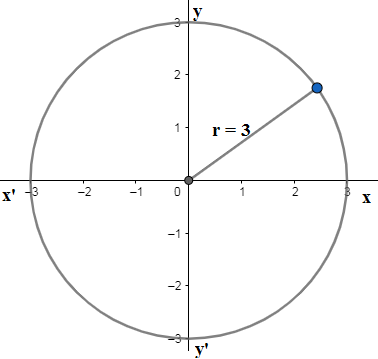
The line of symmetries will divide the circle into two congruent halves which means semicircle with radius $r=3$. So that line will be passing through the centre and hence lines of symmetry of the circle are its diameters. Here $x-$axis and $y-$axis are among the lines of symmetry. \[\]
Note: We note that we call alternatively plot the given implicit equation ${{x}^{2}}+{{y}^{2}}=9$ by converting it to implicit equation $y=\pm \sqrt{9-{{x}^{2}}}$ where $y=\sqrt{9-{{x}^{2}}}$ will represent the semi-circle above $x-$axis and $y=-\sqrt{9-{{x}^{2}}}$ will represent the semi-circle below $x-$axis. The form of the circle is a quadratic equation form which is ${{x}^{2}}+{{y}^{2}}+2gx+2fy+c=0$.
Complete step by step answer:
We know in mirror symmetry or reflection symmetry is symmetry where the shape of an object does not change after reflection. A line of symmetry exists at equal distance from object and image. Hence a line of symmetry for any object will divide the object into two equal shapes which are mirror reflection of each other. \[\]
We know that equation of a circle the centre-radius form can between with coordinates of centre $\left( a,b \right)$ and length of the radius $r$ as
\[{{\left( x-a \right)}^{2}}+{{\left( y-b \right)}^{2}}={{r}^{2}}\]
We are given the following implicit equation in the question
\[{{x}^{2}}+{{y}^{2}}={{9}^{2}}\]
We observe the above equation and standard equation of circle in centre-radius and find that they are quite similar. We can write the above equation as
\[{{\left( x-0 \right)}^{2}}+{{\left( y-0 \right)}^{2}}={{3}^{2}}\]
We now again compare the above equation and standard equation of circle in centre-radius to find centre as $\left( a,b \right)=\left( 0,0 \right)$ and radius as $r=3$. So we draw the circle with centre at origin $\left( 0,0 \right)$ and radius $r=3$.
The line of symmetries will divide the circle into two congruent halves which means semicircle with radius $r=3$. So that line will be passing through the centre and hence lines of symmetry of the circle are its diameters. Here $x-$axis and $y-$axis are among the lines of symmetry. \[\]
Note: We note that we call alternatively plot the given implicit equation ${{x}^{2}}+{{y}^{2}}=9$ by converting it to implicit equation $y=\pm \sqrt{9-{{x}^{2}}}$ where $y=\sqrt{9-{{x}^{2}}}$ will represent the semi-circle above $x-$axis and $y=-\sqrt{9-{{x}^{2}}}$ will represent the semi-circle below $x-$axis. The form of the circle is a quadratic equation form which is ${{x}^{2}}+{{y}^{2}}+2gx+2fy+c=0$.
Recently Updated Pages
Master Class 11 Computer Science: Engaging Questions & Answers for Success

Master Class 11 Business Studies: Engaging Questions & Answers for Success
Master Class 11 Economics: Engaging Questions & Answers for Success
Master Class 11 English: Engaging Questions & Answers for Success
Master Class 11 Maths: Engaging Questions & Answers for Success
Master Class 11 Biology: Engaging Questions & Answers for Success
Trending doubts
One Metric ton is equal to kg A 10000 B 1000 C 100 class 11 physics CBSE
There are 720 permutations of the digits 1 2 3 4 5 class 11 maths CBSE
Discuss the various forms of bacteria class 11 biology CBSE
Draw a diagram of a plant cell and label at least eight class 11 biology CBSE
State the laws of reflection of light
Explain zero factorial class 11 maths CBSE