



How do you graph \[x = {y^2} - 2y\] using a table of values?
Answer
 Verified
578.1k+ views
Hint: We need to draw the graph ‘x’ versus ‘y’. We give the random values for ‘x’ and we find the value of ‘y’. We can give all real numbers for the value of ‘x’. Thus we will have coordinate points (x, y). Hence, we can plot the graph by using the values. We can also draw the graph using the intercept method. But here we have a function which is passing through origin. So we use tables to draw the graph.
Complete step-by-step answer:
Given \[x = {y^2} - 2y\] .
Rearranging the equation we have
\[y = 1 - x\]
Let's give the values for ‘x’ and we find the value of ‘y’.
Put \[x = 1\] in \[x = {y^2} - 2y\] we have,
\[1 = {y^2} - 2y\]
\[{y^2} - 2y - 1 = 0\]
We use quadratic formula \[y = \dfrac{{ - b \pm \sqrt {{b^2} - 4ac} }}{{2a}}\] , where \[a = 1\] , \[b = - 2\] and \[c = - 1\] .
\[y = \dfrac{{ - ( - 2) \pm \sqrt {{{( - 2)}^2} - 4(1)( - 1)} }}{{2(1)}}\]
\[y = \dfrac{{2 \pm \sqrt {4 + 4} }}{2}\]
\[y = \dfrac{{2 \pm \sqrt 8 }}{2}\]
\[y = \dfrac{{2 \pm \sqrt {4 \times 2} }}{2}\]
\[y = \dfrac{{2 \pm 2\sqrt 2 }}{2}\]
\[y = \dfrac{{2\left( {1 \pm \sqrt 2 } \right)}}{2}\]
\[y = 1 \pm \sqrt 2 \]
That is
\[ \Rightarrow y = 1 + \sqrt 2 \] and \[y = 1 - \sqrt 2 \]
\[ \Rightarrow y = 1 + 1.414\] and \[y = 1 - 1.414\]
\[ \Rightarrow y = 2.414\] and \[y = - 0.414\]
Rounding off the decimal points we have
\[ \Rightarrow y = 2.41\] and \[y = - 0.41\]
Thus we have coordinate point \[(1,2.41)\] and \[(1, - 0.41)\] .
Put \[x = - 1\] in \[x = {y^2} - 2y\] we have,
\[ - 1 = {y^2} - 2y\]
\[{y^2} - 2y + 1 = 0\]
This is of the form \[{a^2} - 2ab + {b^2} = {(a - b)^2}\] , where \[a = y\] and \[b = 1\] .
\[{(y - 1)^2} = 0\]
Thus we have
\[ \Rightarrow y = 1,1\]
Thus we have coordinate point \[( - 1,1)\] .
Put \[x = 2\] in \[x = {y^2} - 2y\] we have,
\[2 = {y^2} - 2y\]
\[{y^2} - 2y - 2 = 0\]
We use quadratic formula \[y = \dfrac{{ - b \pm \sqrt {{b^2} - 4ac} }}{{2a}}\] , where \[a = 1\] , \[b = - 2\] and \[c = - 2\] .
\[y = \dfrac{{ - ( - 2) \pm \sqrt {{{( - 2)}^2} - 4(1)( - 2)} }}{{2(1)}}\]
\[y = \dfrac{{2 \pm \sqrt {4 + 8} }}{2}\]
\[y = \dfrac{{2 \pm \sqrt {12} }}{2}\]
\[y = \dfrac{{2 \pm \sqrt {4 \times 3} }}{2}\]
\[y = \dfrac{{2 \pm 2\sqrt 3 }}{2}\]
\[y = \dfrac{{2\left( {1 \pm \sqrt 3 } \right)}}{2}\]
\[y = 1 \pm \sqrt 3 \]
That is
\[ \Rightarrow y = 1 + \sqrt 3 \] and \[y = 1 - \sqrt 3 \]
\[ \Rightarrow y = 1 + 1.732\] and \[y = 1 - 1.732\]
\[ \Rightarrow y = 2.732\] and \[y = - 0.732\]
Round off the decimal point we have,
\[ \Rightarrow y = 2.73\] and \[y = - 0.73\]
Thus we have coordinate points \[(2,2.73)\] and \[(2, - 0.73)\] .
Thus we have,
Let’s draw the graph for these coordinates,
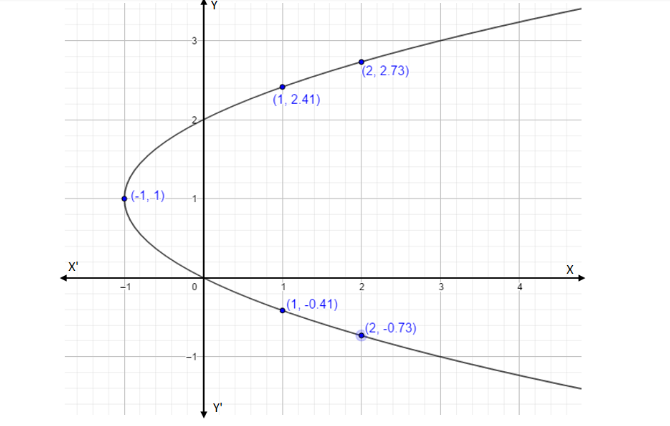
Note: A graph shows the relation between two variable quantities, it contains two axes perpendicular to each other namely the x-axis and the y-axis. Each variable is measured along one of the axes. In the question, we are given one linear equation containing two variables namely x and y, x is measured along the x-axis and y is measured along the y-axis while tracing the given equations.
Complete step-by-step answer:
Given \[x = {y^2} - 2y\] .
Rearranging the equation we have
\[y = 1 - x\]
Let's give the values for ‘x’ and we find the value of ‘y’.
Put \[x = 1\] in \[x = {y^2} - 2y\] we have,
\[1 = {y^2} - 2y\]
\[{y^2} - 2y - 1 = 0\]
We use quadratic formula \[y = \dfrac{{ - b \pm \sqrt {{b^2} - 4ac} }}{{2a}}\] , where \[a = 1\] , \[b = - 2\] and \[c = - 1\] .
\[y = \dfrac{{ - ( - 2) \pm \sqrt {{{( - 2)}^2} - 4(1)( - 1)} }}{{2(1)}}\]
\[y = \dfrac{{2 \pm \sqrt {4 + 4} }}{2}\]
\[y = \dfrac{{2 \pm \sqrt 8 }}{2}\]
\[y = \dfrac{{2 \pm \sqrt {4 \times 2} }}{2}\]
\[y = \dfrac{{2 \pm 2\sqrt 2 }}{2}\]
\[y = \dfrac{{2\left( {1 \pm \sqrt 2 } \right)}}{2}\]
\[y = 1 \pm \sqrt 2 \]
That is
\[ \Rightarrow y = 1 + \sqrt 2 \] and \[y = 1 - \sqrt 2 \]
\[ \Rightarrow y = 1 + 1.414\] and \[y = 1 - 1.414\]
\[ \Rightarrow y = 2.414\] and \[y = - 0.414\]
Rounding off the decimal points we have
\[ \Rightarrow y = 2.41\] and \[y = - 0.41\]
Thus we have coordinate point \[(1,2.41)\] and \[(1, - 0.41)\] .
Put \[x = - 1\] in \[x = {y^2} - 2y\] we have,
\[ - 1 = {y^2} - 2y\]
\[{y^2} - 2y + 1 = 0\]
This is of the form \[{a^2} - 2ab + {b^2} = {(a - b)^2}\] , where \[a = y\] and \[b = 1\] .
\[{(y - 1)^2} = 0\]
Thus we have
\[ \Rightarrow y = 1,1\]
Thus we have coordinate point \[( - 1,1)\] .
Put \[x = 2\] in \[x = {y^2} - 2y\] we have,
\[2 = {y^2} - 2y\]
\[{y^2} - 2y - 2 = 0\]
We use quadratic formula \[y = \dfrac{{ - b \pm \sqrt {{b^2} - 4ac} }}{{2a}}\] , where \[a = 1\] , \[b = - 2\] and \[c = - 2\] .
\[y = \dfrac{{ - ( - 2) \pm \sqrt {{{( - 2)}^2} - 4(1)( - 2)} }}{{2(1)}}\]
\[y = \dfrac{{2 \pm \sqrt {4 + 8} }}{2}\]
\[y = \dfrac{{2 \pm \sqrt {12} }}{2}\]
\[y = \dfrac{{2 \pm \sqrt {4 \times 3} }}{2}\]
\[y = \dfrac{{2 \pm 2\sqrt 3 }}{2}\]
\[y = \dfrac{{2\left( {1 \pm \sqrt 3 } \right)}}{2}\]
\[y = 1 \pm \sqrt 3 \]
That is
\[ \Rightarrow y = 1 + \sqrt 3 \] and \[y = 1 - \sqrt 3 \]
\[ \Rightarrow y = 1 + 1.732\] and \[y = 1 - 1.732\]
\[ \Rightarrow y = 2.732\] and \[y = - 0.732\]
Round off the decimal point we have,
\[ \Rightarrow y = 2.73\] and \[y = - 0.73\]
Thus we have coordinate points \[(2,2.73)\] and \[(2, - 0.73)\] .
Thus we have,
| \[x\] | \[1\] | \[1\] | \[ - 1\] | \[2\] | \[2\] |
| \[y\] | \[2.41\] | \[ - 0.41\] | \[1\] | \[2.73\] | \[ - 0.73\] |
Let’s draw the graph for these coordinates,
Note: A graph shows the relation between two variable quantities, it contains two axes perpendicular to each other namely the x-axis and the y-axis. Each variable is measured along one of the axes. In the question, we are given one linear equation containing two variables namely x and y, x is measured along the x-axis and y is measured along the y-axis while tracing the given equations.
Recently Updated Pages
Master Class 12 Economics: Engaging Questions & Answers for Success

Master Class 12 English: Engaging Questions & Answers for Success
Master Class 12 Social Science: Engaging Questions & Answers for Success
Master Class 12 Maths: Engaging Questions & Answers for Success
Master Class 12 Physics: Engaging Questions & Answers for Success
Master Class 8 English: Engaging Questions & Answers for Success
Trending doubts
What is BLO What is the full form of BLO class 8 social science CBSE
Citizens of India can vote at the age of A 18 years class 8 social science CBSE
Right to vote is a AFundamental Right BFundamental class 8 social science CBSE
Full form of STD, ISD and PCO
What is the area formula of an obtuse triangle class 8 maths CBSE
Give me the opposite gender of Duck class 8 english CBSE