




How do you graph \[x = - 10\] using intercepts?
Answer
 Verified
597k+ views
Hint: Here, we need to graph the given line. We will take the abscissa and ordinate 0 to find the intercepts, and use them to draw the graph of the given equation. The abscissa of a point \[\left( {x,y} \right)\] is \[x\], and the ordinate of a point \[\left( {x,y} \right)\] is \[y\].
Complete step-by-step solution:
First, we will find the intercepts of the given line.
Rewriting the equation, we get
\[x + 0 \times y = - 10\]
Substituting 0 for \[y\] in the equation, we get
\[x + 0 \times 0 = - 10\]
Therefore, we get
\[x = - 10\]
The \[x\]-intercept of the given line is \[ - 10\].
This means that the line touches the \[x\]-axis at the point \[\left( { - 10,0} \right)\].
Substituting 0 for \[x\] in the equation, we get
\[0 + 0 \times y = - 10\]
Therefore, we get
\[0 = - 10\]
This is incorrect.
The given line has no \[y\]-intercept.
Therefore, there is no point on the given line that has the abscissa 0.
This means that the line does not touch the \[y\]-axis at any point.
When two straight lines do not touch each other at any point, they are called parallel lines.
This means that the graph of the line \[x = - 10\] is parallel to the \[y\]-axis.
Now, we will draw the graph of the given line.
The graph of the line \[x = - 10\] touches the \[x\]-axis at the point \[\left( { - 10,0} \right)\], and is parallel to the \[y\]-axis.
The value of \[x\] remains \[ - 10\] for all values of \[y\].
Drawing the graph of the line \[x = - 10\], we get
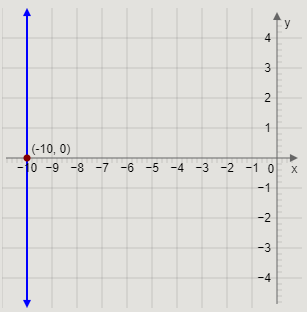
This is the required graph of the line \[x = - 10\].
Note:
We can also rewrite the equation using the intercept form of a line.
The intercept form of a line is given by \[\dfrac{x}{a} + \dfrac{y}{b} = 1\], where \[a\] and \[b\] are the \[x\]-intercept and \[y\]-intercept cut by the straight line respectively.
Dividing both sides of the given equation by \[ - 10\], we get
\[\dfrac{x}{{ - 10}} = 1\]
Here, \[ - 10\] is the \[x\]-intercept, and there is no \[y\]-intercept.
Complete step-by-step solution:
First, we will find the intercepts of the given line.
Rewriting the equation, we get
\[x + 0 \times y = - 10\]
Substituting 0 for \[y\] in the equation, we get
\[x + 0 \times 0 = - 10\]
Therefore, we get
\[x = - 10\]
The \[x\]-intercept of the given line is \[ - 10\].
This means that the line touches the \[x\]-axis at the point \[\left( { - 10,0} \right)\].
Substituting 0 for \[x\] in the equation, we get
\[0 + 0 \times y = - 10\]
Therefore, we get
\[0 = - 10\]
This is incorrect.
The given line has no \[y\]-intercept.
Therefore, there is no point on the given line that has the abscissa 0.
This means that the line does not touch the \[y\]-axis at any point.
When two straight lines do not touch each other at any point, they are called parallel lines.
This means that the graph of the line \[x = - 10\] is parallel to the \[y\]-axis.
Now, we will draw the graph of the given line.
The graph of the line \[x = - 10\] touches the \[x\]-axis at the point \[\left( { - 10,0} \right)\], and is parallel to the \[y\]-axis.
The value of \[x\] remains \[ - 10\] for all values of \[y\].
Drawing the graph of the line \[x = - 10\], we get
This is the required graph of the line \[x = - 10\].
Note:
We can also rewrite the equation using the intercept form of a line.
The intercept form of a line is given by \[\dfrac{x}{a} + \dfrac{y}{b} = 1\], where \[a\] and \[b\] are the \[x\]-intercept and \[y\]-intercept cut by the straight line respectively.
Dividing both sides of the given equation by \[ - 10\], we get
\[\dfrac{x}{{ - 10}} = 1\]
Here, \[ - 10\] is the \[x\]-intercept, and there is no \[y\]-intercept.
Recently Updated Pages
Master Class 11 English: Engaging Questions & Answers for Success

Master Class 11 Social Science: Engaging Questions & Answers for Success
Master Class 11 Maths: Engaging Questions & Answers for Success
Master Class 11 Biology: Engaging Questions & Answers for Success
Master Class 11 Physics: Engaging Questions & Answers for Success
Master Class 11 Chemistry: Engaging Questions & Answers for Success
Trending doubts
One Metric ton is equal to kg A 10000 B 1000 C 100 class 11 physics CBSE
What is cell theory Who formulated it class 11 biology CBSE
Phyllotaxy is the arrangement of ALeaflets BLeaves class 11 biology CBSE
Difference Between Prokaryotic Cells and Eukaryotic Cells
The symbiotic association of fungi and algae is called class 11 biology CBSE
Cell theory was formulated by A Schleiden and Schwann class 11 biology CBSE