




How do you graph using slope and intercept of $x+2y=6$ ?
Answer
 Verified
569.1k+ views
Hint: To graph $x+2y=6$ using its slope and intercept, we will to represent the given equation in slope-intercept form. Slope-intercept form is given as $y=mx+c$ , where m is the slope and c is the y-intercept. Taking its y-intercept value gives a point. To get the next point, we have to find the x-intercept by substituting $y=0$ in the obtained slope-intercept form.
Complete step by step solution:
We have to graph $x+2y=6$ using its slope and intercept. Firstly, we have to represent the given equation in slope-intercept form. We know that slope-intercept form is given as $y=mx+c$ , where m is the slope and c is the y-intercept. Hence, we can write the given equation as
$\Rightarrow 2y=6-x$
Let us take 2 from LHS to RHS.
$\begin{align}
& \Rightarrow y=\dfrac{6-x}{2} \\
& \Rightarrow y=\dfrac{-1}{2}x+3...\left( i \right) \\
\end{align}$
When we compare the above equation to the slope-intercept form, we can see that $m=-\dfrac{1}{2}$ and y-intercept, $c=3$ . Hence, one point will be $\left( 0,3 \right)$ .
Now, we have to find the x-intercept. For this, we will substitute $y=0$ in equation (i).
$\Rightarrow 0=\dfrac{-1}{2}x+3$
Let us take 3 from RHS to LHS. We will get
$\Rightarrow -3=\dfrac{-1}{2}x$
Now, we can cancel the negative sign from both sides.
$\Rightarrow 3=\dfrac{1}{2}x$
Let us take $\dfrac{1}{2}$ from RHS to LHS.
$\Rightarrow x=6$
Hence, the other point is $\left( 6,0 \right)$ .
Let us graph this.
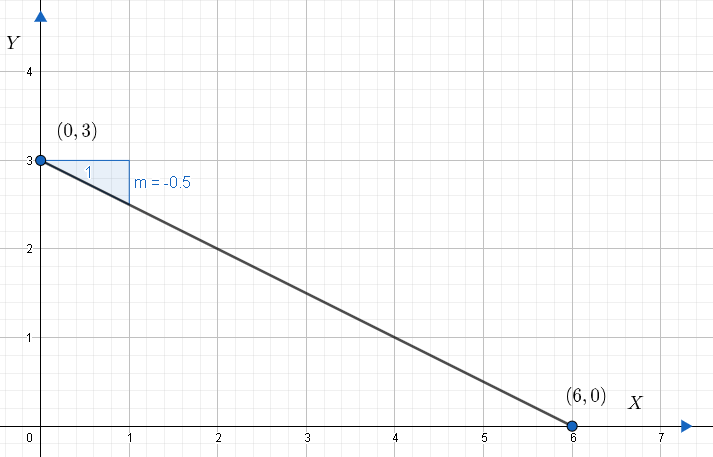
Note: Students must be thorough with the slope-intercept form. ‘c’ in the slope-intercept form in the y-intercept not x-intercept. We can see from the graph that the slope is $-\dfrac{1}{2}$ . We can find the slope from the graph by considering 2 points and using the equation $m=\dfrac{{{y}_{2}}-{{y}_{1}}}{{{x}_{2}}-{{x}_{1}}}$ .
Complete step by step solution:
We have to graph $x+2y=6$ using its slope and intercept. Firstly, we have to represent the given equation in slope-intercept form. We know that slope-intercept form is given as $y=mx+c$ , where m is the slope and c is the y-intercept. Hence, we can write the given equation as
$\Rightarrow 2y=6-x$
Let us take 2 from LHS to RHS.
$\begin{align}
& \Rightarrow y=\dfrac{6-x}{2} \\
& \Rightarrow y=\dfrac{-1}{2}x+3...\left( i \right) \\
\end{align}$
When we compare the above equation to the slope-intercept form, we can see that $m=-\dfrac{1}{2}$ and y-intercept, $c=3$ . Hence, one point will be $\left( 0,3 \right)$ .
Now, we have to find the x-intercept. For this, we will substitute $y=0$ in equation (i).
$\Rightarrow 0=\dfrac{-1}{2}x+3$
Let us take 3 from RHS to LHS. We will get
$\Rightarrow -3=\dfrac{-1}{2}x$
Now, we can cancel the negative sign from both sides.
$\Rightarrow 3=\dfrac{1}{2}x$
Let us take $\dfrac{1}{2}$ from RHS to LHS.
$\Rightarrow x=6$
Hence, the other point is $\left( 6,0 \right)$ .
Let us graph this.
Note: Students must be thorough with the slope-intercept form. ‘c’ in the slope-intercept form in the y-intercept not x-intercept. We can see from the graph that the slope is $-\dfrac{1}{2}$ . We can find the slope from the graph by considering 2 points and using the equation $m=\dfrac{{{y}_{2}}-{{y}_{1}}}{{{x}_{2}}-{{x}_{1}}}$ .
Recently Updated Pages
Master Class 12 Economics: Engaging Questions & Answers for Success

Master Class 12 English: Engaging Questions & Answers for Success
Master Class 12 Social Science: Engaging Questions & Answers for Success
Master Class 12 Maths: Engaging Questions & Answers for Success
Master Class 12 Physics: Engaging Questions & Answers for Success
Master Class 9 General Knowledge: Engaging Questions & Answers for Success
Trending doubts
One Metric ton is equal to kg A 10000 B 1000 C 100 class 11 physics CBSE
Difference Between Prokaryotic Cells and Eukaryotic Cells
Two of the body parts which do not appear in MRI are class 11 biology CBSE
1 ton equals to A 100 kg B 1000 kg C 10 kg D 10000 class 11 physics CBSE
10 examples of friction in our daily life
DNA is not present in A Nucleus B Mitochondria C Chloroplast class 11 biology CBSE