




How do you graph the system of linear inequalities $ x \geqslant - 7 $ , $ y < 10 $ and $ x < y $ ?
Answer
 Verified
590.1k+ views
Hint: In order to graph the linear inequalities, we should know what the inequalities are first. Inequality is an equation which is not equal, that means the left and right side are not equal. One side is either less than, greater than, less than equal to or greater than equal to the other side.
Complete step-by-step answer:
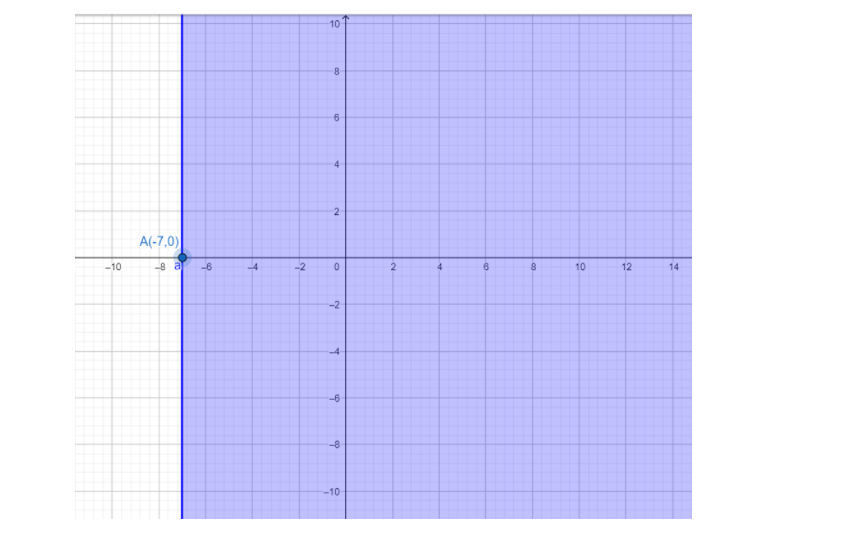
The first inequality we have is: $ x \geqslant - 7 $ . For this we can see that it is a single variable inequation consisting only $ x $ , that means the value of $ y $ is zero. The line obtained by plotting the point would be parallel to y-axis. So, the area becomes the area greater than the $ - 7 $ including $ - 7 $ .
And, the graph obtained is:
The next inequality, we have is $ y < 10 $ , in this inequation also there is only one variable $ y $ , so the other variable $ x $ is zero and the line obtained would be parallel to x-axis. So, the area becomes less than $ 10 $ in which the value of $ 10 $ is not included, the area towards zero. And, the graph we get is:
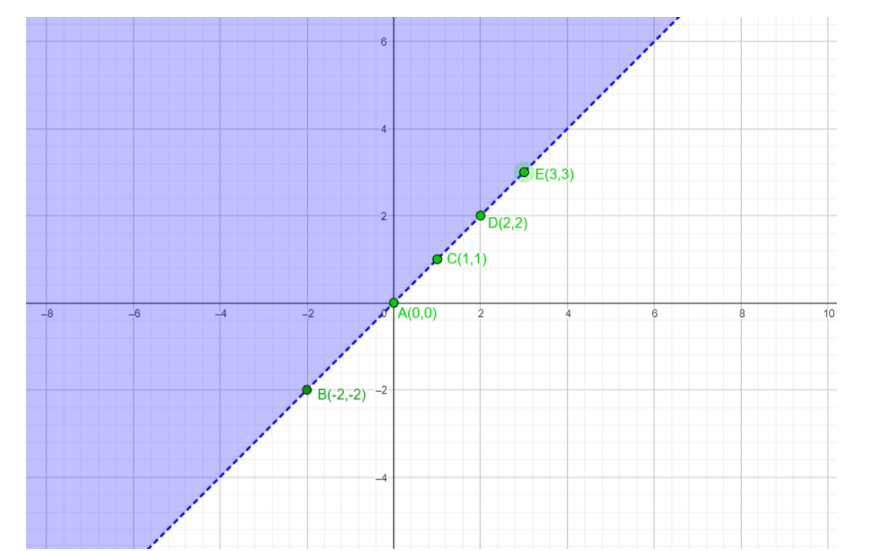
The third inequation we have is $ x < y $ . To solve this inequation let’s consider the inequality sign as the equality sign and finding the graph of the line.
Subtracting both the sides by $ y $ , and we get:
$
x - y = y - y \\
x - y = 0 \;
$
Making a table of some points to draw the line:
Plotting the points and making the graph accordingly. Since, the value is $ x < y $ , only greater than not greater than equal to so the line drawn would not be included.
The graph obtained is:
Therefore, the system of linear inequalities for $ x \geqslant - 7 $ , $ y < 10 $ and $ x < y $ is obtained by combining the above three graphs and, we get:
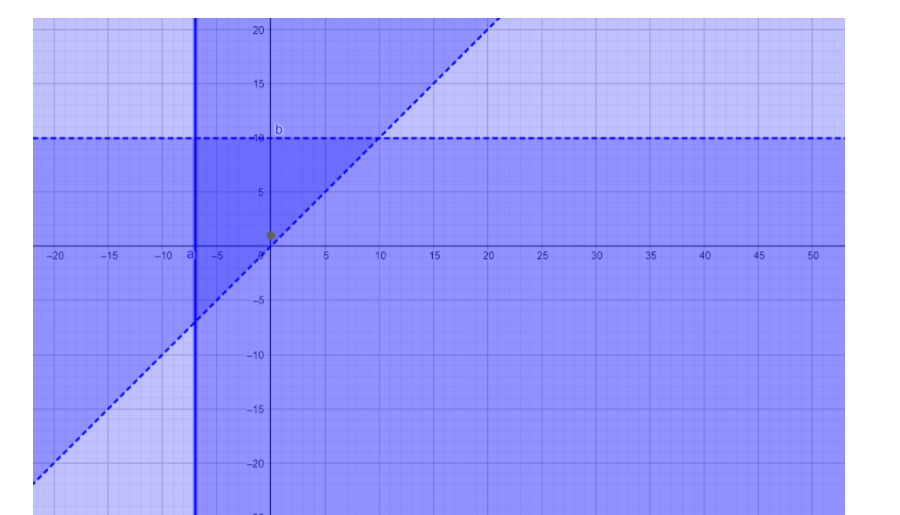
The darker blue portion on the graph represents the area combined with the three inequalities.
Note: There are two types of line we got above, one is normal line and other two are dotted, this is because in the first inequality it was included equal to, which means the value of the line is also included, whereas in other two it's only greater than or less than not equal to, so the line was not included and it gave a dotted line.
Complete step-by-step answer:
The first inequality we have is: $ x \geqslant - 7 $ . For this we can see that it is a single variable inequation consisting only $ x $ , that means the value of $ y $ is zero. The line obtained by plotting the point would be parallel to y-axis. So, the area becomes the area greater than the $ - 7 $ including $ - 7 $ .
And, the graph obtained is:
The next inequality, we have is $ y < 10 $ , in this inequation also there is only one variable $ y $ , so the other variable $ x $ is zero and the line obtained would be parallel to x-axis. So, the area becomes less than $ 10 $ in which the value of $ 10 $ is not included, the area towards zero. And, the graph we get is:
The third inequation we have is $ x < y $ . To solve this inequation let’s consider the inequality sign as the equality sign and finding the graph of the line.
Subtracting both the sides by $ y $ , and we get:
$
x - y = y - y \\
x - y = 0 \;
$
Making a table of some points to draw the line:
| X | -2 | 0 | 1 | 2 | 3 |
| y | -2 | 0 | 1 | 2 | 3 |
Plotting the points and making the graph accordingly. Since, the value is $ x < y $ , only greater than not greater than equal to so the line drawn would not be included.
The graph obtained is:
Therefore, the system of linear inequalities for $ x \geqslant - 7 $ , $ y < 10 $ and $ x < y $ is obtained by combining the above three graphs and, we get:
The darker blue portion on the graph represents the area combined with the three inequalities.
Note: There are two types of line we got above, one is normal line and other two are dotted, this is because in the first inequality it was included equal to, which means the value of the line is also included, whereas in other two it's only greater than or less than not equal to, so the line was not included and it gave a dotted line.

Recently Updated Pages
Find the greatest six digit number that is exactly class 8 maths CBSE

What is the time difference between India and Cana class 8 social science CBSE
Compare LPG and wood as fuels class 8 chemistry CBSE
In Indian rupees 1 trillion is equal to how many c class 8 maths CBSE
30 opposite words in English from a to z class 8 english CBSE
How many cubic feet equals to 1 unit sand class 8 maths CBSE
Trending doubts
What is BLO What is the full form of BLO class 8 social science CBSE
Citizens of India can vote at the age of A 18 years class 8 social science CBSE
Full form of STD, ISD and PCO
One cusec is equal to how many liters class 8 maths CBSE
What are the methods of reducing friction. Explain
What is the difference between rai and mustard see class 8 biology CBSE