




How do you graph the parabola \[y=3{{x}^{2}}\] using vertex, intercepts and additional points?
Answer
 Verified
543.3k+ views
Hint: In this problem, we have to graph the given equation of the parabola using the vertex, intercept and the additional points. We can first write the general formula of the parabola, as in the given parabola equation a is positive hence it is open upward. We can then find the vertex by comparing the general formula and the given equation. We can find the intercepts by assuming x and y values to zero respectively. We can then find the additional points by assuming some values to x and y.
Complete step by step solution:
We know that the given equation of the parabola is,
\[\Rightarrow y=3{{x}^{2}}\]…… (1)
We know that the given parabola is an open upward parabola as the value of a is positive.
We know that the general equation of the open upward parabola is,
\[\Rightarrow y=a{{\left( x-h \right)}^{2}}+k\] ……. (2)
Where \[\left( h,k \right)\] is the vertex.
We can now compare (1) and (2), we can see that
\[\left( h,k \right)=\left( 0,0 \right)\]
The vertex of the given parabola is \[\left( 0,0 \right)\].
We can now find the intercepts.
We know that at x-intercept the value of y = 0, we can substitute y = 0 in (1), we get
\[\begin{align}
& \Rightarrow 0=3{{x}^{2}} \\
& \Rightarrow x=0 \\
\end{align}\]
We know that at y-intercept the value of x = 0, we can substitute x = 0 in (1), we get
\[\begin{align}
& \Rightarrow y=3\left( 0 \right) \\
& \Rightarrow y=0 \\
\end{align}\]
Therefore, the x-intercept and the y-intercept is \[\left( 0,0 \right)\].
We can now find the additional point.
We can assume some points for x to get the value of y.
Let x = 1, we get
\[\begin{align}
& \Rightarrow y=3{{\left( 1 \right)}^{2}} \\
& \Rightarrow y=3 \\
\end{align}\]
Let x = -1, we get
\[\begin{align}
& \Rightarrow y=3{{\left( -1 \right)}^{2}} \\
& \Rightarrow y=3 \\
\end{align}\]
Let x = 2, we get
\[\begin{align}
& \Rightarrow y=3{{\left( 2 \right)}^{2}} \\
& \Rightarrow y=12 \\
\end{align}\]
Let x = -2, we get
\[\begin{align}
& \Rightarrow y=3{{\left( -2 \right)}^{2}} \\
& \Rightarrow y=12 \\
\end{align}\]
The additional points are, \[\left( 1,2 \right),\left( -1,2 \right),\left( 2,12 \right),\left( -2,12 \right)\].
Therefore, the vertex of the given parabola is \[\left( 0,0 \right)\], the x-intercept and the y-intercept is \[\left( 0,0 \right)\].
The additional points are, \[\left( 1,2 \right),\left( -1,2 \right),\left( 2,12 \right),\left( -2,12 \right)\].
Now we can plot the graph using the above points, we get
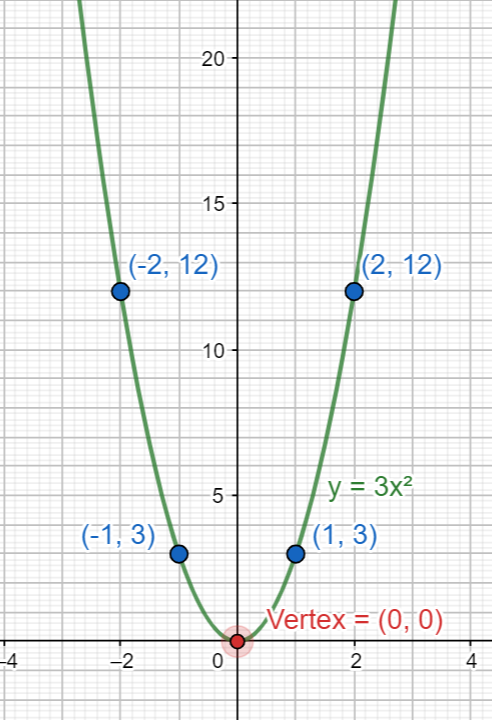
Note: Students make mistakes while finding the intercepts. We can remember that, if vertex is at origin then the intercepts will also be at origin. We should concentrate while substituting some points to the equation to get the additional points. We should concentrate while plotting the points in the graph.
Complete step by step solution:
We know that the given equation of the parabola is,
\[\Rightarrow y=3{{x}^{2}}\]…… (1)
We know that the given parabola is an open upward parabola as the value of a is positive.
We know that the general equation of the open upward parabola is,
\[\Rightarrow y=a{{\left( x-h \right)}^{2}}+k\] ……. (2)
Where \[\left( h,k \right)\] is the vertex.
We can now compare (1) and (2), we can see that
\[\left( h,k \right)=\left( 0,0 \right)\]
The vertex of the given parabola is \[\left( 0,0 \right)\].
We can now find the intercepts.
We know that at x-intercept the value of y = 0, we can substitute y = 0 in (1), we get
\[\begin{align}
& \Rightarrow 0=3{{x}^{2}} \\
& \Rightarrow x=0 \\
\end{align}\]
We know that at y-intercept the value of x = 0, we can substitute x = 0 in (1), we get
\[\begin{align}
& \Rightarrow y=3\left( 0 \right) \\
& \Rightarrow y=0 \\
\end{align}\]
Therefore, the x-intercept and the y-intercept is \[\left( 0,0 \right)\].
We can now find the additional point.
We can assume some points for x to get the value of y.
Let x = 1, we get
\[\begin{align}
& \Rightarrow y=3{{\left( 1 \right)}^{2}} \\
& \Rightarrow y=3 \\
\end{align}\]
Let x = -1, we get
\[\begin{align}
& \Rightarrow y=3{{\left( -1 \right)}^{2}} \\
& \Rightarrow y=3 \\
\end{align}\]
Let x = 2, we get
\[\begin{align}
& \Rightarrow y=3{{\left( 2 \right)}^{2}} \\
& \Rightarrow y=12 \\
\end{align}\]
Let x = -2, we get
\[\begin{align}
& \Rightarrow y=3{{\left( -2 \right)}^{2}} \\
& \Rightarrow y=12 \\
\end{align}\]
The additional points are, \[\left( 1,2 \right),\left( -1,2 \right),\left( 2,12 \right),\left( -2,12 \right)\].
Therefore, the vertex of the given parabola is \[\left( 0,0 \right)\], the x-intercept and the y-intercept is \[\left( 0,0 \right)\].
The additional points are, \[\left( 1,2 \right),\left( -1,2 \right),\left( 2,12 \right),\left( -2,12 \right)\].
Now we can plot the graph using the above points, we get
Note: Students make mistakes while finding the intercepts. We can remember that, if vertex is at origin then the intercepts will also be at origin. We should concentrate while substituting some points to the equation to get the additional points. We should concentrate while plotting the points in the graph.
Recently Updated Pages
Master Class 11 English: Engaging Questions & Answers for Success

Master Class 11 Maths: Engaging Questions & Answers for Success
Master Class 11 Biology: Engaging Questions & Answers for Success
Master Class 11 Social Science: Engaging Questions & Answers for Success
Master Class 11 Physics: Engaging Questions & Answers for Success
Master Class 11 Accountancy: Engaging Questions & Answers for Success
Trending doubts
One Metric ton is equal to kg A 10000 B 1000 C 100 class 11 physics CBSE
There are 720 permutations of the digits 1 2 3 4 5 class 11 maths CBSE
Discuss the various forms of bacteria class 11 biology CBSE
Draw a diagram of a plant cell and label at least eight class 11 biology CBSE
State the laws of reflection of light
Explain zero factorial class 11 maths CBSE