




How do you graph the parabola \[y=-2{{(x-1)}^{2}}+3\] using vertex, intercepts and additional points?
Answer
 Verified
590.4k+ views
Hint: To solve this problem we should initially find the $y$ intercept followed by the value of $x$ to get the points to plot. From the obtained points we can plot the graph. We must use the fact that for the form of equation $y=a{{\left( x-h \right)}^{2}}+k$ , we have the vertex as $\left( h,k \right)$ . To find the $x$ and $y$ intercepts, we have to substitute $y$ and $x$ as $0$ in the equation respectively.
Complete step by step answer:
Here, the given equation is \[y=-2{{(x-1)}^{2}}+3\] .
This is a quadratic equation in vertex form: $y=a{{\left( x-h \right)}^{2}}+k$ where $a=-2,h=1,k=3$ .
The vertex is the point $\left( h,k \right)$ which is $\left( 1,3 \right)$ .
Now let us plot this point.
We know that the $y$ intercept is the value of $y$ when $x=0$ . So, we will substitute $0$ for $x$ and solve for $y$ .
\[\begin{align}
& y=-2{{(0-1)}^{2}}+3 \\
& \Rightarrow y=-2{{(-1)}^{2}}+3 \\
& \Rightarrow y=-2(1)+3 \\
& \Rightarrow y=-2+3 \\
& \Rightarrow y=1 \\
\end{align}\]
The $y$ intercept is $\left( 0,1 \right)$ . We will plot this point.
To find the $x$ intercepts, we will first convert the equation from vertex form to standard form.
We will expand ${{\left( x-1 \right)}^{2}}$ to ${{x}^{2}}-2x+1$ .
\[\begin{align}
& y=-2({{x}^{2}}-2x+1)+3 \\
& \Rightarrow y=-2{{x}^{2}}+4x-2+3 \\
& \Rightarrow y=-2{{x}^{2}}+4x+1 \\
\end{align}\]
We know that the $x$ intercepts are the values of $x$ when $y=0$ . So, we will substitute $0$ for $y$ and solve for $x$, \[0=-2{{x}^{2}}+4x+1\] where \[a=-2,~b=4,~c=1\] .
Solving for the $x$ intercepts using the quadratic formula, we have \[x=\dfrac{-b\pm \sqrt{{{b}^{2}}-4ac}}{2a}\] .
Plugging in the known values, we have
\[\begin{align}
& x=\dfrac{-4\pm \sqrt{{{4}^{2}}-4\left( -2 \right)\left( 1 \right)}}{2\left( -2 \right)} \\
& \Rightarrow x=\dfrac{-4\pm \sqrt{24}}{-4} \\
& \Rightarrow x=\dfrac{-4\pm 2\sqrt{6}}{-4} \\
\end{align}\]
So, \[x=\dfrac{-4+2\sqrt{6}}{-4}\] and \[x=\dfrac{-4-2\sqrt{6}}{-4}\] .
On further simplification we get, \[x=1-\dfrac{\sqrt{6}}{2}\] and \[x=1+\dfrac{\sqrt{6}}{2}\] .
The $x$ intercepts are \[\left( 1-\dfrac{\sqrt{6}}{2},0 \right)\] and \[\left( 1+\dfrac{\sqrt{6}}{2},0 \right)\] .
The approximate $x$ intercepts are $\left( -0.2,0 \right)$ and $\left( 2.2,0 \right)$ .We can plot the $x$ intercepts.
Additional point:
We will choose values for $x$ and solve for $y$ .
Let $x=2$ then
$\begin{align}
& y=-2{{\left( 2-1 \right)}^{2}}+3 \\
& \Rightarrow y=1 \\
\end{align}$
We have got an additional point as $\left( 2,1 \right)$ . We will plot this point.
To find additional points, choose values for $x$ and solve for $y$ .
We will plot the points and sketch a parabola through the points.
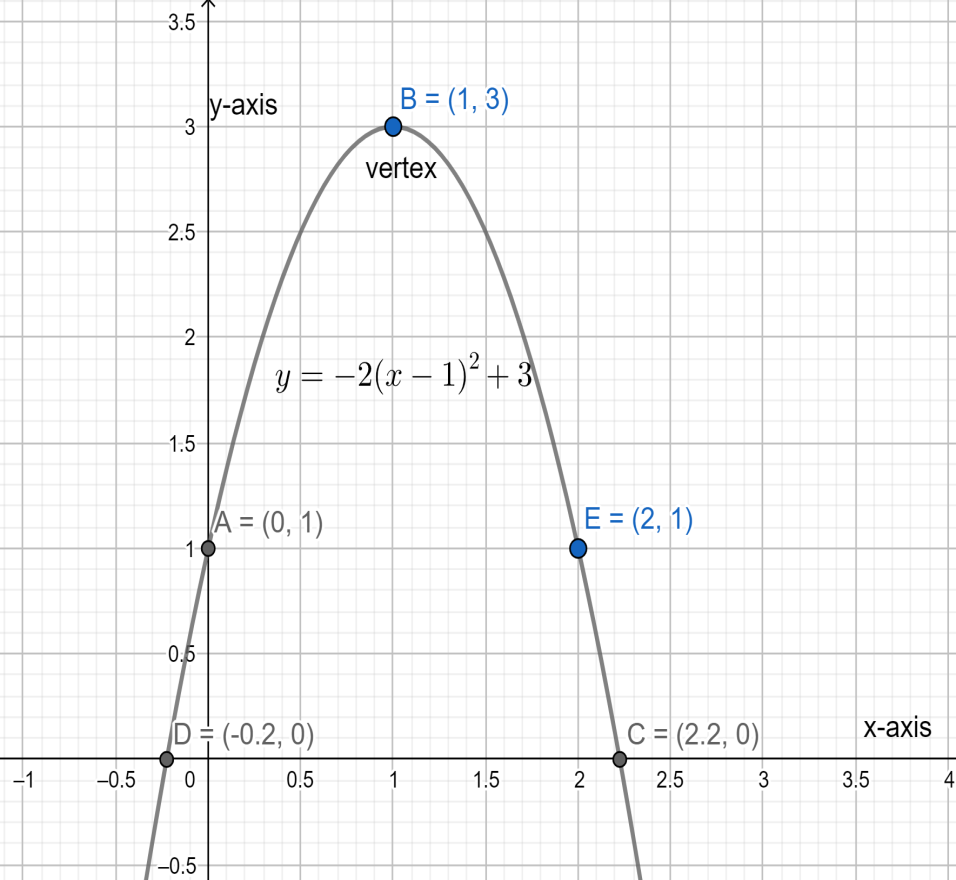
Note: Students usually may go wrong while finding the intercepts to get the required points. If the obtained points are wrong then the solution of plotting the graph becomes wrong. Students must also note that we are supposed to get a parabola and so we have to join the points using a smooth curve and not straight lines.
Complete step by step answer:
Here, the given equation is \[y=-2{{(x-1)}^{2}}+3\] .
This is a quadratic equation in vertex form: $y=a{{\left( x-h \right)}^{2}}+k$ where $a=-2,h=1,k=3$ .
The vertex is the point $\left( h,k \right)$ which is $\left( 1,3 \right)$ .
Now let us plot this point.
We know that the $y$ intercept is the value of $y$ when $x=0$ . So, we will substitute $0$ for $x$ and solve for $y$ .
\[\begin{align}
& y=-2{{(0-1)}^{2}}+3 \\
& \Rightarrow y=-2{{(-1)}^{2}}+3 \\
& \Rightarrow y=-2(1)+3 \\
& \Rightarrow y=-2+3 \\
& \Rightarrow y=1 \\
\end{align}\]
The $y$ intercept is $\left( 0,1 \right)$ . We will plot this point.
To find the $x$ intercepts, we will first convert the equation from vertex form to standard form.
We will expand ${{\left( x-1 \right)}^{2}}$ to ${{x}^{2}}-2x+1$ .
\[\begin{align}
& y=-2({{x}^{2}}-2x+1)+3 \\
& \Rightarrow y=-2{{x}^{2}}+4x-2+3 \\
& \Rightarrow y=-2{{x}^{2}}+4x+1 \\
\end{align}\]
We know that the $x$ intercepts are the values of $x$ when $y=0$ . So, we will substitute $0$ for $y$ and solve for $x$, \[0=-2{{x}^{2}}+4x+1\] where \[a=-2,~b=4,~c=1\] .
Solving for the $x$ intercepts using the quadratic formula, we have \[x=\dfrac{-b\pm \sqrt{{{b}^{2}}-4ac}}{2a}\] .
Plugging in the known values, we have
\[\begin{align}
& x=\dfrac{-4\pm \sqrt{{{4}^{2}}-4\left( -2 \right)\left( 1 \right)}}{2\left( -2 \right)} \\
& \Rightarrow x=\dfrac{-4\pm \sqrt{24}}{-4} \\
& \Rightarrow x=\dfrac{-4\pm 2\sqrt{6}}{-4} \\
\end{align}\]
So, \[x=\dfrac{-4+2\sqrt{6}}{-4}\] and \[x=\dfrac{-4-2\sqrt{6}}{-4}\] .
On further simplification we get, \[x=1-\dfrac{\sqrt{6}}{2}\] and \[x=1+\dfrac{\sqrt{6}}{2}\] .
The $x$ intercepts are \[\left( 1-\dfrac{\sqrt{6}}{2},0 \right)\] and \[\left( 1+\dfrac{\sqrt{6}}{2},0 \right)\] .
The approximate $x$ intercepts are $\left( -0.2,0 \right)$ and $\left( 2.2,0 \right)$ .We can plot the $x$ intercepts.
Additional point:
We will choose values for $x$ and solve for $y$ .
Let $x=2$ then
$\begin{align}
& y=-2{{\left( 2-1 \right)}^{2}}+3 \\
& \Rightarrow y=1 \\
\end{align}$
We have got an additional point as $\left( 2,1 \right)$ . We will plot this point.
To find additional points, choose values for $x$ and solve for $y$ .
We will plot the points and sketch a parabola through the points.
Note: Students usually may go wrong while finding the intercepts to get the required points. If the obtained points are wrong then the solution of plotting the graph becomes wrong. Students must also note that we are supposed to get a parabola and so we have to join the points using a smooth curve and not straight lines.
Recently Updated Pages
Master Class 11 Social Science: Engaging Questions & Answers for Success

Master Class 11 English: Engaging Questions & Answers for Success
Master Class 11 Accountancy: Engaging Questions & Answers for Success
Master Class 11 Physics: Engaging Questions & Answers for Success
Master Class 11 Computer Science: Engaging Questions & Answers for Success
Master Class 11 Business Studies: Engaging Questions & Answers for Success
Trending doubts
Find the value of the expression given below sin 30circ class 11 maths CBSE
One Metric ton is equal to kg A 10000 B 1000 C 100 class 11 physics CBSE
Draw a diagram of nephron and explain its structur class 11 biology CBSE
10 examples of friction in our daily life
Proton was discovered by A Thomson B Rutherford C Chadwick class 11 chemistry CBSE
The teeth used for biting and cutting food are called class 11 biology CBSE