




How do you graph the inequality \[5x + 7y \geqslant 10\] on the coordinate plane ?
Answer
 Verified
605.7k+ views
Hint:First we need to draw the graph of the equation \[5x + 7y = 10\]. We use intercept form to draw the graph. That is we find the coordinate of the given equation lying on the line of x- axis, we can find this by substituting the value of ‘y’ is equal to zero (x-intercept). Similarly we can find the coordinate of the equation lying on the line of y- axis, we can find this by substituting the value of ‘x’ equal to zero (y-intercept). After drawing the graph we can check in which region the inequality satisfies.
Complete step by step answer:
Given, \[5x + 7y \geqslant 10\]. Now consider \[5x + 7y = 10\].To find the x-intercept. That is the value of ‘x’ at\[y = 0\]. Substituting this in the given equation. We have,
\[5x + 7(0) = 10\]
\[\Rightarrow 5x = 10\]
Divide by 5 on both side,
\[x = \dfrac{{10}}{5}\]
\[ \Rightarrow x = 2\]
Thus we have a coordinate of the equation which lies on the line of x-axis. The coordinate is \[(2,0)\]. To find the y-intercept. That is the value of ‘y’ at \[x = 0\]. Substituting this in the given equation we have,
\[5(0) + 7y = 10\]
\[\Rightarrow 7y = 10\]
Divide by 7 on both side,
\[y = \dfrac{{10}}{7}\]
\[\Rightarrow y = 1.428\]
Rounding off we have,
\[y = 1.43\]
Thus we have a coordinate of the equation which lies on the line of y-axis. The coordinate is \[(0,1.43)\]. Thus we have the coordinates \[(2,0)\] and \[(0,1.43)\].Let’s plot a graph for these coordinates. We take scale x-axis= 1 unit = 1 units and y-axis= 1 unit = 1 units.
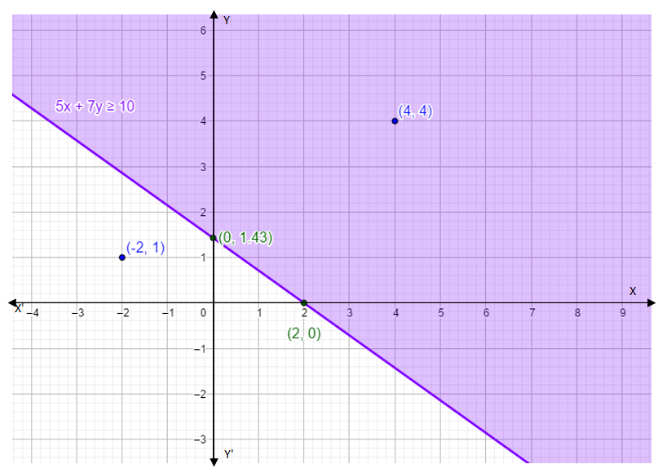
We expanded the point touching the intercepts. We took a coordinate above and below the equation of line (see in above graph).
That is \[(x,y) = ( - 2,1)\] and now put it in the inequality,
\[5( - 2) + 7(1) \geqslant 10\]
\[\Rightarrow - 10 + 7 \geqslant 10\]
\[ \Rightarrow - 3 \geqslant 10\]. Which is wrong.
Now take a coordinate above the equation of line,
That is \[(x,y) = (4,4)\]
\[5(4) + 7(4) \geqslant 10\]
\[\Rightarrow 20 + 28 \geqslant 10\]
\[ \Rightarrow 48 \geqslant 10\]. Which is true.
In the above graph the shaded region is the solution of the given inequality.
Note: If we take any coordinate point below the line of the graph, the inequality satisfies. Also if we take a point on the line, the inequality will be satisfied. A graph shows the relation between two variable quantities, it contains two axes perpendicular to each other namely the x-axis and the y-axis. Each variable is measured along one of the axes. In the question, we are given one linear equation containing two variables namely x and y, x is measured along the x-axis and y is measured along the y-axis while tracing the given equations.
Complete step by step answer:
Given, \[5x + 7y \geqslant 10\]. Now consider \[5x + 7y = 10\].To find the x-intercept. That is the value of ‘x’ at\[y = 0\]. Substituting this in the given equation. We have,
\[5x + 7(0) = 10\]
\[\Rightarrow 5x = 10\]
Divide by 5 on both side,
\[x = \dfrac{{10}}{5}\]
\[ \Rightarrow x = 2\]
Thus we have a coordinate of the equation which lies on the line of x-axis. The coordinate is \[(2,0)\]. To find the y-intercept. That is the value of ‘y’ at \[x = 0\]. Substituting this in the given equation we have,
\[5(0) + 7y = 10\]
\[\Rightarrow 7y = 10\]
Divide by 7 on both side,
\[y = \dfrac{{10}}{7}\]
\[\Rightarrow y = 1.428\]
Rounding off we have,
\[y = 1.43\]
Thus we have a coordinate of the equation which lies on the line of y-axis. The coordinate is \[(0,1.43)\]. Thus we have the coordinates \[(2,0)\] and \[(0,1.43)\].Let’s plot a graph for these coordinates. We take scale x-axis= 1 unit = 1 units and y-axis= 1 unit = 1 units.
We expanded the point touching the intercepts. We took a coordinate above and below the equation of line (see in above graph).
That is \[(x,y) = ( - 2,1)\] and now put it in the inequality,
\[5( - 2) + 7(1) \geqslant 10\]
\[\Rightarrow - 10 + 7 \geqslant 10\]
\[ \Rightarrow - 3 \geqslant 10\]. Which is wrong.
Now take a coordinate above the equation of line,
That is \[(x,y) = (4,4)\]
\[5(4) + 7(4) \geqslant 10\]
\[\Rightarrow 20 + 28 \geqslant 10\]
\[ \Rightarrow 48 \geqslant 10\]. Which is true.
In the above graph the shaded region is the solution of the given inequality.
Note: If we take any coordinate point below the line of the graph, the inequality satisfies. Also if we take a point on the line, the inequality will be satisfied. A graph shows the relation between two variable quantities, it contains two axes perpendicular to each other namely the x-axis and the y-axis. Each variable is measured along one of the axes. In the question, we are given one linear equation containing two variables namely x and y, x is measured along the x-axis and y is measured along the y-axis while tracing the given equations.
Recently Updated Pages
Master Class 11 Social Science: Engaging Questions & Answers for Success

Master Class 11 English: Engaging Questions & Answers for Success
Master Class 11 Accountancy: Engaging Questions & Answers for Success
Master Class 11 Physics: Engaging Questions & Answers for Success
Master Class 11 Computer Science: Engaging Questions & Answers for Success
Master Class 11 Business Studies: Engaging Questions & Answers for Success
Trending doubts
One Metric ton is equal to kg A 10000 B 1000 C 100 class 11 physics CBSE
Find the value of the expression given below sin 30circ class 11 maths CBSE
Draw a diagram of nephron and explain its structur class 11 biology CBSE
10 examples of friction in our daily life
Proton was discovered by A Thomson B Rutherford C Chadwick class 11 chemistry CBSE
The teeth used for biting and cutting food are called class 11 biology CBSE