




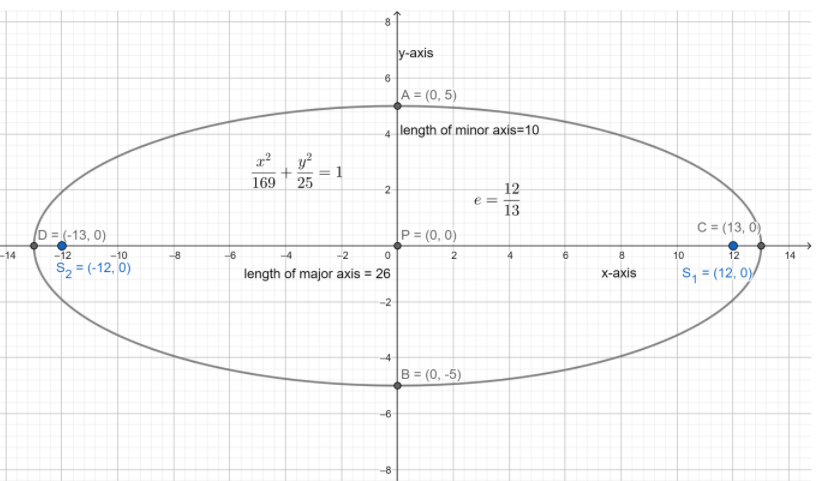
How do you graph the ellipse $\dfrac{{{x}^{2}}}{169}+\dfrac{{{y}^{2}}}{25}=1$ and find the center, the major and minor axis, vertices, foci and eccentricity?
Answer
 Verified
541.8k+ views
Hint: In this we have been asked to draw the graph of the given ellipse $\dfrac{{{x}^{2}}}{169}+\dfrac{{{y}^{2}}}{25}=1$ and find the center, the major and minor axis, vertices, foci and eccentricity. We know that the general equation of ellipse is given as $\dfrac{{{x}^{2}}}{{{a}^{2}}}+\dfrac{{{y}^{2}}}{{{b}^{2}}}=1$ where $a>b$ then its center is located at $\left( 0,0 \right)$ , the length of the major and minor axis is given as $2a$ and $2b$ respectively. Vertices on the major and minor axis are $\left( \pm a,0 \right)$ and $\left( 0,\pm b \right)$ . The eccentricity is given as $e=\sqrt{1-\dfrac{{{b}^{2}}}{{{a}^{2}}}}$ .
Complete step-by-step solution:
Now considering from the question we have been asked to draw the graph of the given ellipse $\dfrac{{{x}^{2}}}{169}+\dfrac{{{y}^{2}}}{25}=1$ and find the center, the major and minor axis, vertices, foci and eccentricity.
From the basic concepts we know that the general equation of ellipse is given as $\dfrac{{{x}^{2}}}{{{a}^{2}}}+\dfrac{{{y}^{2}}}{{{b}^{2}}}=1$ where $a>b$ then its center is located at $\left( 0,0 \right)$ , the length of the major and minor axis is given as $2a$ and $2b$ respectively. Vertices on the major and minor axis are $\left( \pm a,0 \right)$ and $\left( 0,\pm b \right)$ . The eccentricity is given as $e=\sqrt{1-\dfrac{{{b}^{2}}}{{{a}^{2}}}}$ . The foci of an ellipse are given as $\left( \pm ae,0 \right)$
Here the values are $a=13,b=5$ .
Hence the center is located at $\left( 0,0 \right)$ . The vertices on the major and minor axis are $\left( \pm 13,0 \right),\left( 0,\pm 5 \right)$ respectively. The length of major and minor axis is $26,10$ respectively. The eccentricity of the given ellipse is
$\begin{align}
& \Rightarrow e=\sqrt{1-\dfrac{{{\left( 5 \right)}^{2}}}{{{\left( 13 \right)}^{2}}}} \\
& \Rightarrow e=\sqrt{\dfrac{{{13}^{2}}-{{5}^{2}}}{{{13}^{2}}}} \\
& \Rightarrow e=\sqrt{\dfrac{169-25}{169}} \\
& \Rightarrow e=\sqrt{\dfrac{144}{169}}\Rightarrow e=\dfrac{12}{13} \\
\end{align}$
The foci of the given ellipse are given as
$\begin{align}
& \left( \pm \left( 13\times \dfrac{12}{13} \right),0 \right) \\
& \Rightarrow \left( \pm 12,0 \right) \\
\end{align}$ .
The graph of the given ellipse will look like:
Note: While answering questions of this type we should be careful with our concepts. We should carefully mark the points on the graph and join them for getting an accurate one. Someone can make mistake during calculation and write the value of eccentricity as $\begin{align}
& \Rightarrow e=\sqrt{1-\dfrac{{{\left( 5 \right)}^{2}}}{{{\left( 13 \right)}^{2}}}} \\
& \Rightarrow e=\sqrt{\dfrac{169-25}{169}} \\
& \Rightarrow e=\sqrt{\dfrac{121}{169}}\Rightarrow e=\dfrac{11}{13} \\
\end{align}$
which will lead us to end up having a wrong conclusion.
Complete step-by-step solution:
Now considering from the question we have been asked to draw the graph of the given ellipse $\dfrac{{{x}^{2}}}{169}+\dfrac{{{y}^{2}}}{25}=1$ and find the center, the major and minor axis, vertices, foci and eccentricity.
From the basic concepts we know that the general equation of ellipse is given as $\dfrac{{{x}^{2}}}{{{a}^{2}}}+\dfrac{{{y}^{2}}}{{{b}^{2}}}=1$ where $a>b$ then its center is located at $\left( 0,0 \right)$ , the length of the major and minor axis is given as $2a$ and $2b$ respectively. Vertices on the major and minor axis are $\left( \pm a,0 \right)$ and $\left( 0,\pm b \right)$ . The eccentricity is given as $e=\sqrt{1-\dfrac{{{b}^{2}}}{{{a}^{2}}}}$ . The foci of an ellipse are given as $\left( \pm ae,0 \right)$
Here the values are $a=13,b=5$ .
Hence the center is located at $\left( 0,0 \right)$ . The vertices on the major and minor axis are $\left( \pm 13,0 \right),\left( 0,\pm 5 \right)$ respectively. The length of major and minor axis is $26,10$ respectively. The eccentricity of the given ellipse is
$\begin{align}
& \Rightarrow e=\sqrt{1-\dfrac{{{\left( 5 \right)}^{2}}}{{{\left( 13 \right)}^{2}}}} \\
& \Rightarrow e=\sqrt{\dfrac{{{13}^{2}}-{{5}^{2}}}{{{13}^{2}}}} \\
& \Rightarrow e=\sqrt{\dfrac{169-25}{169}} \\
& \Rightarrow e=\sqrt{\dfrac{144}{169}}\Rightarrow e=\dfrac{12}{13} \\
\end{align}$
The foci of the given ellipse are given as
$\begin{align}
& \left( \pm \left( 13\times \dfrac{12}{13} \right),0 \right) \\
& \Rightarrow \left( \pm 12,0 \right) \\
\end{align}$ .
The graph of the given ellipse will look like:
Note: While answering questions of this type we should be careful with our concepts. We should carefully mark the points on the graph and join them for getting an accurate one. Someone can make mistake during calculation and write the value of eccentricity as $\begin{align}
& \Rightarrow e=\sqrt{1-\dfrac{{{\left( 5 \right)}^{2}}}{{{\left( 13 \right)}^{2}}}} \\
& \Rightarrow e=\sqrt{\dfrac{169-25}{169}} \\
& \Rightarrow e=\sqrt{\dfrac{121}{169}}\Rightarrow e=\dfrac{11}{13} \\
\end{align}$
which will lead us to end up having a wrong conclusion.
Recently Updated Pages
Master Class 11 Computer Science: Engaging Questions & Answers for Success

Master Class 11 Business Studies: Engaging Questions & Answers for Success
Master Class 11 Economics: Engaging Questions & Answers for Success
Master Class 11 English: Engaging Questions & Answers for Success
Master Class 11 Maths: Engaging Questions & Answers for Success
Master Class 11 Biology: Engaging Questions & Answers for Success
Trending doubts
One Metric ton is equal to kg A 10000 B 1000 C 100 class 11 physics CBSE
There are 720 permutations of the digits 1 2 3 4 5 class 11 maths CBSE
Discuss the various forms of bacteria class 11 biology CBSE
Draw a diagram of a plant cell and label at least eight class 11 biology CBSE
State the laws of reflection of light
Explain zero factorial class 11 maths CBSE