




How do you graph the ellipse $\dfrac{{{\left( x+2 \right)}^{2}}}{16}+\dfrac{{{\left( y-5 \right)}^{2}}}{20}=1$ and find the center, the major and minor axis, vertices, foci and eccentricity?
Answer
 Verified
576.9k+ views
Hint: In this question we have been asked to find the center, the major and minor axis, vertices, foci and eccentricity of the given ellipse $\dfrac{{{\left( x+2 \right)}^{2}}}{16}+\dfrac{{{\left( y-5 \right)}^{2}}}{20}=1$. We know that the general form of an ellipse is $\dfrac{{{\left( x-h \right)}^{2}}}{{{a}^{2}}}+\dfrac{{{\left( y-k \right)}^{2}}}{{{b}^{2}}}=1$ , where $\left( h,k \right)$ is the center of the ellipse, the major axis is given by $2a$ and the minor axis is given by $2b$, the vertices are $\left( h\pm a,k \right)$ and $\left( h,k\pm b \right)$, eccentricity $e=\sqrt{1-\dfrac{{{a}^{2}}}{{{b}^{2}}}}$ and the foci are $\left( h,k\pm be \right)$.
Complete step-by-step solution:
We have the ellipse given to us as:
$\Rightarrow \dfrac{{{\left( x+2 \right)}^{2}}}{16}+\dfrac{{{\left( y-5 \right)}^{2}}}{20}=1$
We can write the term $16={{4}^{2}}$ and $20=2\sqrt{5}$ therefore, on substituting, we get:
$\Rightarrow \dfrac{{{\left( x+2 \right)}^{2}}}{{{4}^{2}}}+\dfrac{{{\left( y-5 \right)}^{2}}}{{{\left( 2\sqrt{5} \right)}^{2}}}=1$ which is in the general form $\dfrac{{{\left( x-h \right)}^{2}}}{{{a}^{2}}}+\dfrac{{{\left( y-k \right)}^{2}}}{{{b}^{2}}}=1$.
The center is given as $\left( h,k \right)$ which is $\left( -2,5 \right)$.
The major axis will be:
$\Rightarrow 2b=2\times 2\sqrt{5}=4\sqrt{5}$
Now the minor axis will be:
$\Rightarrow 2a=2\times 4=8$
The vertices are $\left( h\pm a,k \right)$ and $\left( h,k\pm b \right)$ therefore, on substituting, we get:
$\Rightarrow \left( -2\pm 4,5 \right)$ and $\left( -2,5\pm 4\sqrt{5} \right)$
The eccentricity is given by: $e=\sqrt{1-\dfrac{{{a}^{2}}}{{{b}^{2}}}}$.
On substituting the values, we get:
$e=\sqrt{1-\dfrac{{{4}^{2}}}{{{\left( 4\sqrt{5} \right)}^{2}}}}$
On simplifying the roots, we get:
$e=\sqrt{1-\dfrac{16}{20}}$
On taking the lowest common multiple, we get:
$e=\sqrt{\dfrac{20-16}{20}}$
On simplifying, we get:
$e=\sqrt{\dfrac{4}{20}}$
On simplifying, we get:
$e=\sqrt{\dfrac{1}{5}}$
Which can be written as:
$e=\dfrac{1}{\sqrt{5}}$
The foci are $\left( h,k\pm be \right)$
On substituting the values, we get:
$\Rightarrow \left( -2,5\pm \left( 2\sqrt{5}\times \dfrac{1}{\sqrt{5}} \right) \right)$
Which can be simplified and written as:
$\Rightarrow \left( -2,5\pm 2 \right)$
Which are $\left( -2,7 \right)$ and $\left( -2,3 \right)$.
On drawing the ellipse on the graph, we get:
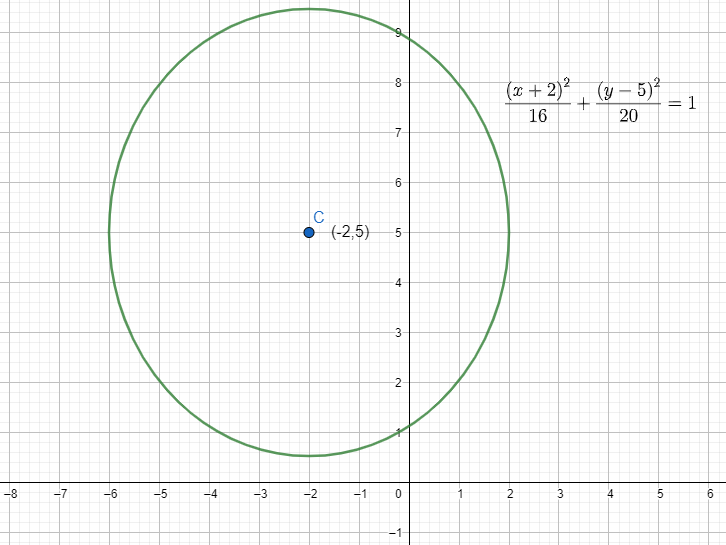
Note: The major axis of the ellipse represents the axis which is longer, in this case the $y$ axis and the minor axis represents the axis which is smaller, in this case the $x$ axis. $b$ represents the major axis and $a$ represents the minor axis. It is to be noted that in this case we have with us a vertical ellipse since $b>a$. If $a
Complete step-by-step solution:
We have the ellipse given to us as:
$\Rightarrow \dfrac{{{\left( x+2 \right)}^{2}}}{16}+\dfrac{{{\left( y-5 \right)}^{2}}}{20}=1$
We can write the term $16={{4}^{2}}$ and $20=2\sqrt{5}$ therefore, on substituting, we get:
$\Rightarrow \dfrac{{{\left( x+2 \right)}^{2}}}{{{4}^{2}}}+\dfrac{{{\left( y-5 \right)}^{2}}}{{{\left( 2\sqrt{5} \right)}^{2}}}=1$ which is in the general form $\dfrac{{{\left( x-h \right)}^{2}}}{{{a}^{2}}}+\dfrac{{{\left( y-k \right)}^{2}}}{{{b}^{2}}}=1$.
The center is given as $\left( h,k \right)$ which is $\left( -2,5 \right)$.
The major axis will be:
$\Rightarrow 2b=2\times 2\sqrt{5}=4\sqrt{5}$
Now the minor axis will be:
$\Rightarrow 2a=2\times 4=8$
The vertices are $\left( h\pm a,k \right)$ and $\left( h,k\pm b \right)$ therefore, on substituting, we get:
$\Rightarrow \left( -2\pm 4,5 \right)$ and $\left( -2,5\pm 4\sqrt{5} \right)$
The eccentricity is given by: $e=\sqrt{1-\dfrac{{{a}^{2}}}{{{b}^{2}}}}$.
On substituting the values, we get:
$e=\sqrt{1-\dfrac{{{4}^{2}}}{{{\left( 4\sqrt{5} \right)}^{2}}}}$
On simplifying the roots, we get:
$e=\sqrt{1-\dfrac{16}{20}}$
On taking the lowest common multiple, we get:
$e=\sqrt{\dfrac{20-16}{20}}$
On simplifying, we get:
$e=\sqrt{\dfrac{4}{20}}$
On simplifying, we get:
$e=\sqrt{\dfrac{1}{5}}$
Which can be written as:
$e=\dfrac{1}{\sqrt{5}}$
The foci are $\left( h,k\pm be \right)$
On substituting the values, we get:
$\Rightarrow \left( -2,5\pm \left( 2\sqrt{5}\times \dfrac{1}{\sqrt{5}} \right) \right)$
Which can be simplified and written as:
$\Rightarrow \left( -2,5\pm 2 \right)$
Which are $\left( -2,7 \right)$ and $\left( -2,3 \right)$.
On drawing the ellipse on the graph, we get:
Note: The major axis of the ellipse represents the axis which is longer, in this case the $y$ axis and the minor axis represents the axis which is smaller, in this case the $x$ axis. $b$ represents the major axis and $a$ represents the minor axis. It is to be noted that in this case we have with us a vertical ellipse since $b>a$. If $a
Recently Updated Pages
Master Class 11 English: Engaging Questions & Answers for Success

Master Class 11 Social Science: Engaging Questions & Answers for Success
Master Class 11 Maths: Engaging Questions & Answers for Success
Master Class 11 Biology: Engaging Questions & Answers for Success
Master Class 11 Physics: Engaging Questions & Answers for Success
Master Class 11 Chemistry: Engaging Questions & Answers for Success
Trending doubts
One Metric ton is equal to kg A 10000 B 1000 C 100 class 11 physics CBSE
What is cell theory Who formulated it class 11 biology CBSE
Phyllotaxy is the arrangement of ALeaflets BLeaves class 11 biology CBSE
Difference Between Prokaryotic Cells and Eukaryotic Cells
The symbiotic association of fungi and algae is called class 11 biology CBSE
Cell theory was formulated by A Schleiden and Schwann class 11 biology CBSE