




How do you graph \[r=\sqrt{\cos \left( 2\cdot \theta \right)}\]?
Answer
 Verified
605.1k+ views
Hint:
In this given question, we have been asked to plot the graph for a given polar form. The polar form of a complex number is the other way to represent a given complex number, the polar form is represented by z = a + bi. When we need to plot the points in the plane, we need to have rectangular coordinate i.e. (x, y). For conversion from polar coordinates to rectangular coordinates, we will need to use the formulas from trigonometric functions.
Complete step by step solution:
We have given that,
\[\Rightarrow r=\sqrt{\cos \left( 2\cdot \theta \right)}\]
Writing the polar-coordinates, we get
To convert from polar coordinates to rectangular coordinates, using the formulas from trigonometric functions definitions:
We have,
\[x=r\cdot \cos \theta \] And \[y=r\cdot \sin \theta \]
So we have that,
\[{{r}^{2}}={{x}^{2}}+{{y}^{2}}\]
And by using trigonometric identity, i.e.
\[\cos \left( 2\theta \right)={{\cos }^{2}}\theta -{{\sin }^{2}}\theta \]
Again, we can write that;
As, \[x=r\cdot \cos \theta ,\ then\ \Rightarrow \cos \theta =\dfrac{x}{r}\]
And, \[y=r\cdot \sin \theta ,\ then\ \Rightarrow \sin \theta =\dfrac{y}{r}\]
Substituting the above values, we get
\[\cos \left( 2\theta \right)={{\cos }^{2}}\theta -{{\sin }^{2}}\theta ={{\left( \dfrac{x}{r} \right)}^{2}}-{{\left( \dfrac{y}{r} \right)}^{2}}\]
So, therefore
\[\Rightarrow r=\sqrt{\cos \left( 2\cdot \theta \right)}\]
Transposing square root to the left side of the above expression, we get
\[\Rightarrow {{r}^{2}}=\cos \left( 2\cdot \theta \right)\]
Substituting the value of \[\cos \left( 2\theta \right)\] in the above expression, we get
\[\Rightarrow {{r}^{2}}={{\left( \dfrac{x}{r} \right)}^{2}}-{{\left( \dfrac{y}{r} \right)}^{2}}\]
Simplifying the above expression, we get
\[\Rightarrow {{r}^{2}}=\dfrac{{{x}^{2}}-{{y}^{2}}}{{{r}^{2}}}\]
Multiply both the sides of the equation by\[{{r}^{2}}\], we get
\[\Rightarrow {{r}^{4}}={{x}^{2}}-{{y}^{2}}\]
Simplifying the exponents in the above expression, we get
\[\Rightarrow {{\left( {{r}^{2}} \right)}^{2}}={{x}^{2}}-{{y}^{2}}\]
Substituting the value of \[{{r}^{2}}={{x}^{2}}+{{y}^{2}}\] in the above expression, we get
\[\Rightarrow {{\left( {{x}^{2}}+{{y}^{2}} \right)}^{2}}={{x}^{2}}-{{y}^{2}}\]
Thus,
The graph of the equation\[{{\left( {{x}^{2}}+{{y}^{2}} \right)}^{2}}={{x}^{2}}-{{y}^{2}}\];
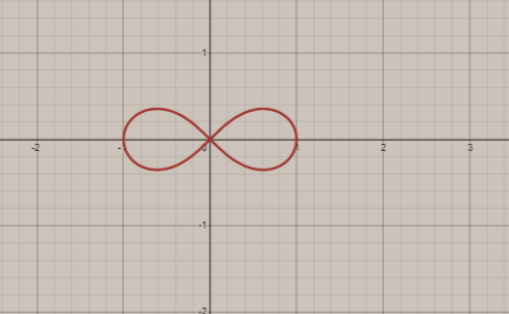
Hence, this is the required graph.
Note:
Students need to remember that polar coordinates are those coordinates that can be plotted into a circular grid. On the other side, rectangular coordinates are those coordinates that can be plotted into a plane i.e. graph and the rectangular coordinates are represented in the form of (x, y). Rectangular coordinates include only numerical values as they represent only horizontal axis and vertical axis.
In this given question, we have been asked to plot the graph for a given polar form. The polar form of a complex number is the other way to represent a given complex number, the polar form is represented by z = a + bi. When we need to plot the points in the plane, we need to have rectangular coordinate i.e. (x, y). For conversion from polar coordinates to rectangular coordinates, we will need to use the formulas from trigonometric functions.
Complete step by step solution:
We have given that,
\[\Rightarrow r=\sqrt{\cos \left( 2\cdot \theta \right)}\]
Writing the polar-coordinates, we get
To convert from polar coordinates to rectangular coordinates, using the formulas from trigonometric functions definitions:
We have,
\[x=r\cdot \cos \theta \] And \[y=r\cdot \sin \theta \]
So we have that,
\[{{r}^{2}}={{x}^{2}}+{{y}^{2}}\]
And by using trigonometric identity, i.e.
\[\cos \left( 2\theta \right)={{\cos }^{2}}\theta -{{\sin }^{2}}\theta \]
Again, we can write that;
As, \[x=r\cdot \cos \theta ,\ then\ \Rightarrow \cos \theta =\dfrac{x}{r}\]
And, \[y=r\cdot \sin \theta ,\ then\ \Rightarrow \sin \theta =\dfrac{y}{r}\]
Substituting the above values, we get
\[\cos \left( 2\theta \right)={{\cos }^{2}}\theta -{{\sin }^{2}}\theta ={{\left( \dfrac{x}{r} \right)}^{2}}-{{\left( \dfrac{y}{r} \right)}^{2}}\]
So, therefore
\[\Rightarrow r=\sqrt{\cos \left( 2\cdot \theta \right)}\]
Transposing square root to the left side of the above expression, we get
\[\Rightarrow {{r}^{2}}=\cos \left( 2\cdot \theta \right)\]
Substituting the value of \[\cos \left( 2\theta \right)\] in the above expression, we get
\[\Rightarrow {{r}^{2}}={{\left( \dfrac{x}{r} \right)}^{2}}-{{\left( \dfrac{y}{r} \right)}^{2}}\]
Simplifying the above expression, we get
\[\Rightarrow {{r}^{2}}=\dfrac{{{x}^{2}}-{{y}^{2}}}{{{r}^{2}}}\]
Multiply both the sides of the equation by\[{{r}^{2}}\], we get
\[\Rightarrow {{r}^{4}}={{x}^{2}}-{{y}^{2}}\]
Simplifying the exponents in the above expression, we get
\[\Rightarrow {{\left( {{r}^{2}} \right)}^{2}}={{x}^{2}}-{{y}^{2}}\]
Substituting the value of \[{{r}^{2}}={{x}^{2}}+{{y}^{2}}\] in the above expression, we get
\[\Rightarrow {{\left( {{x}^{2}}+{{y}^{2}} \right)}^{2}}={{x}^{2}}-{{y}^{2}}\]
Thus,
The graph of the equation\[{{\left( {{x}^{2}}+{{y}^{2}} \right)}^{2}}={{x}^{2}}-{{y}^{2}}\];
Hence, this is the required graph.
Note:
Students need to remember that polar coordinates are those coordinates that can be plotted into a circular grid. On the other side, rectangular coordinates are those coordinates that can be plotted into a plane i.e. graph and the rectangular coordinates are represented in the form of (x, y). Rectangular coordinates include only numerical values as they represent only horizontal axis and vertical axis.
Recently Updated Pages
Explain the structure of megasporangium class 12 biology CBSE

Why is chloroform kept in dark coloured bottles class 12 chemistry CBSE
Derive the balancing condition of a Wheatstone bri class 12 physics CBSE
Draw VI characteristics of a pn junction diode Explain class 12 physics CBSE
Is it possible to carry pride in ones language too class 12 english CBSE
In a population at Hardy Weinberg equilibrium the allele class 12 biology CBSE
Trending doubts
Draw a labelled sketch of the human eye class 12 physics CBSE
Which are the Top 10 Largest Countries of the World?
Draw ray diagrams each showing i myopic eye and ii class 12 physics CBSE
Which is the correct genotypic ratio of mendel dihybrid class 12 biology CBSE
Differentiate between homogeneous and heterogeneous class 12 chemistry CBSE
Which animal never drinks water in its entire life class 12 biology CBSE