




How do you graph ${{r}^{2}}=\sin \left( 2\theta \right)$?
Answer
 Verified
558.9k+ views
Hint: We can use the trigonometric identity $\sin \left( 2\theta \right)=2\sin \theta \cos \theta $ so that we can write the given equation as ${{r}^{2}}=2\sin \theta \cos \theta $. Then by using the relations ${{r}^{2}}={{x}^{2}}+{{y}^{2}}$, $x=r\cos \theta $ and $y=r\sin \theta $ we can convert the given equation to the Cartesian equation. Then by replacing $y$ by $x$ and vice-versa, we can check the symmetry about the line $y=x$. Then by substituting $y=0$ we can find out the intersection of the curve with the coordinate axes. Finally, we can equate the lowest degree term of the Cartesian equation to zero so as to get the tangents at the origin. With the help of these points, we can graph the given equation.
Complete step-by-step solution:
The equation given in the above question is written as
$\Rightarrow {{r}^{2}}=\sin \left( 2\theta \right)$
We know that $\sin \left( 2\theta \right)=2\sin \theta \cos \theta $. Therefore, the above equation can be written as
$\Rightarrow {{r}^{2}}=2\sin \theta \cos \theta $
Multiplying both sides by ${{r}^{2}}$ we get
$\begin{align}
& \Rightarrow {{r}^{4}}=2{{r}^{2}}\sin \theta \cos \theta \\
& \Rightarrow {{r}^{4}}=2\left( r\sin \theta \right)\left( r\cos \theta \right).......\left( i \right) \\
\end{align}$
Since the above equation is in the terms of the polar coordinates $r$ and $\theta $, it is a polar equation. We can convert it to the Cartesian equation by
$\begin{align}
& \Rightarrow {{r}^{2}}={{x}^{2}}+{{y}^{2}}........\left( ii \right) \\
& \Rightarrow x=r\cos \theta ..........\left( iii \right) \\
& \Rightarrow y=r\sin \theta ..........\left( iv \right) \\
\end{align}$
Substituting the above equations (ii), (iii) and (iv) into the equation (i) we get
$\begin{align}
& \Rightarrow {{\left( {{x}^{2}}+{{y}^{2}} \right)}^{2}}=2yx \\
& \Rightarrow {{x}^{4}}+2{{x}^{2}}{{y}^{2}}+{{y}^{4}}=2xy \\
& \Rightarrow {{x}^{4}}+2{{x}^{2}}{{y}^{2}}+{{y}^{4}}-2xy=0......\left( v \right) \\
\end{align}$
Now, we observe the above equation with respect to the below points
(i) Symmetry: Replacing $y$ by $x$ and $x$ by $y$ in the equation (v), we get
$\Rightarrow {{y}^{4}}+2{{y}^{2}}{{x}^{2}}+{{x}^{4}}-2yx=0$
The above equation is similar to the equation (v). Therefore, we can say that the curve will be symmetric with respect to the line $y=x$.
(ii) Intersection with Coordinate axes:
Substituting $x=0$ in (v) we get
$\begin{align}
& \Rightarrow {{\left( 0 \right)}^{4}}+2{{\left( 0 \right)}^{2}}{{y}^{2}}+{{y}^{4}}-2\left( 0 \right)y=0 \\
& \Rightarrow {{y}^{4}}=0 \\
& \Rightarrow y=0 \\
\end{align}$
Since on substituting $x=0$, $y=0$ is obtained, the curve passes through the origin.
(iii) Tangent at the origin:
In the equation (v) we can observe that the lowest degree term is $-2xy$. Equating it to zero, we get
$\begin{align}
& \Rightarrow 2xy=0 \\
& \Rightarrow x=0,y=0 \\
\end{align}$
Therefore, the tangents at the origin are the x and the y axis.
Therefore, the curve can be sketched as
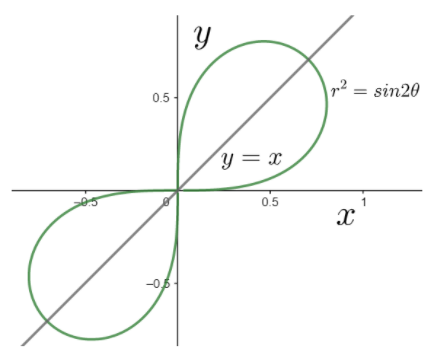
Hence, we have graphed ${{r}^{2}}=\sin \left( 2\theta \right)$.
Note: After changing the polar equation to the Cartesian equation, its sketching becomes easy. But we can sketch it without converting into the Cartesian equation too. For example, we can replace $\theta $ by $-\theta $ to check the symmetry about the initial line, and $r$ by $-r$ to check the symmetry about the pole.
Complete step-by-step solution:
The equation given in the above question is written as
$\Rightarrow {{r}^{2}}=\sin \left( 2\theta \right)$
We know that $\sin \left( 2\theta \right)=2\sin \theta \cos \theta $. Therefore, the above equation can be written as
$\Rightarrow {{r}^{2}}=2\sin \theta \cos \theta $
Multiplying both sides by ${{r}^{2}}$ we get
$\begin{align}
& \Rightarrow {{r}^{4}}=2{{r}^{2}}\sin \theta \cos \theta \\
& \Rightarrow {{r}^{4}}=2\left( r\sin \theta \right)\left( r\cos \theta \right).......\left( i \right) \\
\end{align}$
Since the above equation is in the terms of the polar coordinates $r$ and $\theta $, it is a polar equation. We can convert it to the Cartesian equation by
$\begin{align}
& \Rightarrow {{r}^{2}}={{x}^{2}}+{{y}^{2}}........\left( ii \right) \\
& \Rightarrow x=r\cos \theta ..........\left( iii \right) \\
& \Rightarrow y=r\sin \theta ..........\left( iv \right) \\
\end{align}$
Substituting the above equations (ii), (iii) and (iv) into the equation (i) we get
$\begin{align}
& \Rightarrow {{\left( {{x}^{2}}+{{y}^{2}} \right)}^{2}}=2yx \\
& \Rightarrow {{x}^{4}}+2{{x}^{2}}{{y}^{2}}+{{y}^{4}}=2xy \\
& \Rightarrow {{x}^{4}}+2{{x}^{2}}{{y}^{2}}+{{y}^{4}}-2xy=0......\left( v \right) \\
\end{align}$
Now, we observe the above equation with respect to the below points
(i) Symmetry: Replacing $y$ by $x$ and $x$ by $y$ in the equation (v), we get
$\Rightarrow {{y}^{4}}+2{{y}^{2}}{{x}^{2}}+{{x}^{4}}-2yx=0$
The above equation is similar to the equation (v). Therefore, we can say that the curve will be symmetric with respect to the line $y=x$.
(ii) Intersection with Coordinate axes:
Substituting $x=0$ in (v) we get
$\begin{align}
& \Rightarrow {{\left( 0 \right)}^{4}}+2{{\left( 0 \right)}^{2}}{{y}^{2}}+{{y}^{4}}-2\left( 0 \right)y=0 \\
& \Rightarrow {{y}^{4}}=0 \\
& \Rightarrow y=0 \\
\end{align}$
Since on substituting $x=0$, $y=0$ is obtained, the curve passes through the origin.
(iii) Tangent at the origin:
In the equation (v) we can observe that the lowest degree term is $-2xy$. Equating it to zero, we get
$\begin{align}
& \Rightarrow 2xy=0 \\
& \Rightarrow x=0,y=0 \\
\end{align}$
Therefore, the tangents at the origin are the x and the y axis.
Therefore, the curve can be sketched as
Hence, we have graphed ${{r}^{2}}=\sin \left( 2\theta \right)$.
Note: After changing the polar equation to the Cartesian equation, its sketching becomes easy. But we can sketch it without converting into the Cartesian equation too. For example, we can replace $\theta $ by $-\theta $ to check the symmetry about the initial line, and $r$ by $-r$ to check the symmetry about the pole.
Recently Updated Pages
Master Class 11 Social Science: Engaging Questions & Answers for Success

Master Class 11 Physics: Engaging Questions & Answers for Success
Master Class 11 Maths: Engaging Questions & Answers for Success
Master Class 11 Economics: Engaging Questions & Answers for Success
Master Class 11 Computer Science: Engaging Questions & Answers for Success
Master Class 11 Chemistry: Engaging Questions & Answers for Success
Trending doubts
One Metric ton is equal to kg A 10000 B 1000 C 100 class 11 physics CBSE
How many bones are in the spine class 11 biology CBSE
1 Quintal is equal to a 110 kg b 10 kg c 100kg d 1000 class 11 physics CBSE
There are 720 permutations of the digits 1 2 3 4 5 class 11 maths CBSE
State and prove Bernoullis theorem class 11 physics CBSE
Difference Between Prokaryotic Cells and Eukaryotic Cells