




How is the graph of $ - {\left( {x + 7} \right)^2} + 8 $ compared to the graph of $ f\left( x \right) = {x^2} $ ?
Answer
 Verified
579.3k+ views
Hint: Here, we will consider the function $ f\left( x \right) = {x^2} $ as a parent function because we are asked to compare the given function with it. If we add signs and numbers around this parent function, another graph will look somewhat related to it with some changes. By these significant changes, we can compare any given graph with the main graph.
Complete step-by-step answer:
We are given the function $ - {\left( {x + 7} \right)^2} + 8 $ .
To answer our question, we will compare this function with the standard formula:
$ a{(x + h)^2} + k $ Where,
The value of $ a $ stretch or compress the graph with respect to parent graph,
The value of $ h $ indicates the horizontal shift of the graph with respect to parent graph and
The value of $ k $ indicates the vertical shift of the graph with respect to the parent graph.
By comparing the given function $ - {\left( {x + 7} \right)^2} + 8 $ with $ a{(x + h)^2} + k $ , we get
$ a = - 1 $ which indicates that the function is not stretched or compressed but only reflected with respect to the x axis.
$ h = 7 $ which indicates that the graph shifts left to the parent graph by 7 units.
$ k = 8 $ which indicates that the graph shifts up by 8 units with respect to the parent graph.
We can see these comparisons on the graph as:
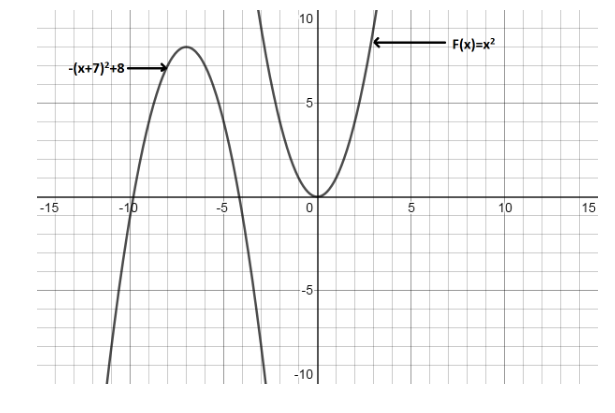
Note: In this problem, we have used the standard equation $ a{(x + h)^2} + k $ . Here, if the value of $ a $ is less than one, then the graph becomes narrower than the parent graph and it becomes wider if the value of $ a $ is greater than one. If the value of $ h $ is positive, the graph shifts left to the parent graph by $ h $ units and shifts right by $ h $ units if the value of $ h $ is negative. Finally, if the value of $ k $ is positive, the graph shifts up to the parent graph by $ k $ units and if it's negative then it will shift down by $ k $ units with respect to the parent unit.
Complete step-by-step answer:
We are given the function $ - {\left( {x + 7} \right)^2} + 8 $ .
To answer our question, we will compare this function with the standard formula:
$ a{(x + h)^2} + k $ Where,
The value of $ a $ stretch or compress the graph with respect to parent graph,
The value of $ h $ indicates the horizontal shift of the graph with respect to parent graph and
The value of $ k $ indicates the vertical shift of the graph with respect to the parent graph.
By comparing the given function $ - {\left( {x + 7} \right)^2} + 8 $ with $ a{(x + h)^2} + k $ , we get
$ a = - 1 $ which indicates that the function is not stretched or compressed but only reflected with respect to the x axis.
$ h = 7 $ which indicates that the graph shifts left to the parent graph by 7 units.
$ k = 8 $ which indicates that the graph shifts up by 8 units with respect to the parent graph.
We can see these comparisons on the graph as:
Note: In this problem, we have used the standard equation $ a{(x + h)^2} + k $ . Here, if the value of $ a $ is less than one, then the graph becomes narrower than the parent graph and it becomes wider if the value of $ a $ is greater than one. If the value of $ h $ is positive, the graph shifts left to the parent graph by $ h $ units and shifts right by $ h $ units if the value of $ h $ is negative. Finally, if the value of $ k $ is positive, the graph shifts up to the parent graph by $ k $ units and if it's negative then it will shift down by $ k $ units with respect to the parent unit.
Recently Updated Pages
Master Class 11 English: Engaging Questions & Answers for Success

Master Class 11 Social Science: Engaging Questions & Answers for Success
Master Class 11 Maths: Engaging Questions & Answers for Success
Master Class 11 Biology: Engaging Questions & Answers for Success
Master Class 11 Physics: Engaging Questions & Answers for Success
Master Class 11 Chemistry: Engaging Questions & Answers for Success
Trending doubts
Find the value of the expression given below sin 30circ class 11 maths CBSE
Difference between physical and chemical change class 11 chemistry CBSE
Draw a diagram of a plant cell and label at least eight class 11 biology CBSE
Draw a diagram showing the external features of fish class 11 biology CBSE
10 examples of law on inertia in our daily life
Draw a diagram of nephron and explain its structur class 11 biology CBSE