




How do you graph $f\left( x \right) = \ln x - 1$?
Answer
 Verified
594.9k+ views
Hint: First draw a rough graph of $\ln x$ to understand the nature and shape of $\ln x - 1$. We know that the graph of $\ln x$ will be increasing throughout the positive $x - $axis from $ - \infty $ at $x = 0$ to $\infty $ as $x \to \infty $. Then shift the graph of $\ln x$ downwards by 1 unit to get the correct graph of $\ln x - 1$.
Complete step-by-step solution:
According to the question, we have to show how to draw the graph of $f\left( x \right) = \ln x - 1$. For this, first we’ll draw the graph of $\ln x$ for reference to get the clear understanding of the nature and shape of $\ln x - 1$.
We know that the graph of $\ln x$ will be increasing throughout positive $x - $axis from $ - \infty $ as $x \to 0$ to $\infty $ as $x \to \infty $ while having 1 as its value at $x = 0$. And $\ln x$ is defined for only positive $x$ so the graph will not have anything on the negative side of the $x - $axis. Based on these observations, the graph of $\ln x$ is as shown below:
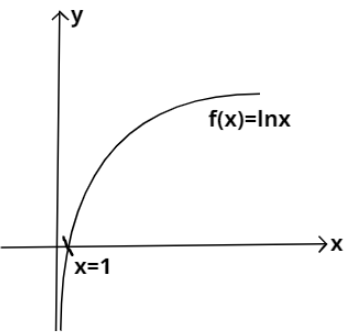
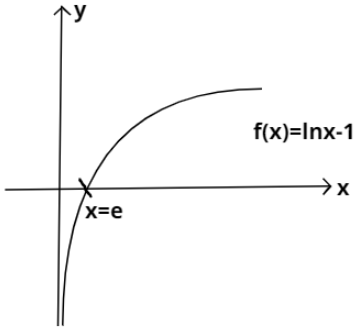
Now, for the graph of $\ln x - 1$, we will just shift the above graph of $\ln x$ downwards by 1 unit . For finding out the point where it cuts $x - $axis, we’ll put $\ln x - 1$ to zero. So we have:
$
\Rightarrow \ln x - 1 = 0 \\
\Rightarrow \ln x = 1 \\
\Rightarrow x = e \\
$
So $\ln x - 1$ will cut the $x - $axis at $x = e$.
The graph of $f\left( x \right) = \ln x - 1$ is shown below:
Note: If we know the graph of $y = f\left( x \right)$, then we can draw graphs related to this using the following rules:
(1) For the graph of $y = f\left( x \right) \pm a$, shift the graph of $y = f\left( x \right)$ by $a$ units upward or downward for positive and negative signs respectively.
(2) For the graph of $y = f\left( {x \pm a} \right)$, shift the graph of $y = f\left( x \right)$ by $a$ units left or right for positive and negative signs respectively.
Complete step-by-step solution:
According to the question, we have to show how to draw the graph of $f\left( x \right) = \ln x - 1$. For this, first we’ll draw the graph of $\ln x$ for reference to get the clear understanding of the nature and shape of $\ln x - 1$.
We know that the graph of $\ln x$ will be increasing throughout positive $x - $axis from $ - \infty $ as $x \to 0$ to $\infty $ as $x \to \infty $ while having 1 as its value at $x = 0$. And $\ln x$ is defined for only positive $x$ so the graph will not have anything on the negative side of the $x - $axis. Based on these observations, the graph of $\ln x$ is as shown below:
Now, for the graph of $\ln x - 1$, we will just shift the above graph of $\ln x$ downwards by 1 unit . For finding out the point where it cuts $x - $axis, we’ll put $\ln x - 1$ to zero. So we have:
$
\Rightarrow \ln x - 1 = 0 \\
\Rightarrow \ln x = 1 \\
\Rightarrow x = e \\
$
So $\ln x - 1$ will cut the $x - $axis at $x = e$.
The graph of $f\left( x \right) = \ln x - 1$ is shown below:
Note: If we know the graph of $y = f\left( x \right)$, then we can draw graphs related to this using the following rules:
(1) For the graph of $y = f\left( x \right) \pm a$, shift the graph of $y = f\left( x \right)$ by $a$ units upward or downward for positive and negative signs respectively.
(2) For the graph of $y = f\left( {x \pm a} \right)$, shift the graph of $y = f\left( x \right)$ by $a$ units left or right for positive and negative signs respectively.
Recently Updated Pages
Master Class 11 English: Engaging Questions & Answers for Success

Master Class 11 Social Science: Engaging Questions & Answers for Success
Master Class 11 Maths: Engaging Questions & Answers for Success
Master Class 11 Biology: Engaging Questions & Answers for Success
Master Class 11 Physics: Engaging Questions & Answers for Success
Master Class 11 Chemistry: Engaging Questions & Answers for Success
Trending doubts
One Metric ton is equal to kg A 10000 B 1000 C 100 class 11 physics CBSE
Difference Between Prokaryotic Cells and Eukaryotic Cells
Find the value of the expression given below sin 30circ class 11 maths CBSE
Two of the body parts which do not appear in MRI are class 11 biology CBSE
Draw a diagram of a plant cell and label at least eight class 11 biology CBSE
10 examples of friction in our daily life