




How do I graph \[\dfrac{{{{(y + 3)}^2}}}{{25}} - \dfrac{{{{(x + 2)}^2}}}{{16}} = 1\] algebraically?
Answer
 Verified
533.4k+ views
Hint: The given algebraic equation is the equation of the conic section known as hyperbola. We will now compare the equation of hyperbola with the standard equation of hyperbola then find its different properties which will help to plot it, those properties are the center of the hyperbola and the other one is the vertices of the hyperbolas. The standard equation is
\[\dfrac{{{{\left( {x - h} \right)}^2}}}{{{a^2}}} - \dfrac{{{{\left( {y - k} \right)}^2}}}{{{b^2}}} = 1\] or
\[\dfrac{{{{(y - k)}^2}}}{{{a^2}}} - \dfrac{{{{(x - h)}^2}}}{{{b^2}}} = 1\] ,for horizontal and vertical hyperbola respectively. Since we are given vertical hyperbola (we know this from seeing that our equation is identical to the second equation we will calculate centre as \[(h,k)\] and the equation of vertices will be \[\left( {h,k \pm a} \right)\] .
Complete step-by-step answer:
Given \[\dfrac{{{{(y + 3)}^2}}}{{25}} - \dfrac{{{{(x + 2)}^2}}}{{16}} = 1\] is the equation of the hyperbola. On comparing with the standard equation we can know the center of the hyperbola which is \[(h,k)\] and the vertices by the formula \[\left( {h,k \pm a} \right)\] after comparing from the standard equation which is given as follows:
\[\dfrac{{{{(y - k)}^2}}}{{{a^2}}} - \dfrac{{{{(x - h)}^2}}}{{{b^2}}} = 1\] on comparing with the original equation we get
\[h = - 2,{\text{ }}k = - 3,a = 5,b = 4\]
Now according to the above formula for centre of the hyperbola we can write that center is
$ ( - 2, - 3) $
The values of the vertices is given by the formula \[\left( {h,k \pm a} \right)\] by applying the above formula we get
The value of two vertices as ( $ - 2,2) $ and $ ( - 2,8) $ . Now we will plot the points and get our hyperbola plotted on the two dimensional coordinate plane as
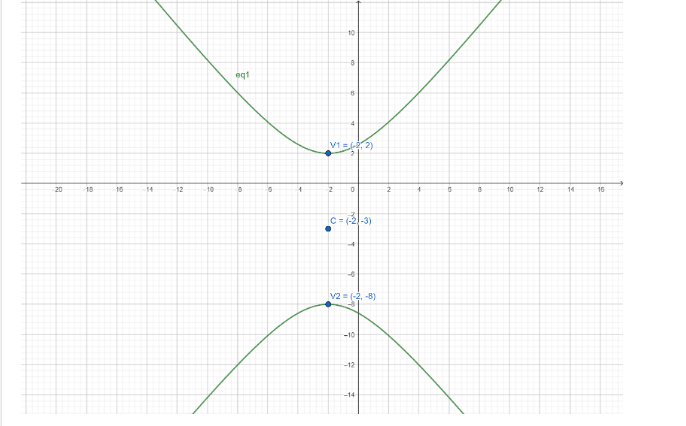
Here C and V $ 1 $ and V $ 2 $ are the centre, and vertices respectively.
Note: The hyperbolas are of two types one is normal hyperbola which can be either horizontal or vertical and the other type is the rectangular hyperbola. This occurs when the semimajor and semiminor axes are equal.
\[\dfrac{{{{\left( {x - h} \right)}^2}}}{{{a^2}}} - \dfrac{{{{\left( {y - k} \right)}^2}}}{{{b^2}}} = 1\] or
\[\dfrac{{{{(y - k)}^2}}}{{{a^2}}} - \dfrac{{{{(x - h)}^2}}}{{{b^2}}} = 1\] ,for horizontal and vertical hyperbola respectively. Since we are given vertical hyperbola (we know this from seeing that our equation is identical to the second equation we will calculate centre as \[(h,k)\] and the equation of vertices will be \[\left( {h,k \pm a} \right)\] .
Complete step-by-step answer:
Given \[\dfrac{{{{(y + 3)}^2}}}{{25}} - \dfrac{{{{(x + 2)}^2}}}{{16}} = 1\] is the equation of the hyperbola. On comparing with the standard equation we can know the center of the hyperbola which is \[(h,k)\] and the vertices by the formula \[\left( {h,k \pm a} \right)\] after comparing from the standard equation which is given as follows:
\[\dfrac{{{{(y - k)}^2}}}{{{a^2}}} - \dfrac{{{{(x - h)}^2}}}{{{b^2}}} = 1\] on comparing with the original equation we get
\[h = - 2,{\text{ }}k = - 3,a = 5,b = 4\]
Now according to the above formula for centre of the hyperbola we can write that center is
$ ( - 2, - 3) $
The values of the vertices is given by the formula \[\left( {h,k \pm a} \right)\] by applying the above formula we get
The value of two vertices as ( $ - 2,2) $ and $ ( - 2,8) $ . Now we will plot the points and get our hyperbola plotted on the two dimensional coordinate plane as
Here C and V $ 1 $ and V $ 2 $ are the centre, and vertices respectively.
Note: The hyperbolas are of two types one is normal hyperbola which can be either horizontal or vertical and the other type is the rectangular hyperbola. This occurs when the semimajor and semiminor axes are equal.
Recently Updated Pages
Master Class 11 Computer Science: Engaging Questions & Answers for Success

Master Class 11 Business Studies: Engaging Questions & Answers for Success
Master Class 11 Economics: Engaging Questions & Answers for Success
Master Class 11 English: Engaging Questions & Answers for Success
Master Class 11 Maths: Engaging Questions & Answers for Success
Master Class 11 Biology: Engaging Questions & Answers for Success
Trending doubts
One Metric ton is equal to kg A 10000 B 1000 C 100 class 11 physics CBSE
There are 720 permutations of the digits 1 2 3 4 5 class 11 maths CBSE
Discuss the various forms of bacteria class 11 biology CBSE
Draw a diagram of a plant cell and label at least eight class 11 biology CBSE
State the laws of reflection of light
Explain zero factorial class 11 maths CBSE