




How to graph a parabola \[y = \dfrac{3}{2}{x^2} - 3x - \dfrac{5}{2}\]?
Answer
 Verified
562.8k+ views
Hint:
Here, we will first convert the given equation into vertex form of the parabola by using the method of completing the square. Then we will compare the obtained equation with the general equation of parabola to find the vertex. Then we will find \[x\] and \[y\] intercepts and also an additional point by substituting different values of the variables in the vertex form of the given equation. Using this we will plot those points on a graph and join them together to find the required graph of the given parabola.
Complete step by step solution:
The given quadratic equation is \[y = \dfrac{3}{2}{x^2} - 3x - \dfrac{5}{2}\].
Now, we will use the method of completing the square.
\[\dfrac{3}{2}{\left( {x - 1} \right)^2} = \dfrac{3}{2}\left( {{x^2} - 2x + 1} \right) = \dfrac{3}{2}{x^2} - 3x + \dfrac{3}{2}\]
Hence, we can write the given quadratic equation as:
\[y = \dfrac{3}{2}{x^2} - 3x + \dfrac{3}{2} - \dfrac{3}{2} - \dfrac{5}{2}\]
\[ \Rightarrow y = \dfrac{3}{2}{\left( {x - 1} \right)^2} - \dfrac{3}{2} - \dfrac{5}{2}\]
Thus, solving further, we get,
\[ \Rightarrow y = \dfrac{3}{2}{\left( {x - 1} \right)^2} - 4\]………………………………………..\[\left( 1 \right)\]
This is in vertex form.
We know that the general equation of a parabola is \[y = a{\left( {x - h} \right)^2} + k\], where \[\left( {h,k} \right)\] is the vertex.
Now, in order to graph a parabola of this quadratic equation, first we will find the vertex.
Also, since, \[\left( {x - h} \right)\] is the axis of symmetry, thus, \[x = 1\] is the axis of symmetry in this question.
Comparing equation \[\left( 1 \right)\] with the given equation with the general equation, we have,
Vertex \[\left( {h,k} \right) = \left( {1, - 4} \right)\]
Now, substituting \[x = 0\] in the equation \[\left( 1 \right)\], we get,
\[y = \dfrac{3}{2}{\left( {0 - 1} \right)^2} - 4\]
\[ \Rightarrow y = \dfrac{3}{2} - 4\]
Subtracting the terms by taking LCM, we get
\[ \Rightarrow y = \dfrac{{3 - 8}}{2} = \dfrac{{ - 5}}{2}\]
Hence, when \[x = 0\], \[y = \dfrac{{ - 5}}{2}\]
Therefore, the \[y\]-intercept is \[\left( {0,\dfrac{{ - 5}}{2}} \right)\]
Similarly, substituting \[y = 0\] in the equation \[\left( 1 \right)\], we get,
\[0 = \dfrac{3}{2}{\left( {x - 1} \right)^2} - 4\]
Adding 4 on both sides, we get
\[ \Rightarrow 4 = \dfrac{3}{2}{\left( {x - 1} \right)^2}\]
Multiplying both sides by \[\dfrac{2}{3}\], we get
\[ \Rightarrow \dfrac{8}{3} = {\left( {x - 1} \right)^2}\]
Taking square root on both sides, we get
\[ \Rightarrow x - 1 = \pm \sqrt {\dfrac{8}{3}} \]
Adding 1 on both sides, we get
\[ \Rightarrow x = 1 \pm \dfrac{{2\sqrt 2 }}{{\sqrt 3 }} \cong 1 \pm 1.633\]
Hence, when \[y = 0\], \[x = \left( {1 + 1.633} \right),\left( {1 - 1.633} \right)\]
Therefore, the \[x\]-intercepts are \[\left( { - 0.633,0} \right)\] and \[\left( {2.633,0} \right)\]
Now, we will find an additional point also.
Thus, let \[x = 2\]
Hence, we get,
\[y = \dfrac{3}{2}{\left( {2 - 1} \right)^2} - 4\]
\[ \Rightarrow y = \dfrac{3}{2} - 4 = \dfrac{{3 - 8}}{2} = \dfrac{{ - 5}}{2}\]
Hence, additional point is \[\left( {2, - \dfrac{5}{2}} \right)\]
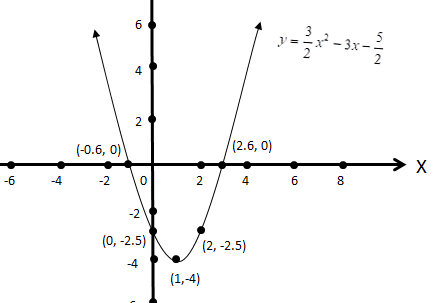
Now, we will draw the graph of parabola, such that,
Vertex \[=\left( {1, - 4} \right)\]
The \[x\]-intercepts are \[\left( { - 0.633,0} \right)\] and \[\left( {2.633,0} \right)\].
The \[y\]-intercept is \[\left( {0,\dfrac{{ - 5}}{2}} \right)\].
An additional point is \[\left( {2, - \dfrac{5}{2}} \right)\].
Hence, the required graph is:
Hence, this is the required answer.
Note:
A parabola is a curve having a focus and a directrix, such that each point on parabola is at equal distance from them. The axis of symmetry of a parabola is a line about which the parabola is symmetrical. When the parabola is vertical, the line of symmetry is vertical. When a quadratic function is graphed in the coordinate plane, the resulting parabola and corresponding axis of symmetry are vertical.
Here, we will first convert the given equation into vertex form of the parabola by using the method of completing the square. Then we will compare the obtained equation with the general equation of parabola to find the vertex. Then we will find \[x\] and \[y\] intercepts and also an additional point by substituting different values of the variables in the vertex form of the given equation. Using this we will plot those points on a graph and join them together to find the required graph of the given parabola.
Complete step by step solution:
The given quadratic equation is \[y = \dfrac{3}{2}{x^2} - 3x - \dfrac{5}{2}\].
Now, we will use the method of completing the square.
\[\dfrac{3}{2}{\left( {x - 1} \right)^2} = \dfrac{3}{2}\left( {{x^2} - 2x + 1} \right) = \dfrac{3}{2}{x^2} - 3x + \dfrac{3}{2}\]
Hence, we can write the given quadratic equation as:
\[y = \dfrac{3}{2}{x^2} - 3x + \dfrac{3}{2} - \dfrac{3}{2} - \dfrac{5}{2}\]
\[ \Rightarrow y = \dfrac{3}{2}{\left( {x - 1} \right)^2} - \dfrac{3}{2} - \dfrac{5}{2}\]
Thus, solving further, we get,
\[ \Rightarrow y = \dfrac{3}{2}{\left( {x - 1} \right)^2} - 4\]………………………………………..\[\left( 1 \right)\]
This is in vertex form.
We know that the general equation of a parabola is \[y = a{\left( {x - h} \right)^2} + k\], where \[\left( {h,k} \right)\] is the vertex.
Now, in order to graph a parabola of this quadratic equation, first we will find the vertex.
Also, since, \[\left( {x - h} \right)\] is the axis of symmetry, thus, \[x = 1\] is the axis of symmetry in this question.
Comparing equation \[\left( 1 \right)\] with the given equation with the general equation, we have,
Vertex \[\left( {h,k} \right) = \left( {1, - 4} \right)\]
Now, substituting \[x = 0\] in the equation \[\left( 1 \right)\], we get,
\[y = \dfrac{3}{2}{\left( {0 - 1} \right)^2} - 4\]
\[ \Rightarrow y = \dfrac{3}{2} - 4\]
Subtracting the terms by taking LCM, we get
\[ \Rightarrow y = \dfrac{{3 - 8}}{2} = \dfrac{{ - 5}}{2}\]
Hence, when \[x = 0\], \[y = \dfrac{{ - 5}}{2}\]
Therefore, the \[y\]-intercept is \[\left( {0,\dfrac{{ - 5}}{2}} \right)\]
Similarly, substituting \[y = 0\] in the equation \[\left( 1 \right)\], we get,
\[0 = \dfrac{3}{2}{\left( {x - 1} \right)^2} - 4\]
Adding 4 on both sides, we get
\[ \Rightarrow 4 = \dfrac{3}{2}{\left( {x - 1} \right)^2}\]
Multiplying both sides by \[\dfrac{2}{3}\], we get
\[ \Rightarrow \dfrac{8}{3} = {\left( {x - 1} \right)^2}\]
Taking square root on both sides, we get
\[ \Rightarrow x - 1 = \pm \sqrt {\dfrac{8}{3}} \]
Adding 1 on both sides, we get
\[ \Rightarrow x = 1 \pm \dfrac{{2\sqrt 2 }}{{\sqrt 3 }} \cong 1 \pm 1.633\]
Hence, when \[y = 0\], \[x = \left( {1 + 1.633} \right),\left( {1 - 1.633} \right)\]
Therefore, the \[x\]-intercepts are \[\left( { - 0.633,0} \right)\] and \[\left( {2.633,0} \right)\]
Now, we will find an additional point also.
Thus, let \[x = 2\]
Hence, we get,
\[y = \dfrac{3}{2}{\left( {2 - 1} \right)^2} - 4\]
\[ \Rightarrow y = \dfrac{3}{2} - 4 = \dfrac{{3 - 8}}{2} = \dfrac{{ - 5}}{2}\]
Hence, additional point is \[\left( {2, - \dfrac{5}{2}} \right)\]
Now, we will draw the graph of parabola, such that,
Vertex \[=\left( {1, - 4} \right)\]
The \[x\]-intercepts are \[\left( { - 0.633,0} \right)\] and \[\left( {2.633,0} \right)\].
The \[y\]-intercept is \[\left( {0,\dfrac{{ - 5}}{2}} \right)\].
An additional point is \[\left( {2, - \dfrac{5}{2}} \right)\].
Hence, the required graph is:
Hence, this is the required answer.
Note:
A parabola is a curve having a focus and a directrix, such that each point on parabola is at equal distance from them. The axis of symmetry of a parabola is a line about which the parabola is symmetrical. When the parabola is vertical, the line of symmetry is vertical. When a quadratic function is graphed in the coordinate plane, the resulting parabola and corresponding axis of symmetry are vertical.
Recently Updated Pages
Basicity of sulphurous acid and sulphuric acid are

Master Class 12 English: Engaging Questions & Answers for Success
Master Class 12 Social Science: Engaging Questions & Answers for Success
Master Class 12 Maths: Engaging Questions & Answers for Success
Master Class 12 Economics: Engaging Questions & Answers for Success
Master Class 12 Physics: Engaging Questions & Answers for Success
Trending doubts
Which are the Top 10 Largest Countries of the World?
Draw a labelled sketch of the human eye class 12 physics CBSE
Give 10 examples of unisexual and bisexual flowers
Coming together federation is practiced in A India class 12 social science CBSE
Write the formula to find the shortest distance between class 12 maths CBSE
Find the foot of the perpendicular from point232to class 12 maths CBSE