




Glycogenesis refer to
(a) Conversion of glycogen to glucose.
(b) Breakdown of glucose to form pyruvate.
(c) Breakdown of pyruvate to form glucose.
(d) Conversion of glucose to glycogen.
Answer
 Verified
608.1k+ views
Hint: The liver is the most important vital organ in our body which controls many functions. Breakdown of carbohydrate, protein, and fat takes place in the liver which helps for the production of glucose.
Complete answer:
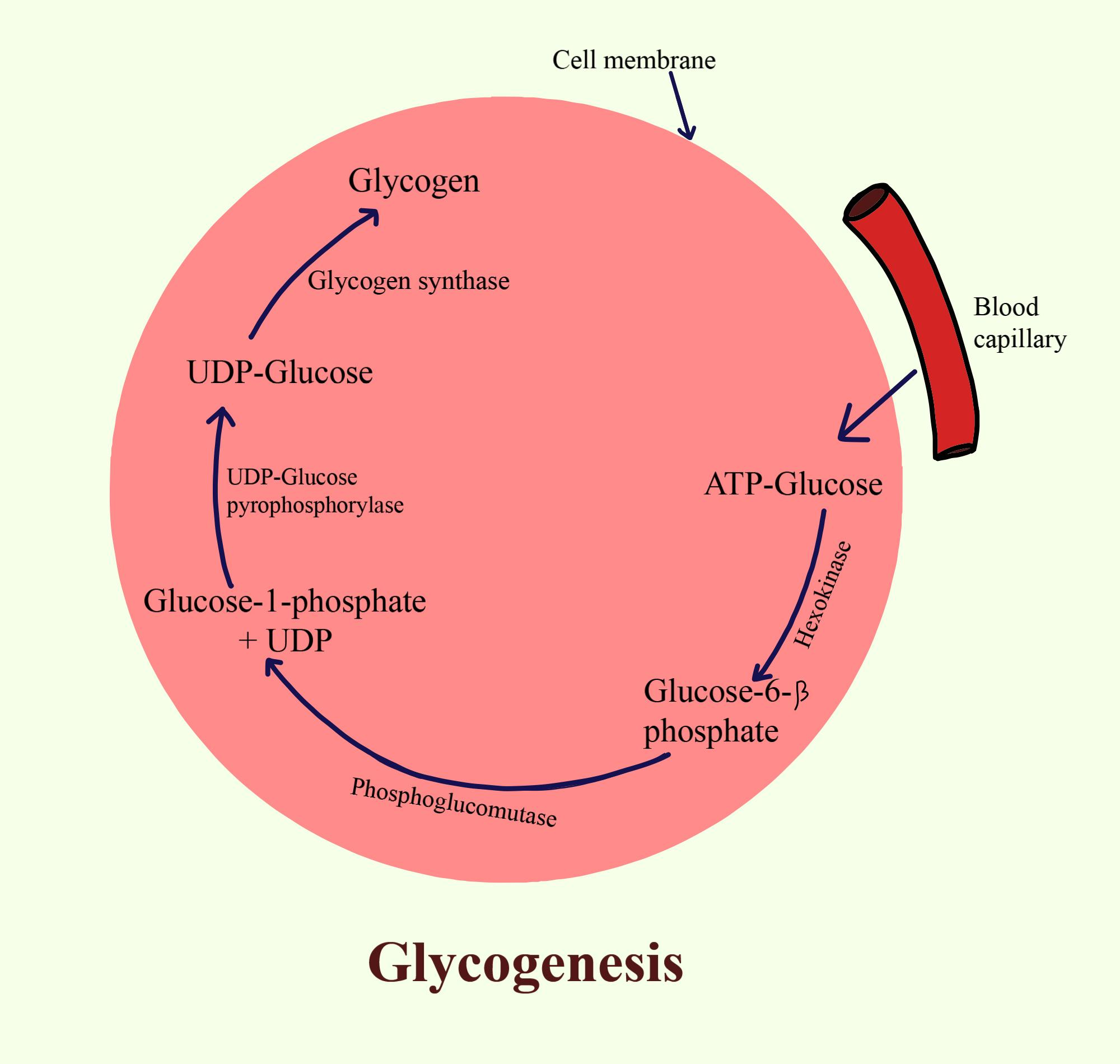
In glycogenesis, the liver cell converts excess glucose into glycogen with the help of insulin secreted by plasma. Glycogenesis takes place when a person is fasting and glycogen starts depleting, so to fulfill the demand of glycogen, glucose gets converted into glycogen.
Additional Information: The liver also performs a function as the production of bile, which is the main endocrine secretion of the liver containing bile pigment, bile salts, cholesterol, and phospholipid, bile salts help in the digestion of fat. The liver excretes out like urea which obtains ammonia and carbon dioxide, pigment bilirubin and biliverdin with other waste like cholesterol, metal ion, hemoglobin waste, etc. Hematopoiesis takes place in the liver where the formation of blood corpuscles takes place, hematopoiesis occurs in the liver at the embryo stage. It synthesizes blood proteins like prothrombin and fibrinogen. It also synthesizes vitamin A from carotene. It consists of Kuffer cells which engulf the disease-causing microbes and dead cells. Worn out RBC is broken down in the liver cell, by which hemoglobin changes into bile. It maintains body fluid by the production of angiotensinogen, it also maintains body temperature with the generation of heat through the metabolic process. The liver also secretes anticoagulant heparin which decreases the clotting ability of harmful clots in the blood vessel.
So, the correct answer is the ‘conversion of glucose into glycogen’.
Note: Glycogenolysis and glycogenolysis also take place in the liver. In glycogenolysis, glycogen gets converted into glucose, while in gluconeogenesis formation of glucose and glycogen takes place from the non-carbohydrate source. Glycogenesis and glycogenolysis take place in the liver but gluconeogenesis takes place in the liver as well in kidney and striped muscles.
Complete answer:
In glycogenesis, the liver cell converts excess glucose into glycogen with the help of insulin secreted by plasma. Glycogenesis takes place when a person is fasting and glycogen starts depleting, so to fulfill the demand of glycogen, glucose gets converted into glycogen.
Additional Information: The liver also performs a function as the production of bile, which is the main endocrine secretion of the liver containing bile pigment, bile salts, cholesterol, and phospholipid, bile salts help in the digestion of fat. The liver excretes out like urea which obtains ammonia and carbon dioxide, pigment bilirubin and biliverdin with other waste like cholesterol, metal ion, hemoglobin waste, etc. Hematopoiesis takes place in the liver where the formation of blood corpuscles takes place, hematopoiesis occurs in the liver at the embryo stage. It synthesizes blood proteins like prothrombin and fibrinogen. It also synthesizes vitamin A from carotene. It consists of Kuffer cells which engulf the disease-causing microbes and dead cells. Worn out RBC is broken down in the liver cell, by which hemoglobin changes into bile. It maintains body fluid by the production of angiotensinogen, it also maintains body temperature with the generation of heat through the metabolic process. The liver also secretes anticoagulant heparin which decreases the clotting ability of harmful clots in the blood vessel.
So, the correct answer is the ‘conversion of glucose into glycogen’.
Note: Glycogenolysis and glycogenolysis also take place in the liver. In glycogenolysis, glycogen gets converted into glucose, while in gluconeogenesis formation of glucose and glycogen takes place from the non-carbohydrate source. Glycogenesis and glycogenolysis take place in the liver but gluconeogenesis takes place in the liver as well in kidney and striped muscles.
Recently Updated Pages
Master Class 11 English: Engaging Questions & Answers for Success

Master Class 11 Social Science: Engaging Questions & Answers for Success
Master Class 11 Maths: Engaging Questions & Answers for Success
Master Class 11 Biology: Engaging Questions & Answers for Success
Master Class 11 Physics: Engaging Questions & Answers for Success
Master Class 11 Chemistry: Engaging Questions & Answers for Success
Trending doubts
One Metric ton is equal to kg A 10000 B 1000 C 100 class 11 physics CBSE
Difference Between Prokaryotic Cells and Eukaryotic Cells
Find the value of the expression given below sin 30circ class 11 maths CBSE
Difference between physical and chemical change class 11 chemistry CBSE
Two of the body parts which do not appear in MRI are class 11 biology CBSE
Draw a diagram of a plant cell and label at least eight class 11 biology CBSE