




Glass snake is
(a)Venomous snake
(b)Non-venomous snake
(c)Limbless snake
(d)Limbless lizard
Answer
 Verified
608.7k+ views
Hint: One of the wider communities of squamate reptiles is the glass snake. They are generally found within the walls of the house. They've got no legs. On either side of the head, they have an ear gap. They are not a member of the sub-order of serpentes.
Complete answer:
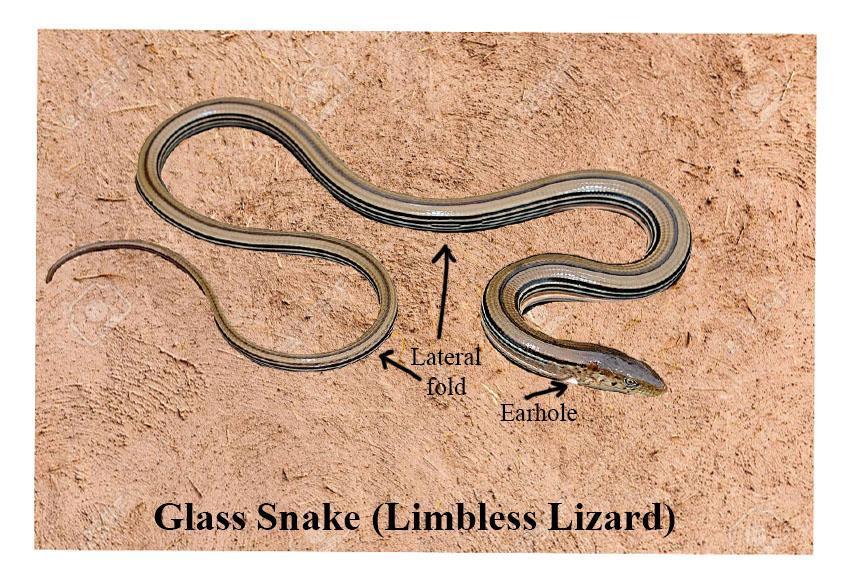
The common name for the snake-like legless lizards of the Ophisaurus genus is the Glass snake. The shiny, scaled body, often striped above and whitish below, is grey or greenish-brown.
-The length of the American species, Ophisaurus ventralis, is 2 to 3 ft (60 to 90 cm); the tail is two-thirds long.
-A glass snake's tail quickly falls out of the body, either whole or in parts, if struck; a new, usually shorter, tail without a real backbone is regenerated by the lizard.
The glass snake has eyelids and ear openings, similar to other lizards, and unlike snakes. Its tongue is big. Mostly, it feeds on spiders, larvae, and slugs. A burrower lives in fields and meadows and, in the daytime, seldom appears above ground.
-Glass snakes, subphylum Vertebrata, Reptilia class, order Squamata, Anguidae tribe, are known as phylum Chordata.
So, the correct answer is, ‘Limbless lizard’.
Note: As the tail is easily broken off, the glass lizard, also called a glass snake, is so named. Ophisaurus ventralis, the Eastern glass lizard, occurs in southeastern North America and grows to around 41 inches (105 cm). The head and body of the lizard together account for just 30 to 35 percent of its overall length. It has no legs, but its paws, movable eyelids, non-expandable jaws, and the fact that the scales on the lower and upper sides of the body are of similar size can be easily differentiated from a snake. The slender glass lizard, O.attenuatus is a close resemblance to it which has a wider distribution northwestward to the upper Mississippi River valley in southeastern North America. Different from Ophisaurus ventralis, which, along each lower side, has broadband, Ophisaurus attenuatus has short dark lines.
Complete answer:
The common name for the snake-like legless lizards of the Ophisaurus genus is the Glass snake. The shiny, scaled body, often striped above and whitish below, is grey or greenish-brown.
-The length of the American species, Ophisaurus ventralis, is 2 to 3 ft (60 to 90 cm); the tail is two-thirds long.
-A glass snake's tail quickly falls out of the body, either whole or in parts, if struck; a new, usually shorter, tail without a real backbone is regenerated by the lizard.
The glass snake has eyelids and ear openings, similar to other lizards, and unlike snakes. Its tongue is big. Mostly, it feeds on spiders, larvae, and slugs. A burrower lives in fields and meadows and, in the daytime, seldom appears above ground.
-Glass snakes, subphylum Vertebrata, Reptilia class, order Squamata, Anguidae tribe, are known as phylum Chordata.
So, the correct answer is, ‘Limbless lizard’.
Note: As the tail is easily broken off, the glass lizard, also called a glass snake, is so named. Ophisaurus ventralis, the Eastern glass lizard, occurs in southeastern North America and grows to around 41 inches (105 cm). The head and body of the lizard together account for just 30 to 35 percent of its overall length. It has no legs, but its paws, movable eyelids, non-expandable jaws, and the fact that the scales on the lower and upper sides of the body are of similar size can be easily differentiated from a snake. The slender glass lizard, O.attenuatus is a close resemblance to it which has a wider distribution northwestward to the upper Mississippi River valley in southeastern North America. Different from Ophisaurus ventralis, which, along each lower side, has broadband, Ophisaurus attenuatus has short dark lines.
Recently Updated Pages
Master Class 11 Social Science: Engaging Questions & Answers for Success

Master Class 11 Chemistry: Engaging Questions & Answers for Success
Master Class 12 Business Studies: Engaging Questions & Answers for Success
Master Class 12 Chemistry: Engaging Questions & Answers for Success
Master Class 12 Biology: Engaging Questions & Answers for Success
Class 12 Question and Answer - Your Ultimate Solutions Guide
Trending doubts
How many of the following diseases can be studied with class 11 biology CBSE
Which of the following enzymes is used for carboxylation class 11 biology CBSE
Explain zero factorial class 11 maths CBSE
Receptor sites for neurotransmitters are present on class 11 biology CBSE
JGA JuxtaGlomerular Apparatus a sensitive region which class 11 biology CBSE
Root hairs develop from the region of A Meristematic class 11 biology CBSE