




Given,${{H}_{2}}O$ is dipolar, whereas $Be{{F}_{2}}$ is not. It is because:
A. ${{H}_{2}}O$ involves hydrogen bonding whereas $Be{{F}_{2}}$ is a discrete molecule
B. ${{H}_{2}}O$ is linear and $Be{{F}_{2}}$ is angular
C. ${{H}_{2}}O$ is angular and $Be{{F}_{2}}$ is linear
D. the electronegativity of F is greater than that of O
Answer
 Verified
516.3k+ views
Hint: A dipolar molecule is the compound having polarity. Dipole moment means the difference between the magnitude of charge and the distance between the charged atoms. A molecule is considered to be polar and non – polar due to the resultant dipole it possesses. In polyatomic molecules the dipole moment depends on the shape or spatial arrangement of the atoms.
Complete answer:
Dipole moment of any molecule is the product of the magnitude of the charge and the distance between the centre of the positive and the negative charges. This dipole moment denoted as$\mu $can tell us that any molecule is polar (i.e. have a dipole) or not. When the value of the dipole moment is greater than zero, it means the molecule possesses a dipole. When the value of$\mu $is equal to zero, it means the molecule is not polar.
The value of $\mu $depends on the spatial arrangement of atoms in a polyatomic molecule. As the dipole moment is a vector quantity, it depends on the sum of dipole moments of the individual bonds. When $\mu $= 0, it means that the molecule has a linear shape. While the angular or bent shaped molecules possess a dipole.
We have ${{H}_{2}}O$ which has an angular or bent structure as
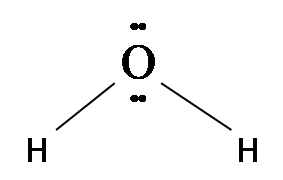
This means it has $\mu $> 0.
While, $Be{{F}_{2}}$ has a linear shape as
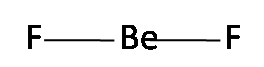
This means that its dipole moment is $\mu $= 0.
Hence, ${{H}_{2}}O$ is dipolar, whereas $Be{{F}_{2}}$ is not because ${{H}_{2}}O$ is angular and $Be{{F}_{2}}$ is linear.
So, option C is correct.
Note:
The shapes of covalent molecules can be determined through a theory called VSEPR theory that suggests the shape depends on the distribution of valence electrons of the atoms in the form of bond and lone pairs. The repulsion in lone pairs and lone pairs of electrons is the maximum. Water molecule has lone pairs on oxygen that makes its structure bent.
Complete answer:
Dipole moment of any molecule is the product of the magnitude of the charge and the distance between the centre of the positive and the negative charges. This dipole moment denoted as$\mu $can tell us that any molecule is polar (i.e. have a dipole) or not. When the value of the dipole moment is greater than zero, it means the molecule possesses a dipole. When the value of$\mu $is equal to zero, it means the molecule is not polar.
The value of $\mu $depends on the spatial arrangement of atoms in a polyatomic molecule. As the dipole moment is a vector quantity, it depends on the sum of dipole moments of the individual bonds. When $\mu $= 0, it means that the molecule has a linear shape. While the angular or bent shaped molecules possess a dipole.
We have ${{H}_{2}}O$ which has an angular or bent structure as
This means it has $\mu $> 0.
While, $Be{{F}_{2}}$ has a linear shape as
This means that its dipole moment is $\mu $= 0.
Hence, ${{H}_{2}}O$ is dipolar, whereas $Be{{F}_{2}}$ is not because ${{H}_{2}}O$ is angular and $Be{{F}_{2}}$ is linear.
So, option C is correct.
Note:
The shapes of covalent molecules can be determined through a theory called VSEPR theory that suggests the shape depends on the distribution of valence electrons of the atoms in the form of bond and lone pairs. The repulsion in lone pairs and lone pairs of electrons is the maximum. Water molecule has lone pairs on oxygen that makes its structure bent.
Recently Updated Pages
Master Class 11 Computer Science: Engaging Questions & Answers for Success

Master Class 11 Business Studies: Engaging Questions & Answers for Success
Master Class 11 Economics: Engaging Questions & Answers for Success
Master Class 11 English: Engaging Questions & Answers for Success
Master Class 11 Maths: Engaging Questions & Answers for Success
Master Class 11 Biology: Engaging Questions & Answers for Success
Trending doubts
One Metric ton is equal to kg A 10000 B 1000 C 100 class 11 physics CBSE
There are 720 permutations of the digits 1 2 3 4 5 class 11 maths CBSE
Discuss the various forms of bacteria class 11 biology CBSE
Draw a diagram of a plant cell and label at least eight class 11 biology CBSE
State the laws of reflection of light
Explain zero factorial class 11 maths CBSE