




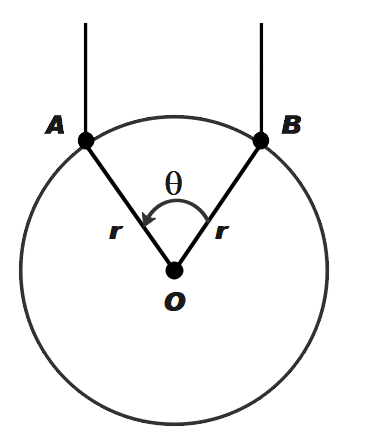
Given,A and B are two points on a uniform ring of radius r. The resistance of the ring is R. \[\angle AOB=\theta \] as shown in the figure. The equivalent resistance between A and B is:
A. \[\dfrac{R\theta }{2\pi }\]
B. \[\dfrac{R(2\pi -\theta )}{4\pi }\]
C. \[R\left( 1-\dfrac{\theta }{2\pi } \right)\]
D. \[\dfrac{R}{4{{\pi }^{2}}}\left( 2\pi -\theta \right)\theta \]
Answer
 Verified
579.6k+ views
Hint: In this question we have been asked to calculate the equivalent resistance between the given points. It is given that A and B are two points on the uniform circular ring. No, from the figure we can say that, the two arcs formed by the points A and B are connected in parallel to each other. Therefore, if we calculate the individual resistance of the bigger and smaller arc, we can calculate the equivalent resistance between points A and B.
Formula used:
\[l=r\theta \]
Where,
l is the length of the arc,
r is the radius of ring
\[\theta \] is the angle made by the arc
\[\dfrac{1}{{{R}_{AB}}}=\dfrac{1}{{{R}_{1}}}+\dfrac{1}{{{R}_{2}}}\]
Complete step by step solution:
From the given figure,
We know that the arc length is given by,
\[l=r\theta \]
Now, calculating the resistance of the smaller arc
We get,
\[{{R}_{1}}=\dfrac{r\theta }{2\pi r}R\]
On solving,
\[{{R}_{1}}=\dfrac{\theta }{2\pi }R\]…………….. (1)
Similarly, for bigger arc
We get,
\[{{R}_{2}}=\dfrac{2\pi -\theta }{2\pi }R\] …………………… (2)
Now,
From the figure we can say that the two arcs are connected in parallel combination with each other.Therefore, We know,
\[\dfrac{1}{{{R}_{AB}}}=\dfrac{1}{{{R}_{1}}}+\dfrac{1}{{{R}_{2}}}\]
After substituting values from (1) and (2)
We get,
\[\dfrac{1}{{{R}_{AB}}}=\dfrac{2\pi }{\theta R}+\dfrac{2\pi }{\left( 2\pi -\theta \right)R}\]
Therefore,
\[{{R}_{AB}}=\dfrac{R}{4{{\pi }^{2}}}(2\pi -\theta )\theta \]
Therefore, the correct answer is option D.
Note:
If two or more resistors in a circuit are connected to the same nodes, the resistors are said to be in parallel connection. The equivalent resistance in parallel connection is given by adding the reciprocals on individual resistance and then taking the reciprocal of the sum. The equivalent resistance is smaller than the resistor with smallest resistance.
Formula used:
\[l=r\theta \]
Where,
l is the length of the arc,
r is the radius of ring
\[\theta \] is the angle made by the arc
\[\dfrac{1}{{{R}_{AB}}}=\dfrac{1}{{{R}_{1}}}+\dfrac{1}{{{R}_{2}}}\]
Complete step by step solution:
From the given figure,
We know that the arc length is given by,
\[l=r\theta \]
Now, calculating the resistance of the smaller arc
We get,
\[{{R}_{1}}=\dfrac{r\theta }{2\pi r}R\]
On solving,
\[{{R}_{1}}=\dfrac{\theta }{2\pi }R\]…………….. (1)
Similarly, for bigger arc
We get,
\[{{R}_{2}}=\dfrac{2\pi -\theta }{2\pi }R\] …………………… (2)
Now,
From the figure we can say that the two arcs are connected in parallel combination with each other.Therefore, We know,
\[\dfrac{1}{{{R}_{AB}}}=\dfrac{1}{{{R}_{1}}}+\dfrac{1}{{{R}_{2}}}\]
After substituting values from (1) and (2)
We get,
\[\dfrac{1}{{{R}_{AB}}}=\dfrac{2\pi }{\theta R}+\dfrac{2\pi }{\left( 2\pi -\theta \right)R}\]
Therefore,
\[{{R}_{AB}}=\dfrac{R}{4{{\pi }^{2}}}(2\pi -\theta )\theta \]
Therefore, the correct answer is option D.
Note:
If two or more resistors in a circuit are connected to the same nodes, the resistors are said to be in parallel connection. The equivalent resistance in parallel connection is given by adding the reciprocals on individual resistance and then taking the reciprocal of the sum. The equivalent resistance is smaller than the resistor with smallest resistance.
Recently Updated Pages
Basicity of sulphurous acid and sulphuric acid are

Master Class 11 Business Studies: Engaging Questions & Answers for Success
Master Class 11 Computer Science: Engaging Questions & Answers for Success
Master Class 11 Economics: Engaging Questions & Answers for Success
Master Class 11 Social Science: Engaging Questions & Answers for Success
Master Class 11 English: Engaging Questions & Answers for Success
Trending doubts
Draw a diagram of nephron and explain its structur class 11 biology CBSE
Explain zero factorial class 11 maths CBSE
Chemical formula of Bleaching powder is A Ca2OCl2 B class 11 chemistry CBSE
Name the part of the brain responsible for the precision class 11 biology CBSE
The growth of tendril in pea plants is due to AEffect class 11 biology CBSE
One Metric ton is equal to kg A 10000 B 1000 C 100 class 11 physics CBSE