




Given,4 point-size spheres each of mass 1 kg are placed on a turntable and are connected by 4 strings, each of length a to form a square. If the spheres are rotated with an angular velocity of \[\dfrac{1}{2\pi }\,{rev}/{sec}\;\], the tension in the connecting strings in newton is:
$\begin{align}
& A.\,\,\,a \\
& B.\,\,\,\dfrac{a}{2} \\
& C.\,\,\,\dfrac{a}{\sqrt{2}} \\
& D.\,\,\,\sqrt{2a} \\
\end{align}$
Answer
 Verified
552.3k+ views
Hint: To get the solution for this question, first get the centrifugal force that is applied on the sphere due to the two strings attached to it and once the centrifugal force is calculated then using the resultant tension, the value of tension on the string can be received. The formula for centrifugal force is known and the value of the variable is also mentioned in the question, which will help to get the value of the force.
Formula used:
$F=mr{{\omega }^{2}}$
Complete answer:
4 point-size steel spheres each of mass 1 kg are placed on a turntable and are connected by 4 strings, each of length a to form a square, such that every sphere is connected to two strings that are right angled to each other.
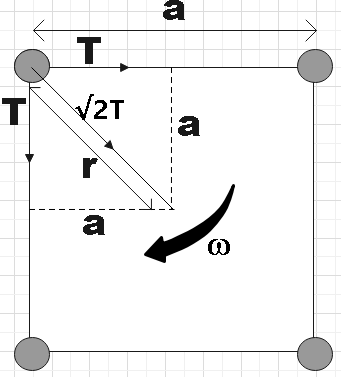
The resultant tension of the string gives the centrifugal force to a sphere, such that
${{T}_{res}}={{F}_{{{c}_{{}}}}}$
The resultant tension due to tension T in the adjacent strings will be,
${{T}_{res}}=\sqrt{{{T}^{2}}+{{T}^{2}}+2{{T}^{2}}\cos 90}$
$\therefore {{T}_{res}}=\sqrt{2}T$ ……………………………………………. (1)
Now, Centrifugal force is given by,
${{F}_{c}}=mr{{\omega }^{2}}$
where, ‘m’ is the mass of the sphere which is given 1kg according to the question.
‘r’ is the radius of the circle, which can also be written as the distance between the mass and center of the square.
‘$\omega $’ is angular velocity.
According to the question,
$\omega =\dfrac{1}{2\pi }\,{rev}/{sec}\;=\dfrac{1}{2\pi }\,{\times \,2\pi \,rad}/{sec}\;={1\,rad}/{sec}\;$
And radius of the circle is equal to the half of the diagonal of a square, which is
$\begin{align}
& \text{Radius of Circle = }\dfrac{1}{2}\times (\text{Diagonal of Square}) \\
& \Rightarrow \text{Radius of Circle = }\dfrac{1}{2}\times (\sqrt{{{a}^{2}}+{{a}^{2}}}) \\
& \Rightarrow \text{Radius of Circle = }\dfrac{1}{2}\times (\sqrt{2{{a}^{2}}}) \\
& \Rightarrow \text{Radius of Circle = }\dfrac{1}{2}\times (\sqrt{2}a) \\
& \therefore \text{Radius of Circle = }\dfrac{a}{\sqrt{2}} \\
\end{align}$
Since, we know the mass, radius, and angular velocity, so the centrifugal force can be found by substituting the value in the force equation, which is shown below:
$\begin{align}
& {{F}_{c}}=(1\times \dfrac{a}{\sqrt{2}}\times {{1}^{2}})\,N \\
& \therefore {{F}_{c}}=\dfrac{a}{\sqrt{2}}\,N \\
\end{align}$………………………………………….. (2)
Hence, the tension in the connected strings can be obtained by equating equations (1) and (2). So,
$\sqrt{2}T=\dfrac{a}{\sqrt{2}}$
$T=\dfrac{a}{2}$
Therefore, the correct answer is Option (B).
Note:
This type of question is frequently asked in exams, where in place of giving the diagram all the details are explained in the question. After reading the question properly, it becomes easy to imagine the diagram of this question, which will help to get the answer easily. But if the question is not understood properly, then imagining the diagram becomes difficult due to which reaching the answer becomes difficult.
Formula used:
$F=mr{{\omega }^{2}}$
Complete answer:
4 point-size steel spheres each of mass 1 kg are placed on a turntable and are connected by 4 strings, each of length a to form a square, such that every sphere is connected to two strings that are right angled to each other.
The resultant tension of the string gives the centrifugal force to a sphere, such that
${{T}_{res}}={{F}_{{{c}_{{}}}}}$
The resultant tension due to tension T in the adjacent strings will be,
${{T}_{res}}=\sqrt{{{T}^{2}}+{{T}^{2}}+2{{T}^{2}}\cos 90}$
$\therefore {{T}_{res}}=\sqrt{2}T$ ……………………………………………. (1)
Now, Centrifugal force is given by,
${{F}_{c}}=mr{{\omega }^{2}}$
where, ‘m’ is the mass of the sphere which is given 1kg according to the question.
‘r’ is the radius of the circle, which can also be written as the distance between the mass and center of the square.
‘$\omega $’ is angular velocity.
According to the question,
$\omega =\dfrac{1}{2\pi }\,{rev}/{sec}\;=\dfrac{1}{2\pi }\,{\times \,2\pi \,rad}/{sec}\;={1\,rad}/{sec}\;$
And radius of the circle is equal to the half of the diagonal of a square, which is
$\begin{align}
& \text{Radius of Circle = }\dfrac{1}{2}\times (\text{Diagonal of Square}) \\
& \Rightarrow \text{Radius of Circle = }\dfrac{1}{2}\times (\sqrt{{{a}^{2}}+{{a}^{2}}}) \\
& \Rightarrow \text{Radius of Circle = }\dfrac{1}{2}\times (\sqrt{2{{a}^{2}}}) \\
& \Rightarrow \text{Radius of Circle = }\dfrac{1}{2}\times (\sqrt{2}a) \\
& \therefore \text{Radius of Circle = }\dfrac{a}{\sqrt{2}} \\
\end{align}$
Since, we know the mass, radius, and angular velocity, so the centrifugal force can be found by substituting the value in the force equation, which is shown below:
$\begin{align}
& {{F}_{c}}=(1\times \dfrac{a}{\sqrt{2}}\times {{1}^{2}})\,N \\
& \therefore {{F}_{c}}=\dfrac{a}{\sqrt{2}}\,N \\
\end{align}$………………………………………….. (2)
Hence, the tension in the connected strings can be obtained by equating equations (1) and (2). So,
$\sqrt{2}T=\dfrac{a}{\sqrt{2}}$
$T=\dfrac{a}{2}$
Therefore, the correct answer is Option (B).
Note:
This type of question is frequently asked in exams, where in place of giving the diagram all the details are explained in the question. After reading the question properly, it becomes easy to imagine the diagram of this question, which will help to get the answer easily. But if the question is not understood properly, then imagining the diagram becomes difficult due to which reaching the answer becomes difficult.
Recently Updated Pages
Master Class 11 Computer Science: Engaging Questions & Answers for Success

Master Class 11 Business Studies: Engaging Questions & Answers for Success
Master Class 11 Economics: Engaging Questions & Answers for Success
Master Class 11 English: Engaging Questions & Answers for Success
Master Class 11 Maths: Engaging Questions & Answers for Success
Master Class 11 Biology: Engaging Questions & Answers for Success
Trending doubts
One Metric ton is equal to kg A 10000 B 1000 C 100 class 11 physics CBSE
There are 720 permutations of the digits 1 2 3 4 5 class 11 maths CBSE
Discuss the various forms of bacteria class 11 biology CBSE
Draw a diagram of a plant cell and label at least eight class 11 biology CBSE
State the laws of reflection of light
Explain zero factorial class 11 maths CBSE