




Given \[y=-2{{\left( x+4 \right)}^{2}}-3\], how do you find the vertex and axis of symmetry?
Answer
 Verified
564.6k+ views
Hint: From the question we have been asked to find the vertex and axis of symmetry of a parabola. To solve this question, we will use the formula of standard form parabola in vertex form which is \[y=a{{\left( x-h \right)}^{2}}+k\]. Here in this standard form \[(h,k)\] is the vertex. For finding the axis of symmetry of the parabola we will use the principle which is “the axis of symmetry passes through the vertex”. In this way we will find the solution to the given question.
Complete step-by-step answer:
So, firstly from the basic formula for the standard form of parabola in vertex form is \[y=a{{\left( x-h \right)}^{2}}+k\].
Here in this form the coordinates of the vertex are \[(h,k)\].
Now, we will reduce the given parabola equation into the standard form. So, the equation will be simplified as follows.
\[\Rightarrow y=a{{\left( x-h \right)}^{2}}+k\]
\[\Rightarrow y=-2{{\left( x+4 \right)}^{2}}-3\]
\[\Rightarrow y=\left( -2 \right){{(x-(-4))}^{2}}+(-3)\]
Now, we compare the reduced equation with standard form of parabola. We get, \[h=-4\] and \[k=-3\].
So, the vertex \[(h,k)\] will be as follows.
\[\Rightarrow (h,k)=\left( -4,-3 \right)\]
Now, we know that for a parabola the axis of symmetry passes through the vertex of the parabola.
Since the coefficient of \[{{\left( x+4 \right)}^{2}}\] is \[-2\] the parabola opens downwards.
So, the equation of axis of symmetry is as follows.
\[\Rightarrow x=h\]
\[\Rightarrow x=-4\]
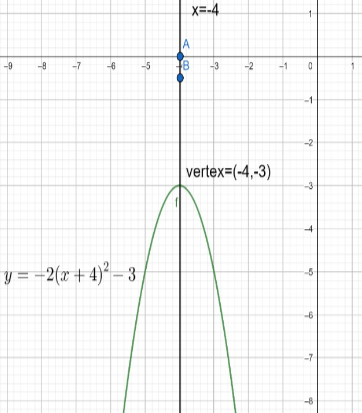
Note: Students must not do any calculation mistakes. Students must not have good knowledge in the concept of parabola and its formulae.
Students should know the vertex form of parabola which is \[\Rightarrow y=a{{\left( x-h \right)}^{2}}+k\]. Students should not be confused that for this vertex form the vertex will be \[(h,k)\] if and only if the given question is converted into \[\Rightarrow y=a{{\left( x-h \right)}^{2}}+k\] form or else our solution will be wrong.
Complete step-by-step answer:
So, firstly from the basic formula for the standard form of parabola in vertex form is \[y=a{{\left( x-h \right)}^{2}}+k\].
Here in this form the coordinates of the vertex are \[(h,k)\].
Now, we will reduce the given parabola equation into the standard form. So, the equation will be simplified as follows.
\[\Rightarrow y=a{{\left( x-h \right)}^{2}}+k\]
\[\Rightarrow y=-2{{\left( x+4 \right)}^{2}}-3\]
\[\Rightarrow y=\left( -2 \right){{(x-(-4))}^{2}}+(-3)\]
Now, we compare the reduced equation with standard form of parabola. We get, \[h=-4\] and \[k=-3\].
So, the vertex \[(h,k)\] will be as follows.
\[\Rightarrow (h,k)=\left( -4,-3 \right)\]
Now, we know that for a parabola the axis of symmetry passes through the vertex of the parabola.
Since the coefficient of \[{{\left( x+4 \right)}^{2}}\] is \[-2\] the parabola opens downwards.
So, the equation of axis of symmetry is as follows.
\[\Rightarrow x=h\]
\[\Rightarrow x=-4\]
Note: Students must not do any calculation mistakes. Students must not have good knowledge in the concept of parabola and its formulae.
Students should know the vertex form of parabola which is \[\Rightarrow y=a{{\left( x-h \right)}^{2}}+k\]. Students should not be confused that for this vertex form the vertex will be \[(h,k)\] if and only if the given question is converted into \[\Rightarrow y=a{{\left( x-h \right)}^{2}}+k\] form or else our solution will be wrong.
Recently Updated Pages
Three beakers labelled as A B and C each containing 25 mL of water were taken A small amount of NaOH anhydrous CuSO4 and NaCl were added to the beakers A B and C respectively It was observed that there was an increase in the temperature of the solutions contained in beakers A and B whereas in case of beaker C the temperature of the solution falls Which one of the following statements isarecorrect i In beakers A and B exothermic process has occurred ii In beakers A and B endothermic process has occurred iii In beaker C exothermic process has occurred iv In beaker C endothermic process has occurred

Master Class 11 Social Science: Engaging Questions & Answers for Success
Master Class 11 Physics: Engaging Questions & Answers for Success
Master Class 11 Maths: Engaging Questions & Answers for Success
Master Class 11 Economics: Engaging Questions & Answers for Success
Master Class 11 Computer Science: Engaging Questions & Answers for Success
Three beakers labelled as A B and C each containing 25 mL of water were taken A small amount of NaOH anhydrous CuSO4 and NaCl were added to the beakers A B and C respectively It was observed that there was an increase in the temperature of the solutions contained in beakers A and B whereas in case of beaker C the temperature of the solution falls Which one of the following statements isarecorrect i In beakers A and B exothermic process has occurred ii In beakers A and B endothermic process has occurred iii In beaker C exothermic process has occurred iv In beaker C endothermic process has occurred
Master Class 11 Social Science: Engaging Questions & Answers for Success
Master Class 11 Physics: Engaging Questions & Answers for Success
Trending doubts
One Metric ton is equal to kg A 10000 B 1000 C 100 class 11 physics CBSE
There are 720 permutations of the digits 1 2 3 4 5 class 11 maths CBSE
State and prove Bernoullis theorem class 11 physics CBSE
Difference Between Prokaryotic Cells and Eukaryotic Cells
1 Quintal is equal to a 110 kg b 10 kg c 100kg d 1000 class 11 physics CBSE
Which among the following are examples of coming together class 11 social science CBSE