




Given $x=2\cot t$ and $y=2{{\sin }^{2}}t$ for $0 < t < \dfrac{\pi }{2}$ , how do you find the Cartesian equation for this curve and state the domain?
Answer
 Verified
577.2k+ views
Hint: To find the Cartesian equation for this curve, we have to find ${{\cot }^{2}}t$ from $x=2\cot t$ and ${{\csc }^{2}}t$ from $y=2{{\sin }^{2}}t$ so that we can substitute these in the formula ${{\csc }^{2}}t-{{\cot }^{2}}t=1$ . Then we will simplify the equation for y. To find a domain, we know that domain of a function is the set of all possible inputs for the function.
Complete step-by-step solution:
We are given that $x=2\cot t$ and $y=2{{\sin }^{2}}t$ for $0 < t < \dfrac{\pi }{2}$ . Let us consider $x=2\cot t$ . From this, we can find $\cot t$ as follows.
$\begin{align}
& x=2\cot t \\
& \Rightarrow \cot t=\dfrac{x}{2}...\left( i \right) \\
\end{align}$
Now, let us find ${{\cot }^{2}}t$ by squaring equation (i). We will get
$\begin{align}
& \Rightarrow {{\left( \cot t \right)}^{2}}={{\left( \dfrac{x}{2} \right)}^{2}} \\
& \Rightarrow {{\cot }^{2}}t=\dfrac{{{x}^{2}}}{4}...\left( ii \right) \\
\end{align}$
Now, let us consider $y=2{{\sin }^{2}}t$ . We know that $\csc x=\dfrac{1}{\sin x}$ . Hence, we can find ${{\csc }^{2}}t$ as follows.
$\begin{align}
& y=2{{\sin }^{2}}t \\
& \Rightarrow {{\sin }^{2}}t=\dfrac{y}{2} \\
& \Rightarrow {{\csc }^{2}}t=\dfrac{1}{{{\sin }^{2}}t}=\dfrac{2}{y}...\left( iii \right) \\
\end{align}$
We know that ${{\csc }^{2}}t-{{\cot }^{2}}t=1$ . Hence from (ii) and (iii), we can write
$\dfrac{2}{y}-\dfrac{{{x}^{2}}}{4}=1$
We have to form an equation in y by solving the above equation. Let us take the second term of LHS to the RHS.
$\Rightarrow \dfrac{2}{y}=1+\dfrac{{{x}^{2}}}{4}$
Now, we have to take the reciprocal of the above equation.
$\begin{align}
& \Rightarrow \dfrac{1}{\dfrac{2}{y}}=\dfrac{1}{1+\dfrac{{{x}^{2}}}{4}} \\
& \Rightarrow \dfrac{y}{2}=\dfrac{1}{1+\dfrac{{{x}^{2}}}{4}} \\
\end{align}$
Let us solve the denominator at the RHS of the above equation.
$\begin{align}
& \Rightarrow \dfrac{y}{2}=\dfrac{1}{\dfrac{4+{{x}^{2}}}{4}} \\
& \Rightarrow \dfrac{y}{2}=\dfrac{4}{4+{{x}^{2}}} \\
\end{align}$
We have to take 2 from LHS to RHS.
$\begin{align}
& \Rightarrow y=2\times \dfrac{4}{4+{{x}^{2}}} \\
& \Rightarrow y=\dfrac{8}{4+{{x}^{2}}}...\left( iv \right) \\
\end{align}$
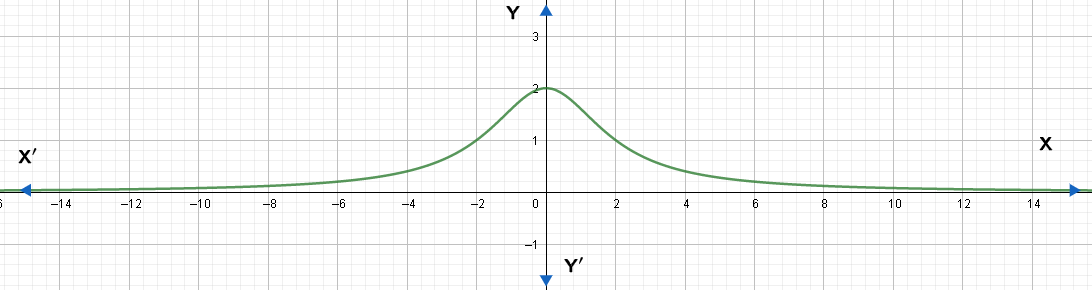
Hence, the required Cartesian equation is $y=\dfrac{8}{4+{{x}^{2}}}$ .
Now, let us find the domain. We know that the domain of a function is the set of all possible inputs for the function. Hence, for the above equation, all real values are possible. Hence, the domain of the function is $x\in R$ .
We can draw a graph of equation (iv) for different values of x.
Note: Students must know trigonometric identities to solve these problems. We can also draw a graph of $y=\dfrac{8}{4+{{x}^{2}}}$ by substituting different real values for x and finding the corresponding y values. The graph obtained is shown below.
Complete step-by-step solution:
We are given that $x=2\cot t$ and $y=2{{\sin }^{2}}t$ for $0 < t < \dfrac{\pi }{2}$ . Let us consider $x=2\cot t$ . From this, we can find $\cot t$ as follows.
$\begin{align}
& x=2\cot t \\
& \Rightarrow \cot t=\dfrac{x}{2}...\left( i \right) \\
\end{align}$
Now, let us find ${{\cot }^{2}}t$ by squaring equation (i). We will get
$\begin{align}
& \Rightarrow {{\left( \cot t \right)}^{2}}={{\left( \dfrac{x}{2} \right)}^{2}} \\
& \Rightarrow {{\cot }^{2}}t=\dfrac{{{x}^{2}}}{4}...\left( ii \right) \\
\end{align}$
Now, let us consider $y=2{{\sin }^{2}}t$ . We know that $\csc x=\dfrac{1}{\sin x}$ . Hence, we can find ${{\csc }^{2}}t$ as follows.
$\begin{align}
& y=2{{\sin }^{2}}t \\
& \Rightarrow {{\sin }^{2}}t=\dfrac{y}{2} \\
& \Rightarrow {{\csc }^{2}}t=\dfrac{1}{{{\sin }^{2}}t}=\dfrac{2}{y}...\left( iii \right) \\
\end{align}$
We know that ${{\csc }^{2}}t-{{\cot }^{2}}t=1$ . Hence from (ii) and (iii), we can write
$\dfrac{2}{y}-\dfrac{{{x}^{2}}}{4}=1$
We have to form an equation in y by solving the above equation. Let us take the second term of LHS to the RHS.
$\Rightarrow \dfrac{2}{y}=1+\dfrac{{{x}^{2}}}{4}$
Now, we have to take the reciprocal of the above equation.
$\begin{align}
& \Rightarrow \dfrac{1}{\dfrac{2}{y}}=\dfrac{1}{1+\dfrac{{{x}^{2}}}{4}} \\
& \Rightarrow \dfrac{y}{2}=\dfrac{1}{1+\dfrac{{{x}^{2}}}{4}} \\
\end{align}$
Let us solve the denominator at the RHS of the above equation.
$\begin{align}
& \Rightarrow \dfrac{y}{2}=\dfrac{1}{\dfrac{4+{{x}^{2}}}{4}} \\
& \Rightarrow \dfrac{y}{2}=\dfrac{4}{4+{{x}^{2}}} \\
\end{align}$
We have to take 2 from LHS to RHS.
$\begin{align}
& \Rightarrow y=2\times \dfrac{4}{4+{{x}^{2}}} \\
& \Rightarrow y=\dfrac{8}{4+{{x}^{2}}}...\left( iv \right) \\
\end{align}$
Hence, the required Cartesian equation is $y=\dfrac{8}{4+{{x}^{2}}}$ .
Now, let us find the domain. We know that the domain of a function is the set of all possible inputs for the function. Hence, for the above equation, all real values are possible. Hence, the domain of the function is $x\in R$ .
We can draw a graph of equation (iv) for different values of x.
Note: Students must know trigonometric identities to solve these problems. We can also draw a graph of $y=\dfrac{8}{4+{{x}^{2}}}$ by substituting different real values for x and finding the corresponding y values. The graph obtained is shown below.
Recently Updated Pages
Master Class 5 English: Engaging Questions & Answers for Success

Master Class 5 Maths: Engaging Questions & Answers for Success
Master Class 5 Social Science: Engaging Questions & Answers for Success
Master Class 5 Science: Engaging Questions & Answers for Success
Class 5 Question and Answer - Your Ultimate Solutions Guide
Master Class 9 General Knowledge: Engaging Questions & Answers for Success
Trending doubts
One Metric ton is equal to kg A 10000 B 1000 C 100 class 11 physics CBSE
What is cell theory Who formulated it class 11 biology CBSE
Phyllotaxy is the arrangement of ALeaflets BLeaves class 11 biology CBSE
Difference Between Prokaryotic Cells and Eukaryotic Cells
The symbiotic association of fungi and algae is called class 11 biology CBSE
Cell theory was formulated by A Schleiden and Schwann class 11 biology CBSE