




Given $\theta =\dfrac{19\pi }{6}$, how do you find $\sin \theta $?
Answer
 Verified
546.3k+ views
Hint: We will use $\sin \left( \dfrac{\pi }{6} \right)=\dfrac{1}{2}$ to get to the right answer. Also, to simplify the angle we will convert \[\dfrac{19\pi }{6}=6\left( \dfrac{\pi }{2} \right)+\dfrac{\pi }{6}\] and solve it further. Moreover, to know about the presence of an angle is in which quadrant we have to take the help of a graph in which each angle will be $90{}^\circ $ apart.
Complete step-by-step answer:
We will consider the following diagram to solve this question.
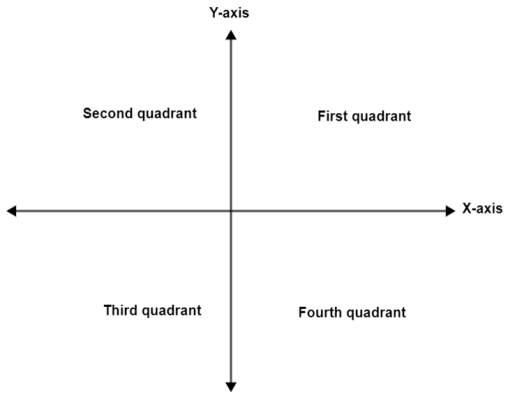
In this question, we can see the four quadrants. Now, we will find out that where the given angle lies in it. For this we need to simplify the angle $\theta =\dfrac{19\pi }{6}$. This can be done as follows,
\[\begin{align}
& \theta =\dfrac{19\pi }{6} \\
& \Rightarrow \theta =\dfrac{18\pi +\pi }{6} \\
& \Rightarrow \theta =\dfrac{6\left( 3\pi \right)+\pi }{6} \\
& \Rightarrow \theta =\dfrac{6\left( 3\pi \right)}{6}+\dfrac{\pi }{6} \\
& \Rightarrow \theta =6\left( \dfrac{\pi }{2} \right)+\dfrac{\pi }{6}\,...(i) \\
\end{align}\]
Now, in order to find $\sin \left( \theta \right)$, we need to substitute equation (i) in it. Therefore, we get$\sin \left( \theta \right)=\sin \left( 6\left( \dfrac{\pi }{2} \right)+\dfrac{\pi }{6} \right)$. At this point we will move $\dfrac{\pi }{2}$ six times in the above figure. Thus, we get the following new diagram,
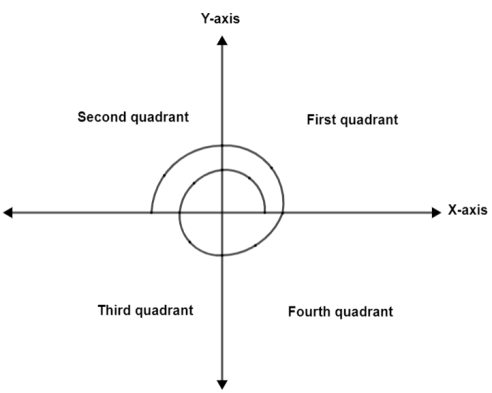
After this we are going to trace $\dfrac{\pi }{6}$ and stop when reached to the third quadrant. Thus, we get
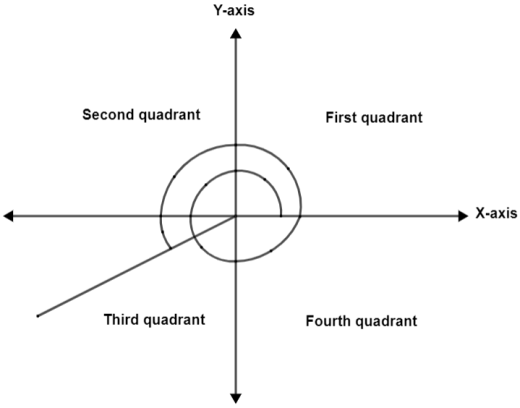
Since, in the third quadrant sine is always negative therefore, we will now have $\sin \left( \theta \right)=-\sin \left( \dfrac{\pi }{6} \right)$. As the value of $\sin \left( \dfrac{\pi }{6} \right)=\dfrac{1}{2}$ thus, we get $\sin \left( \theta \right)=-\dfrac{1}{2}$.
Hence, the value of $\sin \left( \theta \right)=-\dfrac{1}{2}$.
Note:We could have solve the problem with the following process,
\[\begin{align}
& \theta =\dfrac{19\pi }{6} \\
& \Rightarrow \theta =\dfrac{18\pi +\pi }{6} \\
& \Rightarrow \theta =\dfrac{6\left( 3\pi \right)+\pi }{6} \\
& \Rightarrow \theta =\dfrac{6\left( 3\pi \right)}{6}+\dfrac{\pi }{6} \\
& \Rightarrow \theta =3\pi +\dfrac{\pi }{6} \\
\end{align}\]
From this method we would have traced $\pi $ instead of $\dfrac{\pi }{2}$ and get to the same answer. But in this case the formula would have used here be \[\sin \left( 3\pi +\dfrac{\pi }{6} \right)=-\sin \left( \dfrac{\pi }{6} \right)\]. Leading towards the right answer must be tricky here as in trigonometry, one small mistake can give wrong angle. This may result into getting no marks at all. The angle of $\pi $ taken here is $180{}^\circ $. This is how we have traced the above diagrams.
Complete step-by-step answer:
We will consider the following diagram to solve this question.
In this question, we can see the four quadrants. Now, we will find out that where the given angle lies in it. For this we need to simplify the angle $\theta =\dfrac{19\pi }{6}$. This can be done as follows,
\[\begin{align}
& \theta =\dfrac{19\pi }{6} \\
& \Rightarrow \theta =\dfrac{18\pi +\pi }{6} \\
& \Rightarrow \theta =\dfrac{6\left( 3\pi \right)+\pi }{6} \\
& \Rightarrow \theta =\dfrac{6\left( 3\pi \right)}{6}+\dfrac{\pi }{6} \\
& \Rightarrow \theta =6\left( \dfrac{\pi }{2} \right)+\dfrac{\pi }{6}\,...(i) \\
\end{align}\]
Now, in order to find $\sin \left( \theta \right)$, we need to substitute equation (i) in it. Therefore, we get$\sin \left( \theta \right)=\sin \left( 6\left( \dfrac{\pi }{2} \right)+\dfrac{\pi }{6} \right)$. At this point we will move $\dfrac{\pi }{2}$ six times in the above figure. Thus, we get the following new diagram,
After this we are going to trace $\dfrac{\pi }{6}$ and stop when reached to the third quadrant. Thus, we get
Since, in the third quadrant sine is always negative therefore, we will now have $\sin \left( \theta \right)=-\sin \left( \dfrac{\pi }{6} \right)$. As the value of $\sin \left( \dfrac{\pi }{6} \right)=\dfrac{1}{2}$ thus, we get $\sin \left( \theta \right)=-\dfrac{1}{2}$.
Hence, the value of $\sin \left( \theta \right)=-\dfrac{1}{2}$.
Note:We could have solve the problem with the following process,
\[\begin{align}
& \theta =\dfrac{19\pi }{6} \\
& \Rightarrow \theta =\dfrac{18\pi +\pi }{6} \\
& \Rightarrow \theta =\dfrac{6\left( 3\pi \right)+\pi }{6} \\
& \Rightarrow \theta =\dfrac{6\left( 3\pi \right)}{6}+\dfrac{\pi }{6} \\
& \Rightarrow \theta =3\pi +\dfrac{\pi }{6} \\
\end{align}\]
From this method we would have traced $\pi $ instead of $\dfrac{\pi }{2}$ and get to the same answer. But in this case the formula would have used here be \[\sin \left( 3\pi +\dfrac{\pi }{6} \right)=-\sin \left( \dfrac{\pi }{6} \right)\]. Leading towards the right answer must be tricky here as in trigonometry, one small mistake can give wrong angle. This may result into getting no marks at all. The angle of $\pi $ taken here is $180{}^\circ $. This is how we have traced the above diagrams.
Recently Updated Pages
Master Class 10 Computer Science: Engaging Questions & Answers for Success

Master Class 10 General Knowledge: Engaging Questions & Answers for Success
Master Class 10 English: Engaging Questions & Answers for Success
Master Class 10 Social Science: Engaging Questions & Answers for Success
Master Class 10 Maths: Engaging Questions & Answers for Success
Master Class 10 Science: Engaging Questions & Answers for Success
Trending doubts
What is the median of the first 10 natural numbers class 10 maths CBSE
Which women's tennis player has 24 Grand Slam singles titles?
Who is the Brand Ambassador of Incredible India?
Why is there a time difference of about 5 hours between class 10 social science CBSE
Write a letter to the principal requesting him to grant class 10 english CBSE
A moving boat is observed from the top of a 150 m high class 10 maths CBSE