




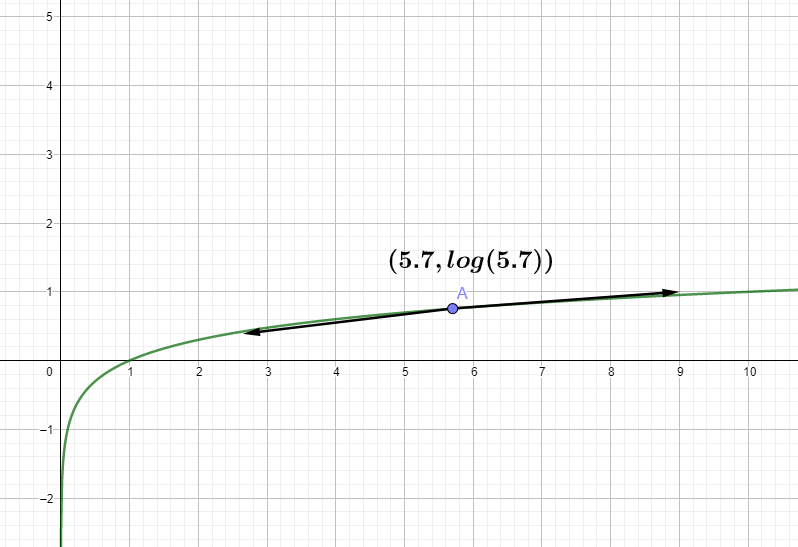
Given the function \[y = \log \left( x \right),{\text{ }}0 < x < 10\] , what is the slope of the graph where \[x = 5.7?\]
Answer
 Verified
478.2k+ views
Hint: In order to solve this question, first we will assume that the \[\log \] is taken to base \[10\] , then using the logarithmic base change rule i.e., \[{\log _b}\left( x \right) = \dfrac{{{{\log }_a}\left( x \right)}}{{{{\log }_a}\left( b \right)}}\] we will change the log base \[10\] to log base \[e\] .After that we will find the differentiation of the function and we know that \[slope = \dfrac{{dy}}{{dx}}\] hence we will get the required slope of the given function.
Complete answer:
The given function is: \[y = \log \left( x \right)\]
Let us assuming that the log is taken to base \[10\]
Now we know that
According to the logarithm base change rule:
The base \[b\] logarithm of \[x\] is base \[a\] logarithm of \[x\] divided by the base \[a\] logarithm of \[b\]
i.e., \[{\log _b}\left( x \right) = \dfrac{{{{\log }_a}\left( x \right)}}{{{{\log }_a}\left( b \right)}}\]
So, here we will change the log base \[10\] to log base \[e\]
Therefore, we get
\[y = {\log _{10}}\left( x \right) = \dfrac{{{{\log }_e}\left( x \right)}}{{{{\log }_e}\left( {10} \right)}}\]
We know that
\[{\log _e}\left( x \right)\] is also written as \[\ln \left( x \right)\]
Therefore, from the above equation we get
\[y = {\log _{10}}\left( x \right) = \dfrac{{\ln \left( x \right)}}{{\ln \left( {10} \right)}}\]
\[ \Rightarrow y = \dfrac{1}{{\ln \left( {10} \right)}} \cdot \ln \left( x \right){\text{ }} - - - \left( i \right)\]
Now we know that,
Slope defines the relationship between the change in y-values with the change in x-values
Mathematically, we can write
\[slope = \dfrac{{dy}}{{dx}}\]
Therefore, for finding the slope we will have to differentiate the equation \[\left( i \right)\]
So, on differentiating equation \[\left( i \right)\] we get
\[ \Rightarrow \dfrac{{dy}}{{dx}} = \dfrac{d}{{dx}}\left( {\dfrac{1}{{\ln \left( {10} \right)}} \cdot \ln \left( x \right)} \right)\]
As \[\dfrac{1}{{\ln \left( {10} \right)}}\] is a constant term, so we can take it out from the differentiation.
Therefore, we get
\[ \Rightarrow \dfrac{{dy}}{{dx}} = \dfrac{1}{{\ln \left( {10} \right)}} \cdot \dfrac{d}{{dx}}\left( {\ln \left( x \right)} \right)\]
As we know that
\[\dfrac{d}{{dx}}\ln \left( x \right) = \dfrac{1}{x}\]
Therefore, we have
\[ \Rightarrow \dfrac{{dy}}{{dx}} = \dfrac{1}{{\ln \left( {10} \right)}} \cdot \dfrac{1}{x}\]
\[ \Rightarrow \dfrac{{dy}}{{dx}} = \dfrac{1}{{x\ln \left( {10} \right)}}\]
Now we know that
\[a\ln \left( b \right) = \ln \left( {{b^a}} \right)\]
Therefore, we get
\[ \Rightarrow \dfrac{{dy}}{{dx}} = \dfrac{1}{{\ln \left( {{{10}^x}} \right)}}\]
It is given that \[x = 5.7\]
On substituting the value, we get
\[ \Rightarrow \dfrac{{dy}}{{dx}} = \dfrac{1}{{\ln \left( {{{10}^{5.7}}} \right)}}\]
\[\ln \left( {{{10}^{5.7}}} \right) \approx 13.124\]
Therefore,
\[ \Rightarrow \dfrac{{dy}}{{dx}} = \dfrac{1}{{13.124}}\]
On dividing, we get
\[ \Rightarrow \dfrac{{dy}}{{dx}} = 0.076\]
Hence, the slope is \[0.076\]
Note:
To solve logarithmic problems, you must know the difference between \[\log \] and \[\ln \] . \[\log \] generally, refers to a logarithm to the base \[10\] and known as common logarithm which is represented by \[{\log _{10}}\left( x \right)\] . while \[\ln \] refers to a logarithm to the base \[e\] and known as natural logarithm which is represented by \[{\log _e}\left( x \right)\]
Complete answer:
The given function is: \[y = \log \left( x \right)\]
Let us assuming that the log is taken to base \[10\]
Now we know that
According to the logarithm base change rule:
The base \[b\] logarithm of \[x\] is base \[a\] logarithm of \[x\] divided by the base \[a\] logarithm of \[b\]
i.e., \[{\log _b}\left( x \right) = \dfrac{{{{\log }_a}\left( x \right)}}{{{{\log }_a}\left( b \right)}}\]
So, here we will change the log base \[10\] to log base \[e\]
Therefore, we get
\[y = {\log _{10}}\left( x \right) = \dfrac{{{{\log }_e}\left( x \right)}}{{{{\log }_e}\left( {10} \right)}}\]
We know that
\[{\log _e}\left( x \right)\] is also written as \[\ln \left( x \right)\]
Therefore, from the above equation we get
\[y = {\log _{10}}\left( x \right) = \dfrac{{\ln \left( x \right)}}{{\ln \left( {10} \right)}}\]
\[ \Rightarrow y = \dfrac{1}{{\ln \left( {10} \right)}} \cdot \ln \left( x \right){\text{ }} - - - \left( i \right)\]
Now we know that,
Slope defines the relationship between the change in y-values with the change in x-values
Mathematically, we can write
\[slope = \dfrac{{dy}}{{dx}}\]
Therefore, for finding the slope we will have to differentiate the equation \[\left( i \right)\]
So, on differentiating equation \[\left( i \right)\] we get
\[ \Rightarrow \dfrac{{dy}}{{dx}} = \dfrac{d}{{dx}}\left( {\dfrac{1}{{\ln \left( {10} \right)}} \cdot \ln \left( x \right)} \right)\]
As \[\dfrac{1}{{\ln \left( {10} \right)}}\] is a constant term, so we can take it out from the differentiation.
Therefore, we get
\[ \Rightarrow \dfrac{{dy}}{{dx}} = \dfrac{1}{{\ln \left( {10} \right)}} \cdot \dfrac{d}{{dx}}\left( {\ln \left( x \right)} \right)\]
As we know that
\[\dfrac{d}{{dx}}\ln \left( x \right) = \dfrac{1}{x}\]
Therefore, we have
\[ \Rightarrow \dfrac{{dy}}{{dx}} = \dfrac{1}{{\ln \left( {10} \right)}} \cdot \dfrac{1}{x}\]
\[ \Rightarrow \dfrac{{dy}}{{dx}} = \dfrac{1}{{x\ln \left( {10} \right)}}\]
Now we know that
\[a\ln \left( b \right) = \ln \left( {{b^a}} \right)\]
Therefore, we get
\[ \Rightarrow \dfrac{{dy}}{{dx}} = \dfrac{1}{{\ln \left( {{{10}^x}} \right)}}\]
It is given that \[x = 5.7\]
On substituting the value, we get
\[ \Rightarrow \dfrac{{dy}}{{dx}} = \dfrac{1}{{\ln \left( {{{10}^{5.7}}} \right)}}\]
\[\ln \left( {{{10}^{5.7}}} \right) \approx 13.124\]
Therefore,
\[ \Rightarrow \dfrac{{dy}}{{dx}} = \dfrac{1}{{13.124}}\]
On dividing, we get
\[ \Rightarrow \dfrac{{dy}}{{dx}} = 0.076\]
Hence, the slope is \[0.076\]
Note:
To solve logarithmic problems, you must know the difference between \[\log \] and \[\ln \] . \[\log \] generally, refers to a logarithm to the base \[10\] and known as common logarithm which is represented by \[{\log _{10}}\left( x \right)\] . while \[\ln \] refers to a logarithm to the base \[e\] and known as natural logarithm which is represented by \[{\log _e}\left( x \right)\]
Recently Updated Pages
Master Class 11 Business Studies: Engaging Questions & Answers for Success

Master Class 11 Economics: Engaging Questions & Answers for Success
Master Class 11 Computer Science: Engaging Questions & Answers for Success
Master Class 11 English: Engaging Questions & Answers for Success
Master Class 11 Maths: Engaging Questions & Answers for Success
Master Class 11 Biology: Engaging Questions & Answers for Success
Trending doubts
One Metric ton is equal to kg A 10000 B 1000 C 100 class 11 physics CBSE
Discuss the various forms of bacteria class 11 biology CBSE
Draw a diagram of a plant cell and label at least eight class 11 biology CBSE
State the laws of reflection of light
Explain zero factorial class 11 maths CBSE
10 examples of friction in our daily life