




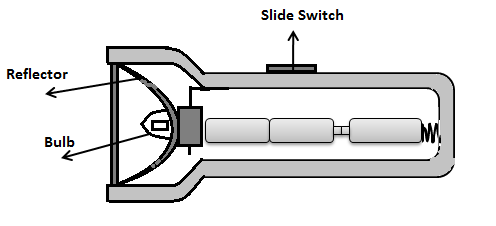
Given the diagram is a torch containing cells. The torch is not glowing when the switch is ON. Now, it is opened to know the reasons. Which of the following statements is correct regarding the reasons?
(i)Bulb of the torch is fused.
(ii)Cells are not connected properly.
(iii)The metal parts of the torch do not make proper contact with the cell.
A. Only (i) and (ii)
B. Only (ii) and (iii)
C. Only (i) and (iii)
D. All (i), (ii), and (iii)
Answer
 Verified
630.6k+ views
Hint: We know the direction of current flow is from cathode to anode of the cell. The reverse flow is not possible from anode to cathode. In the torch, the metal part gets completely compressed after inserting the cells.
Complete step by step answer:
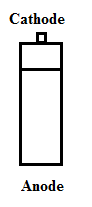
We know that the battery cell has two electrodes: cathode and anode. The part of the cell which has a slight tip is known as cathode and the other part is known as anode. We know the direction of current flow is from cathode to anode.
We know that the reverse flow is not possible from anode to cathode. When we open the torch and see what is shown in the above figure, we can say that the cells of the torch are not properly connected. In the above figure, the two last cells are connected such that the cathode of the both cells are connected to each other. The connection is interrupted at the second cell. Therefore, the statement (ii) seems to be the proper reason.
Also, we know in the torch, the metal part gets completely compressed after inserting the cells. In the above figure, we see the metal part is not making the proper contact with the last cell. Therefore, the statement (iii) can also be the proper reason.
We cannot identify if the wire of the bulb is fused. Therefore, it may be the reason why the bulb is not glowing.
So, the correct answer is “Option D”.
Note:
In torch, the three cells, bulb and sliding switch all are connected in series. If there are any faults in one of these parts, the current flow will be interrupted. Even if the switch is kept OFF, the small amount of current passes through the circuit due to improper contact of the sliding switches. Therefore, if we do not need the torch for a longer time, we improperly arrange the cells to restrict the flow of current.
Complete step by step answer:
We know that the battery cell has two electrodes: cathode and anode. The part of the cell which has a slight tip is known as cathode and the other part is known as anode. We know the direction of current flow is from cathode to anode.
We know that the reverse flow is not possible from anode to cathode. When we open the torch and see what is shown in the above figure, we can say that the cells of the torch are not properly connected. In the above figure, the two last cells are connected such that the cathode of the both cells are connected to each other. The connection is interrupted at the second cell. Therefore, the statement (ii) seems to be the proper reason.
Also, we know in the torch, the metal part gets completely compressed after inserting the cells. In the above figure, we see the metal part is not making the proper contact with the last cell. Therefore, the statement (iii) can also be the proper reason.
We cannot identify if the wire of the bulb is fused. Therefore, it may be the reason why the bulb is not glowing.
So, the correct answer is “Option D”.
Note:
In torch, the three cells, bulb and sliding switch all are connected in series. If there are any faults in one of these parts, the current flow will be interrupted. Even if the switch is kept OFF, the small amount of current passes through the circuit due to improper contact of the sliding switches. Therefore, if we do not need the torch for a longer time, we improperly arrange the cells to restrict the flow of current.
Recently Updated Pages
Master Class 12 Economics: Engaging Questions & Answers for Success

Master Class 12 Social Science: Engaging Questions & Answers for Success
Master Class 12 English: Engaging Questions & Answers for Success
Master Class 12 Maths: Engaging Questions & Answers for Success
Master Class 12 Physics: Engaging Questions & Answers for Success
Master Class 12 Biology: Engaging Questions & Answers for Success
Trending doubts
Draw a labelled sketch of the human eye class 12 physics CBSE
Which are the Top 10 Largest Countries of the World?
Draw ray diagrams each showing i myopic eye and ii class 12 physics CBSE
Which is the correct genotypic ratio of mendel dihybrid class 12 biology CBSE
Differentiate between homogeneous and heterogeneous class 12 chemistry CBSE
Which animal never drinks water in its entire life class 12 biology CBSE