




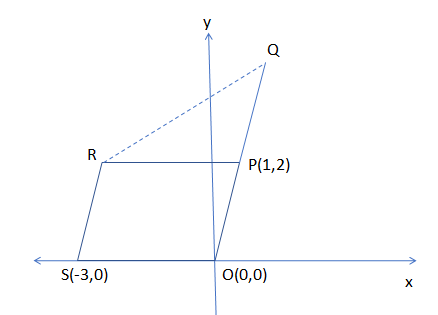
Given O(0,0), P(1,2) and S(-3,0). P divides OQ in the ratio 2:3 and OPRS is a parallelogram. Find the coordinates of Q.
Answer
 Verified
622.2k+ views
Hint: First, proceeding for this, we must know that P is dividing the line segment OQ in the ratio 2:3. Then, we also know the formula named as section formula for the line with end points $A\left( {{x}_{1}},{{y}_{1}} \right)$and $B\left( {{x}_{2}},{{y}_{2}} \right)$ with the intersection point $C\left( {{x}_{3}},{{y}_{3}} \right)$ and ratio of dividing as m:n, then we get${{x}_{3}}=\dfrac{m{{x}_{2}}+n{{x}_{1}}}{m+n}$ and ${{y}_{3}}=\dfrac{m{{y}_{2}}+n{{y}_{1}}}{m+n}$. Then, substituting the values of ${{x}_{1}}$as 0, ${{x}_{3}}$as 1, m as 2, n as 3 and ${{x}_{2}}$as x and by substituting the values of ${{y}_{1}}$as 0, ${{y}_{3}}$as 2, m as 2, n as 3 and ${{y}_{2}}$as y, we get the required values.
Complete step by step answer:
In this question, we are supposed to find the coordinates of Q when O(0,0), P(1,2), and S(-3,0). P divides OQ in the ratio 2:3 and OPRS is a parallelogram.
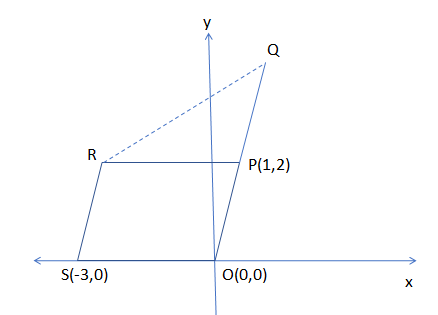
So, before proceeding for this, we must know that P is dividing the line segment OQ in the ratio 2:3.
Now, let us suppose the coordinates of the point Q as (x,y).
Then, we also know the formula named as section formula for the line with end points $A\left( {{x}_{1}},{{y}_{1}} \right)$and $B\left( {{x}_{2}},{{y}_{2}} \right)$ with the intersection point $C\left( {{x}_{3}},{{y}_{3}} \right)$ and ratio of dividing as m:n, then we get:
${{x}_{3}}=\dfrac{m{{x}_{2}}+n{{x}_{1}}}{m+n}$ and ${{y}_{3}}=\dfrac{m{{y}_{2}}+n{{y}_{1}}}{m+n}$
Then, by substituting the values of ${{x}_{1}}$as 0, ${{x}_{3}}$as 1, m as 2, n as 3 and ${{x}_{2}}$as x, we get the expression as:
$1=\dfrac{2x+3\left( 0 \right)}{2+3}$
Now, by solving the above expression, we get:
$\begin{align}
& 1=\dfrac{2x+0}{5} \\
& \Rightarrow 5=2x \\
& \Rightarrow x=\dfrac{5}{2} \\
\end{align}$
Then, by substituting the values of ${{y}_{1}}$as 0, ${{y}_{3}}$as 2, m as 2, n as 3 and ${{y}_{2}}$as y, we get the expression as:
$2=\dfrac{2y+3\left( 0 \right)}{2+3}$
Now, by solving the above expression, we get:
$\begin{align}
& 2=\dfrac{2y+0}{5} \\
& \Rightarrow 10=2y \\
& \Rightarrow y=\dfrac{10}{2} \\
& \Rightarrow y=5 \\
\end{align}$
So, we get the coordinates of Q as $\left( \dfrac{5}{2},5 \right)$.
Hence, $\left( \dfrac{5}{2},5 \right)$is the required answer.
Note:
Now, to solve these type of the questions we need to know some of the basic of the formula for the section of the line segments. So, the section formula for the line segment with ratio as m:n with end points $A\left( {{x}_{1}},{{y}_{1}} \right)$and $B\left( {{x}_{2}},{{y}_{2}} \right)$ with the intersection point $C\left( {{x}_{3}},{{y}_{3}} \right)$, then we get:
${{x}_{3}}=\dfrac{m{{x}_{2}}+n{{x}_{1}}}{m+n}$ and ${{y}_{3}}=\dfrac{m{{y}_{2}}+n{{y}_{1}}}{m+n}$
Complete step by step answer:
In this question, we are supposed to find the coordinates of Q when O(0,0), P(1,2), and S(-3,0). P divides OQ in the ratio 2:3 and OPRS is a parallelogram.
So, before proceeding for this, we must know that P is dividing the line segment OQ in the ratio 2:3.
Now, let us suppose the coordinates of the point Q as (x,y).
Then, we also know the formula named as section formula for the line with end points $A\left( {{x}_{1}},{{y}_{1}} \right)$and $B\left( {{x}_{2}},{{y}_{2}} \right)$ with the intersection point $C\left( {{x}_{3}},{{y}_{3}} \right)$ and ratio of dividing as m:n, then we get:
${{x}_{3}}=\dfrac{m{{x}_{2}}+n{{x}_{1}}}{m+n}$ and ${{y}_{3}}=\dfrac{m{{y}_{2}}+n{{y}_{1}}}{m+n}$
Then, by substituting the values of ${{x}_{1}}$as 0, ${{x}_{3}}$as 1, m as 2, n as 3 and ${{x}_{2}}$as x, we get the expression as:
$1=\dfrac{2x+3\left( 0 \right)}{2+3}$
Now, by solving the above expression, we get:
$\begin{align}
& 1=\dfrac{2x+0}{5} \\
& \Rightarrow 5=2x \\
& \Rightarrow x=\dfrac{5}{2} \\
\end{align}$
Then, by substituting the values of ${{y}_{1}}$as 0, ${{y}_{3}}$as 2, m as 2, n as 3 and ${{y}_{2}}$as y, we get the expression as:
$2=\dfrac{2y+3\left( 0 \right)}{2+3}$
Now, by solving the above expression, we get:
$\begin{align}
& 2=\dfrac{2y+0}{5} \\
& \Rightarrow 10=2y \\
& \Rightarrow y=\dfrac{10}{2} \\
& \Rightarrow y=5 \\
\end{align}$
So, we get the coordinates of Q as $\left( \dfrac{5}{2},5 \right)$.
Hence, $\left( \dfrac{5}{2},5 \right)$is the required answer.
Note:
Now, to solve these type of the questions we need to know some of the basic of the formula for the section of the line segments. So, the section formula for the line segment with ratio as m:n with end points $A\left( {{x}_{1}},{{y}_{1}} \right)$and $B\left( {{x}_{2}},{{y}_{2}} \right)$ with the intersection point $C\left( {{x}_{3}},{{y}_{3}} \right)$, then we get:
${{x}_{3}}=\dfrac{m{{x}_{2}}+n{{x}_{1}}}{m+n}$ and ${{y}_{3}}=\dfrac{m{{y}_{2}}+n{{y}_{1}}}{m+n}$
Recently Updated Pages
Master Class 11 English: Engaging Questions & Answers for Success

Master Class 11 Social Science: Engaging Questions & Answers for Success
Master Class 11 Maths: Engaging Questions & Answers for Success
Master Class 11 Biology: Engaging Questions & Answers for Success
Master Class 11 Physics: Engaging Questions & Answers for Success
Master Class 11 Chemistry: Engaging Questions & Answers for Success
Trending doubts
Explain the Treaty of Vienna of 1815 class 10 social science CBSE
What is the full form of POSCO class 10 social science CBSE
Define Potential, Developed, Stock and Reserved resources
The diagonals of a rhombus are 10cm and 24cm Find the class 10 maths CBSE
Fill the blanks with proper collective nouns 1 A of class 10 english CBSE
What planets have no moons Which one has only one moon class 10 physics CBSE