




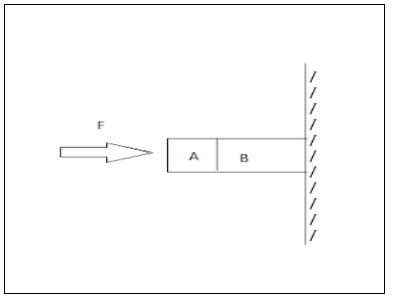
Given in the figure are two blocks A and B of weight $20N$ and $100N$ respectively. These are being pressed against a wall by a force F as shown. If the coefficient of friction between the blocks is $0.1$ and between block B and the wall is $0.15,$ the frictional force applied by the wall on block B is
$
{\text{A. 100N}} \\
{\text{B. 80N}} \\
{\text{C. 120N}} \\
{\text{D. 150N}} \\
$
Answer
 Verified
610.5k+ views
Hint: The force is a push or pull upon an object resulting from the object’s contact with another object. Apply different friction properties on the levelled surface. Here we will use the total force applied on the wall irrespective of the coefficient of friction between the blocks.
Complete step by step answer:
Since both the given masses are in equilibrium, in the vertical direction the static frictional force will be acting on the blocks which are to be found to be balancing the forces.
The weights of the bodies are balanced by the frictional forces, and they are equal to the normal reaction forces, hence the total force is equal to the sum of normal reaction forces in the given conditions.
Let, the force acting by the block A in the vertical direction be ${f_1} = 20N$
Similarly force acting by the block B in the vertical direction be ${f_2} = 100N$
The total force applied by both the blocks on the wall is
$
F = {f_1} + {f_2} \\
\implies F = 20 + 100 \\
\therefore F = 120N \\
$
Hence, from the given multiple choices – the option C is the correct answer.
Note:
Remember the frictional force and the normal force and its properties. Also, remember the difference between the force applied and the friction produced on the levelled and unlevelled surfaces. Since the friction and load are measured in units of force, they cancel each other as a result the unit of coefficient of friction ($\mu = \dfrac{F}{L}$ ) is dimensionless, since both the units in the division cancel each other. Basically there are two types of coefficient of friction.
a) Static coefficient friction – It is applied to the objects which are motionless.
b) Kinetic coefficient friction – It is applied to the objects which are in motion.
Complete step by step answer:
Since both the given masses are in equilibrium, in the vertical direction the static frictional force will be acting on the blocks which are to be found to be balancing the forces.
The weights of the bodies are balanced by the frictional forces, and they are equal to the normal reaction forces, hence the total force is equal to the sum of normal reaction forces in the given conditions.
Let, the force acting by the block A in the vertical direction be ${f_1} = 20N$
Similarly force acting by the block B in the vertical direction be ${f_2} = 100N$
The total force applied by both the blocks on the wall is
$
F = {f_1} + {f_2} \\
\implies F = 20 + 100 \\
\therefore F = 120N \\
$
Hence, from the given multiple choices – the option C is the correct answer.
Note:
Remember the frictional force and the normal force and its properties. Also, remember the difference between the force applied and the friction produced on the levelled and unlevelled surfaces. Since the friction and load are measured in units of force, they cancel each other as a result the unit of coefficient of friction ($\mu = \dfrac{F}{L}$ ) is dimensionless, since both the units in the division cancel each other. Basically there are two types of coefficient of friction.
a) Static coefficient friction – It is applied to the objects which are motionless.
b) Kinetic coefficient friction – It is applied to the objects which are in motion.
Recently Updated Pages
Master Class 12 Economics: Engaging Questions & Answers for Success

Master Class 12 English: Engaging Questions & Answers for Success
Master Class 12 Social Science: Engaging Questions & Answers for Success
Master Class 12 Maths: Engaging Questions & Answers for Success
Master Class 12 Physics: Engaging Questions & Answers for Success
Master Class 11 Social Science: Engaging Questions & Answers for Success
Trending doubts
One Metric ton is equal to kg A 10000 B 1000 C 100 class 11 physics CBSE
Difference Between Prokaryotic Cells and Eukaryotic Cells
Two of the body parts which do not appear in MRI are class 11 biology CBSE
1 ton equals to A 100 kg B 1000 kg C 10 kg D 10000 class 11 physics CBSE
Draw a diagram of nephron and explain its structur class 11 biology CBSE
10 examples of friction in our daily life