




Given figures labelled by A and B represent
A B (1) Isogametes of Rhizopus Heterogametes of Fucus (2) Isogametes of Cladophora Heterogametes of Pinus (3) Isogametes of Rhizopus Heterogametes of angiosperms (4) Isogametes of Chara Heterogametes of Synchytrium
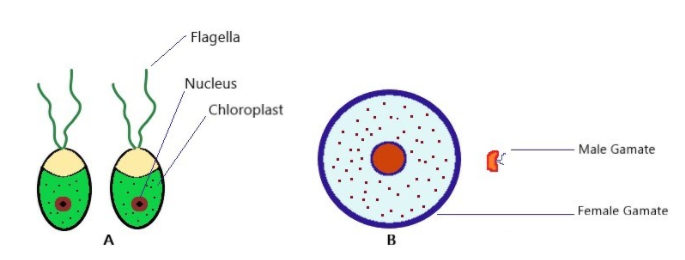
| A | B | |
| (1) | Isogametes of Rhizopus | Heterogametes of Fucus |
| (2) | Isogametes of Cladophora | Heterogametes of Pinus |
| (3) | Isogametes of Rhizopus | Heterogametes of angiosperms |
| (4) | Isogametes of Chara | Heterogametes of Synchytrium |
Answer
 Verified
646.5k+ views
Hint: Iso means similar. Therefore isogametes means gametes that are similar in size and form to the one that unites during the time of fertilization. No difference is seen in terms of size, sex or structure. Heterogametes do differ in size and form. Hence, they are morphologically dissimilar and so the male and female gametes can be distinguished.
Complete answer:
As the hint suggests, the isogametes are the same in appearance. So, the picture on the left is a depiction of isogamy whereas the picture on right is heterogametic.
1) Isogametes of Rhizopus and Heterogametes of Fucus- Rhizopus is a saprophytic fungus which can grow as filamentous branching hyphae. In oomycetes of Fucus, large non-motile female fuses with motile male gametes. This option is the most suitable one in terms of appearance and the definition as well.
2) Cladophora is reticulated filamentous green algae. In this, the sexual reproduction is isogamous. Pinus looks like a cone and they are the largest genus of conifers.
3) Angiosperms make up the majority of all plants on Earth. They are vascular plants. Their seeds can be found in a flower.
4) Chara is a freshwater green algae which can be found in submerged shallow water. Synchytrium is simple parasitic fungi. It is unicellular in nature.
Therefore option 1 is the most appropriate and correct option.
Note: Rhizopus are cosmopolitan in nature which can be commonly found in soil, decaying fruit and vegetables. Rhizopus has many different species. There are some morphological characteristics like the sporangia diameter, length of rhizoids, shape, size and texture which helps to differentiate each of its species.
Complete answer:
As the hint suggests, the isogametes are the same in appearance. So, the picture on the left is a depiction of isogamy whereas the picture on right is heterogametic.
1) Isogametes of Rhizopus and Heterogametes of Fucus- Rhizopus is a saprophytic fungus which can grow as filamentous branching hyphae. In oomycetes of Fucus, large non-motile female fuses with motile male gametes. This option is the most suitable one in terms of appearance and the definition as well.
2) Cladophora is reticulated filamentous green algae. In this, the sexual reproduction is isogamous. Pinus looks like a cone and they are the largest genus of conifers.
3) Angiosperms make up the majority of all plants on Earth. They are vascular plants. Their seeds can be found in a flower.
4) Chara is a freshwater green algae which can be found in submerged shallow water. Synchytrium is simple parasitic fungi. It is unicellular in nature.
Therefore option 1 is the most appropriate and correct option.
Note: Rhizopus are cosmopolitan in nature which can be commonly found in soil, decaying fruit and vegetables. Rhizopus has many different species. There are some morphological characteristics like the sporangia diameter, length of rhizoids, shape, size and texture which helps to differentiate each of its species.
Recently Updated Pages
Write structures of the following compounds i 2 Chloro3methylpentane class 11 chemistry CBSE

What is BLO What is the full form of BLO class 8 social science CBSE
Explain the Treaty of Vienna of 1815 class 10 social science CBSE
A Paragraph on Pollution in about 100-150 Words
XIX+XXX A 49 B 51 C 55 D 44 class 5 maths CBSE
If x a + bt + ct2 where x is in meters and t is in class 11 physics CBSE
Trending doubts
One Metric ton is equal to kg A 10000 B 1000 C 100 class 11 physics CBSE
Find the value of the expression given below sin 30circ class 11 maths CBSE
Draw a diagram of nephron and explain its structur class 11 biology CBSE
10 examples of friction in our daily life
Draw a diagram of a plant cell and label at least eight class 11 biology CBSE
Proton was discovered by A Thomson B Rutherford C Chadwick class 11 chemistry CBSE