




Given figure is of filamentous blue-green alga Nostoc.
Identify the parts marked as A and B and select the correct option.
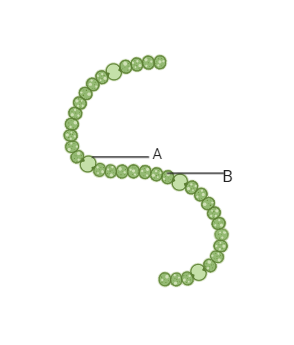
A - Heterocyst, B - Mucilaginous sheath
A - Vegetative cell, B - Mucilaginous sheath
A - Trichomes, B - Cell wall
A - Mucilaginous sheath, B - Heterocyst
Answer
 Verified
608.4k+ views
Hint:Blue-green algae or cyanobacteria are capable of fixing the environment's nitrogen and can be present both in terrestrial and marine settings. It can be seen in gelatinous colonies, and the mucilage sheath covers the filaments.
Complete answer:
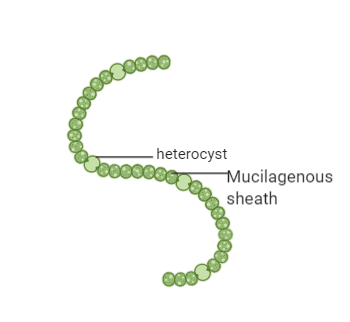
Here A – heterocyst and B- Mucilaginous sheath
A heterocyst is a cyanobacterial cell that is segregated and conducts nitrogen fixation. Under aerobic conditions, the heterocysts serve as the sites for the fixation of nitrogen. In response to a lack of fixed nitrogen, they are created.
The mucilaginous sheath has a major role that covers and protects the cells from damage, resulting in cells that are immune to cell degradation. Before entering the process of DNA extraction, removing the mucilaginous sheath becomes a crucial step.
Nostoc is a cyanobacteria genus within the Nostocaceae family. Blue-green algae are primarily found in various environments that form colonies in a gelatin sheath consisting of filaments of moniliform cells. Nostoc is often found in damp rocks, soil, lakes, and springs at the bottom, and occasionally in marine waters. It was given the name Nostoc by Paracelsus. The blue-green bacteria are cyanobacteria or blue-green algae. Some of them are rod-shaped, some are circular, and some of them are filamentous.
Cyanobacteria (also referred to as blue-green algae) are similar to green plants and have chlorophyll and are photosynthetic autotrophs. Cyanobacteria are fresh-water marine or terrestrial algae, unicellular, colonial, or filamentous. A gelatinous sheath usually covers the colonies. In contaminated bodies of water, they also form blooms. Some of these species, such as Nostoc and Anabaena, are able to fix atmospheric nitrogen in complex cells called heterocysts.
Option- B" A - heterocyst, B- Mucilagenous sheath" is therefore the correct alternative.
Note: The thread-like structure of fungi that can be contained in soil and other substrates are mycelium. Hypha is the long structure of the fungus, filament-like and collectively known as mycelium. A colony is made up of two or more groups of organisms that live or are related to each other.
Complete answer:
Here A – heterocyst and B- Mucilaginous sheath
A heterocyst is a cyanobacterial cell that is segregated and conducts nitrogen fixation. Under aerobic conditions, the heterocysts serve as the sites for the fixation of nitrogen. In response to a lack of fixed nitrogen, they are created.
The mucilaginous sheath has a major role that covers and protects the cells from damage, resulting in cells that are immune to cell degradation. Before entering the process of DNA extraction, removing the mucilaginous sheath becomes a crucial step.
Nostoc is a cyanobacteria genus within the Nostocaceae family. Blue-green algae are primarily found in various environments that form colonies in a gelatin sheath consisting of filaments of moniliform cells. Nostoc is often found in damp rocks, soil, lakes, and springs at the bottom, and occasionally in marine waters. It was given the name Nostoc by Paracelsus. The blue-green bacteria are cyanobacteria or blue-green algae. Some of them are rod-shaped, some are circular, and some of them are filamentous.
Cyanobacteria (also referred to as blue-green algae) are similar to green plants and have chlorophyll and are photosynthetic autotrophs. Cyanobacteria are fresh-water marine or terrestrial algae, unicellular, colonial, or filamentous. A gelatinous sheath usually covers the colonies. In contaminated bodies of water, they also form blooms. Some of these species, such as Nostoc and Anabaena, are able to fix atmospheric nitrogen in complex cells called heterocysts.
Option- B" A - heterocyst, B- Mucilagenous sheath" is therefore the correct alternative.
Note: The thread-like structure of fungi that can be contained in soil and other substrates are mycelium. Hypha is the long structure of the fungus, filament-like and collectively known as mycelium. A colony is made up of two or more groups of organisms that live or are related to each other.
Recently Updated Pages
Master Class 12 Business Studies: Engaging Questions & Answers for Success

Master Class 12 Chemistry: Engaging Questions & Answers for Success
Master Class 12 Biology: Engaging Questions & Answers for Success
Class 12 Question and Answer - Your Ultimate Solutions Guide
Master Class 11 English: Engaging Questions & Answers for Success
Master Class 11 Social Science: Engaging Questions & Answers for Success
Trending doubts
Which are the Top 10 Largest Countries of the World?
Draw a labelled sketch of the human eye class 12 physics CBSE
Differentiate between homogeneous and heterogeneous class 12 chemistry CBSE
Differentiate between Pyramid of energy and pyramid class 12 biology CBSE
Why is the cell called the structural and functional class 12 biology CBSE
Draw the diagram of the pyramid of energy Explain In class 12 biology CBSE