




Given equation \[y = 3x - 3\]
Answer
 Verified
587.7k+ views
Hint:
As we know that the slope intercept form is \[y = mx + c\], where y= y coordinate, x= x coordinate, m=slope, c=y intercept. Now we will take random values of x to get values of y, and then we will plot it in a graph in the form of coordinates that is (x, y). Also by comparing it with the value of c we get the value of intercepts.
Complete step by step solution:
By comparing the given equation with standard equation form that is \[y = mx + c\], we get slope \[\left( m \right) = 3\]
where + sign indicates the increasing nature of slope. Now, for random values of x, we find value of y
So, when \[x = 1\], putting this value of \[x\] in original equation we get \[y{\text{ }}as{\text{ }}y = 3 \times 1 - 3 = 0\].
So, our first coordinate is \[\left( {1,0} \right)\]
Now, when \[y = - 3\], we get \[{\text{x }}as{\text{ x}} = \dfrac{{ - 3 + 3}}{3} = 0\]
The second coordinate is \[\left( {0, - 3} \right)\]
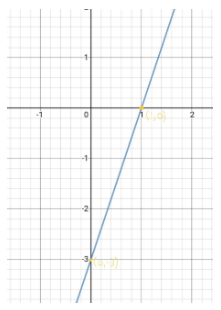
Now, we will plot both coordinates in x-y plane and join both of these coordinates to get our required graph. As we can see that point \[\left( {1,0} \right)\] lies on x-axis and point \[\left( {0, - 3} \right)\] lies on y axis, so when we join we get a graph of increasing slope.
Also by comparing our standard equation with our original equation we get the value of intercept as \[c = - 3\]
Note:
We can cross check our graph by observing our slope. For the given question our slope is positive, so the graph must be of increasing nature. For plotting the graph our coordinates must be real numbers otherwise we are unable to plot it in x-y plane. As it is a linear equation so it will get a straight line and also it contains an intercept so it must not pass through origin.it must cut the negative y axis and positive x axis because it has some y intercept. We can assume rough ideas of the graph by just observing the equation and also crosscheck them.
As we know that the slope intercept form is \[y = mx + c\], where y= y coordinate, x= x coordinate, m=slope, c=y intercept. Now we will take random values of x to get values of y, and then we will plot it in a graph in the form of coordinates that is (x, y). Also by comparing it with the value of c we get the value of intercepts.
Complete step by step solution:
By comparing the given equation with standard equation form that is \[y = mx + c\], we get slope \[\left( m \right) = 3\]
where + sign indicates the increasing nature of slope. Now, for random values of x, we find value of y
So, when \[x = 1\], putting this value of \[x\] in original equation we get \[y{\text{ }}as{\text{ }}y = 3 \times 1 - 3 = 0\].
So, our first coordinate is \[\left( {1,0} \right)\]
Now, when \[y = - 3\], we get \[{\text{x }}as{\text{ x}} = \dfrac{{ - 3 + 3}}{3} = 0\]
The second coordinate is \[\left( {0, - 3} \right)\]
Now, we will plot both coordinates in x-y plane and join both of these coordinates to get our required graph. As we can see that point \[\left( {1,0} \right)\] lies on x-axis and point \[\left( {0, - 3} \right)\] lies on y axis, so when we join we get a graph of increasing slope.
Also by comparing our standard equation with our original equation we get the value of intercept as \[c = - 3\]
Note:
We can cross check our graph by observing our slope. For the given question our slope is positive, so the graph must be of increasing nature. For plotting the graph our coordinates must be real numbers otherwise we are unable to plot it in x-y plane. As it is a linear equation so it will get a straight line and also it contains an intercept so it must not pass through origin.it must cut the negative y axis and positive x axis because it has some y intercept. We can assume rough ideas of the graph by just observing the equation and also crosscheck them.
Recently Updated Pages
Master Class 12 Economics: Engaging Questions & Answers for Success

Master Class 12 English: Engaging Questions & Answers for Success
Master Class 12 Social Science: Engaging Questions & Answers for Success
Master Class 12 Maths: Engaging Questions & Answers for Success
Master Class 12 Physics: Engaging Questions & Answers for Success
Master Class 9 General Knowledge: Engaging Questions & Answers for Success
Trending doubts
One Metric ton is equal to kg A 10000 B 1000 C 100 class 11 physics CBSE
Difference Between Prokaryotic Cells and Eukaryotic Cells
Two of the body parts which do not appear in MRI are class 11 biology CBSE
1 ton equals to A 100 kg B 1000 kg C 10 kg D 10000 class 11 physics CBSE
Draw a diagram of nephron and explain its structur class 11 biology CBSE
10 examples of friction in our daily life