




Given below is the diagram of a bacteriophage.
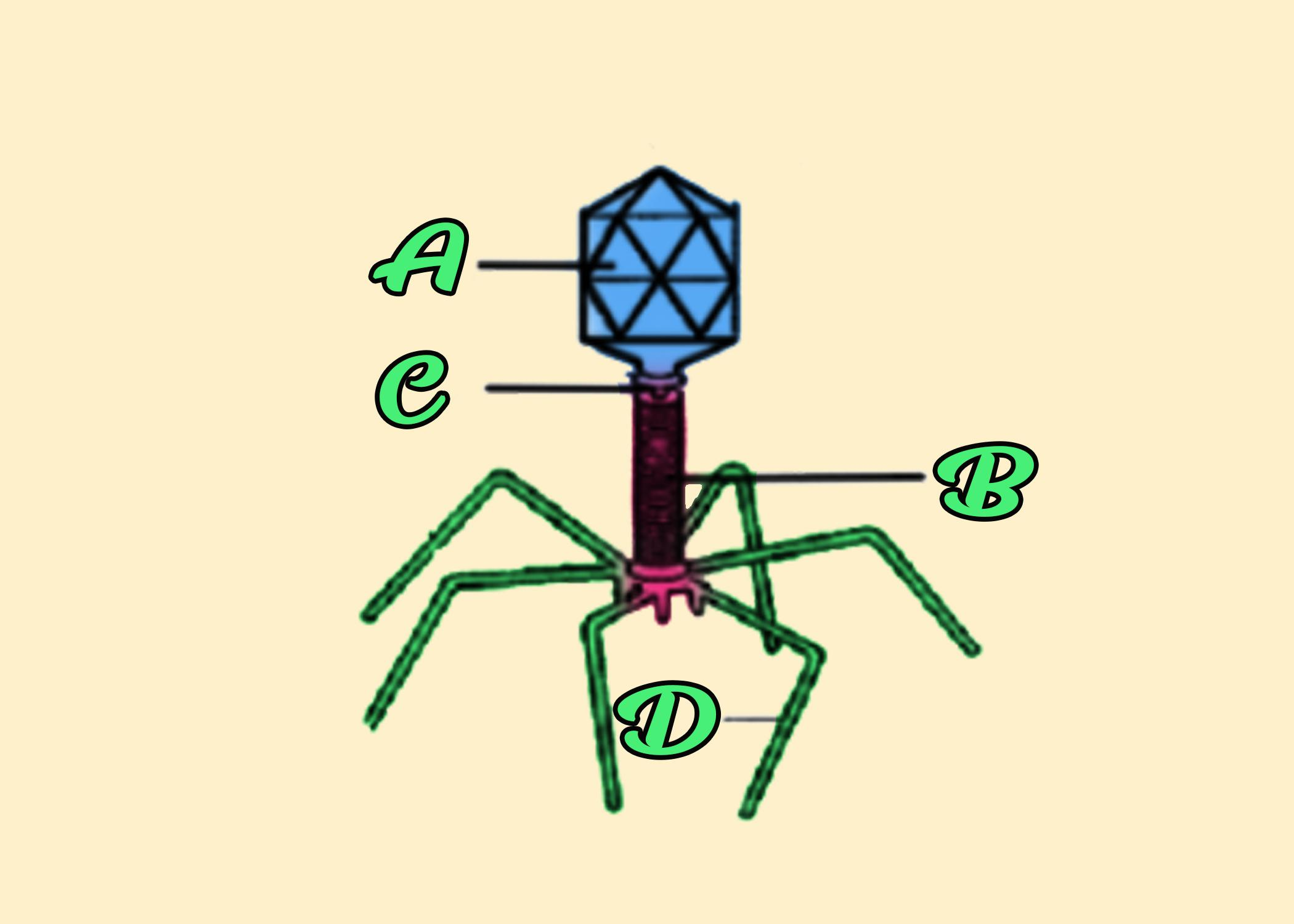
In which one of the options all the four parts A, B, C, and D are correct?
(a)A - Tail fibres, B - Head, C - Sheath, D - Collar
(b)A - Sheath, B - Collar, C - Head, D - Tail fibres
(c)A - Head, B - Sheath, C - Collar, D - Tail fibres
(d)A - Collar, B - Tail fibres, C - Head, D - Sheath
Answer
 Verified
641.1k+ views
Hint: This is the virus that infects bacteria. It is also called bacteria eater and is composed of a nucleic acid molecule that is surrounded by a protein structure.
Complete answer:
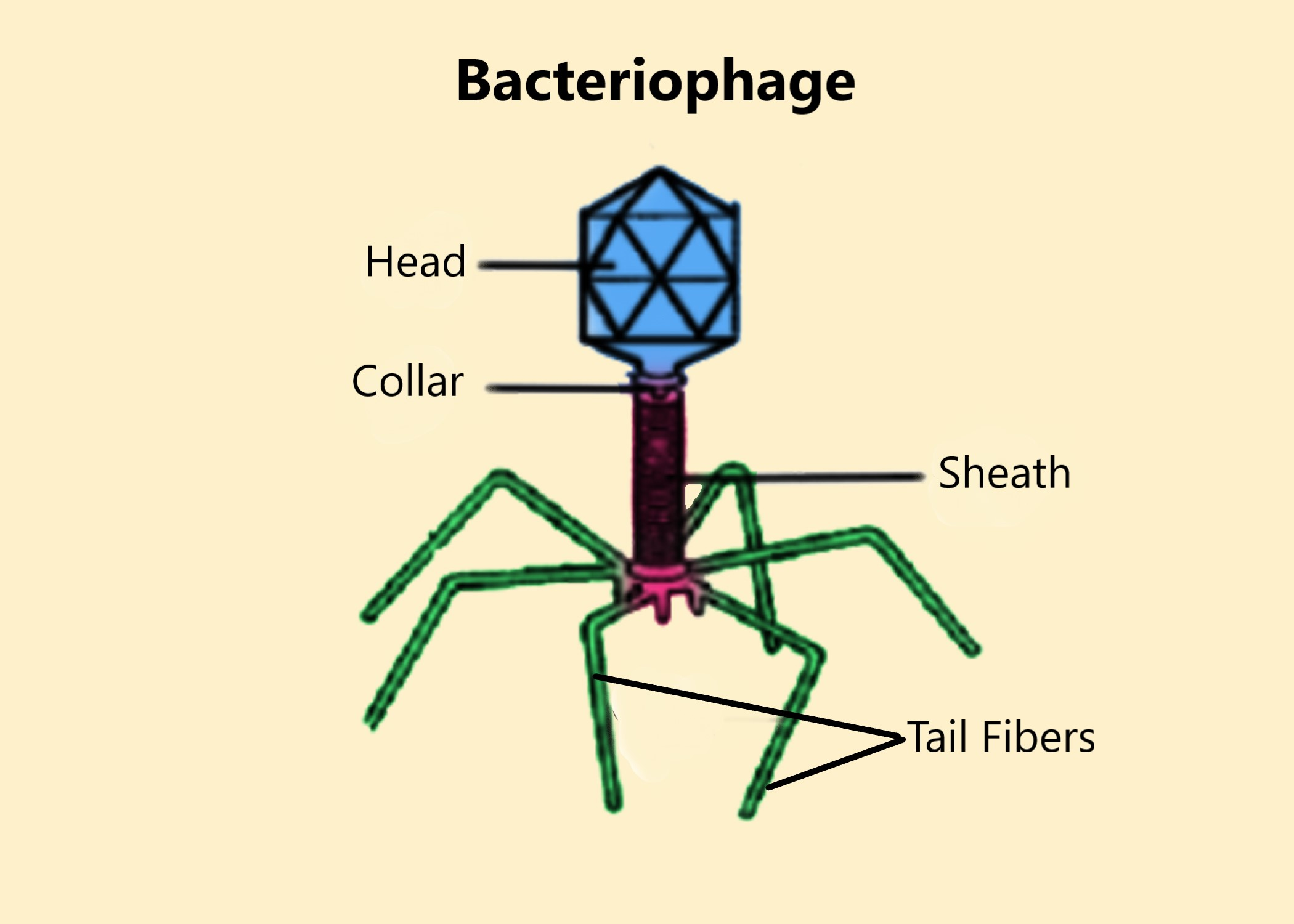
Bacteriophages are a virus that infects bacteria. Phage means eaters of bacteria. The T4 phage that infects the bacterium Escherichia coli consists of a polyhedral head attached to a helical tail, a shape commonly found in bacteriophages. In between the head and tail, there exists a sheath and a collar. Many phages have tail fibres that help the virus to attach to the host cell.
Additional Information:
All the bacteriophages are made up of a nucleic acid molecule surrounded by a protein structure.
A bacteriophage attaches itself to a bacterium (host cell) and infects it. After assembling the new bacteriophages burst out of the bacterium.
It removes a portion of bacterial DNA of the host cell during the infection process and then transfers this DNA into the genome of new host cells.
The bacteriophages are characterised by a high specificity only to bacteria at infection and are very common in all environments. Their number is directly related to the number of bacteria present in the biosphere.
The scientists are estimating that more than 1030 tailed phages are present in the biosphere.
So, the correct answer is option (c) ’ A - Head, B - Sheath, C - Collar, D - Tail fibres’.
Note: Bacteriophages or phages are viruses that infect and use only bacterial resources for their growth and reproduction.
Escherichia virus T4 is that species of bacteriophages that infect only Escherichia coli bacteria.
Phages are common in soil and readily isolated from faeces and sewage, as well as being very abundant in freshwater and oceans with an estimate of more than 10 million virus-like particles in 1 mL of seawater.
Complete answer:
Bacteriophages are a virus that infects bacteria. Phage means eaters of bacteria. The T4 phage that infects the bacterium Escherichia coli consists of a polyhedral head attached to a helical tail, a shape commonly found in bacteriophages. In between the head and tail, there exists a sheath and a collar. Many phages have tail fibres that help the virus to attach to the host cell.
Additional Information:
All the bacteriophages are made up of a nucleic acid molecule surrounded by a protein structure.
A bacteriophage attaches itself to a bacterium (host cell) and infects it. After assembling the new bacteriophages burst out of the bacterium.
It removes a portion of bacterial DNA of the host cell during the infection process and then transfers this DNA into the genome of new host cells.
The bacteriophages are characterised by a high specificity only to bacteria at infection and are very common in all environments. Their number is directly related to the number of bacteria present in the biosphere.
The scientists are estimating that more than 1030 tailed phages are present in the biosphere.
So, the correct answer is option (c) ’ A - Head, B - Sheath, C - Collar, D - Tail fibres’.
Note: Bacteriophages or phages are viruses that infect and use only bacterial resources for their growth and reproduction.
Escherichia virus T4 is that species of bacteriophages that infect only Escherichia coli bacteria.
Phages are common in soil and readily isolated from faeces and sewage, as well as being very abundant in freshwater and oceans with an estimate of more than 10 million virus-like particles in 1 mL of seawater.
Recently Updated Pages
Which will be the least stable resonating structure class 11 chemistry CBSE

How many 5 digit telephone numbers can be construc-class-11-maths-CBSE
How do you find the angle of the resultant vector class 11 physics CBSE
Draw labelled diagram of the following i Gram seed class 11 biology CBSE
1 Quintal is equal to a 110 kg b 10 kg c 100kg d 1000 class 11 physics CBSE
What is the need and importance of classification class 11 biology CBSE
Trending doubts
Find the value of the expression given below sin 30circ class 11 maths CBSE
One Metric ton is equal to kg A 10000 B 1000 C 100 class 11 physics CBSE
10 examples of friction in our daily life
Draw a diagram of a plant cell and label at least eight class 11 biology CBSE
Difference between physical and chemical change class 11 chemistry CBSE
Proton was discovered by A Thomson B Rutherford C Chadwick class 11 chemistry CBSE