



Given an equilateral triangle, how would you find its area using: The Pythagorean Theorem?
Answer
 Verified
531.9k+ views
Hint: Imagine or construct an equilateral triangle. Mark its known values. The angles of an equilateral triangle are always equal to $ 60 $ degrees. We know the regular formula to find the area of any triangle, it is: $ \dfrac{1}{2} \times b \times h $ ; where $ b = $ base of triangle and $ h = $ height of that triangle. We need to relate it to the Pythagorean theorem, that theorem says that hypotenuse of a triangle can be represented by this formula: $ {l^2} = \sqrt {{a^2} + {b^2}} $ , here $ l = $ length of hypotenuse of the triangle (side of triangle opposite the right angle), $ a,b = $ length of remaining two sides
Complete step-by-step answer:
Our goal is to give a formula using Pythagorean Theorem to find out the area of an equilateral triangle. We must see how we can relate the original formula of area of a triangle to the Pythagorean Theorem.
Now let us first note down what we know from the given data:
We know that the triangle is equilateral, so it’s sides are all the same. Let the side of the triangle be $ s $ , then all the sides will be length $ s $ .
Then we know that in an equilateral triangle, all the inner angles are $ {60^ \circ } $ so there is no hypotenuse as of now, so let us construct a median from any one corner to the center of the opposite edge. In this manner we have constructed an angle of $ {90^ \circ } $ in the triangle so we can assume that one of the sides is the hypotenuse.
In the above mentioned way we can make a triangle that looks like this:
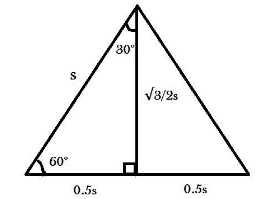
Now we can write the Pythagorean theorem for the constructed triangle.
$ \Rightarrow {(\dfrac{1}{2} \times s)^2} + {h^2} = {s^2} $
Let us separate the value of $ {h^2} $ , to find the value of height of triangle;
\[ \Rightarrow {h^2} = {s^2} - {(\dfrac{1}{2} \times s)^2}\]
\[ \Rightarrow {h^2} = {s^2} - (\dfrac{1}{4}) \times {s^2}\]
\[ \Rightarrow {h^2} = \dfrac{3}{4} \times {s^2}\]
\[\therefore h = \dfrac{{\sqrt 3 }}{2} \times s\]
But the area of the complete triangle can be written in this way:
$ \Rightarrow A = 2 \times \dfrac{1}{2} \times \dfrac{1}{2}s \times \dfrac{{\sqrt 3 }}{2}s $
$ \Rightarrow A = \dfrac{{\sqrt 3 }}{4} \times {s^2} $
So the equilateral triangle’s area using the Pythagorean Theorem is: $ \dfrac{{\sqrt 3 }}{4} \times {s^2} $ .
So, the correct answer is “ $ \dfrac{{\sqrt 3 }}{4} \times {s^2} $ .”.
Note: There are many other ways in which we can find the area of a triangle, one other way is using Heron's formula. In order for us to use this formula, we should know the sides of the triangle before calculating its area. If we know this we can use the Heron’s formula that says;
$ Area = \sqrt {s \times (s - a) \times (s - b) \times (s - c)} $ ; here the value of
$ a,b,c = $ length of each side , $ s $ = $ \dfrac{1}{2} \times (a + b + c) $
Using this formula, if the area is already given we can find the sides of the triangle also.
Complete step-by-step answer:
Our goal is to give a formula using Pythagorean Theorem to find out the area of an equilateral triangle. We must see how we can relate the original formula of area of a triangle to the Pythagorean Theorem.
Now let us first note down what we know from the given data:
We know that the triangle is equilateral, so it’s sides are all the same. Let the side of the triangle be $ s $ , then all the sides will be length $ s $ .
Then we know that in an equilateral triangle, all the inner angles are $ {60^ \circ } $ so there is no hypotenuse as of now, so let us construct a median from any one corner to the center of the opposite edge. In this manner we have constructed an angle of $ {90^ \circ } $ in the triangle so we can assume that one of the sides is the hypotenuse.
In the above mentioned way we can make a triangle that looks like this:
Now we can write the Pythagorean theorem for the constructed triangle.
$ \Rightarrow {(\dfrac{1}{2} \times s)^2} + {h^2} = {s^2} $
Let us separate the value of $ {h^2} $ , to find the value of height of triangle;
\[ \Rightarrow {h^2} = {s^2} - {(\dfrac{1}{2} \times s)^2}\]
\[ \Rightarrow {h^2} = {s^2} - (\dfrac{1}{4}) \times {s^2}\]
\[ \Rightarrow {h^2} = \dfrac{3}{4} \times {s^2}\]
\[\therefore h = \dfrac{{\sqrt 3 }}{2} \times s\]
But the area of the complete triangle can be written in this way:
$ \Rightarrow A = 2 \times \dfrac{1}{2} \times \dfrac{1}{2}s \times \dfrac{{\sqrt 3 }}{2}s $
$ \Rightarrow A = \dfrac{{\sqrt 3 }}{4} \times {s^2} $
So the equilateral triangle’s area using the Pythagorean Theorem is: $ \dfrac{{\sqrt 3 }}{4} \times {s^2} $ .
So, the correct answer is “ $ \dfrac{{\sqrt 3 }}{4} \times {s^2} $ .”.
Note: There are many other ways in which we can find the area of a triangle, one other way is using Heron's formula. In order for us to use this formula, we should know the sides of the triangle before calculating its area. If we know this we can use the Heron’s formula that says;
$ Area = \sqrt {s \times (s - a) \times (s - b) \times (s - c)} $ ; here the value of
$ a,b,c = $ length of each side , $ s $ = $ \dfrac{1}{2} \times (a + b + c) $
Using this formula, if the area is already given we can find the sides of the triangle also.
Recently Updated Pages
Master Class 8 Social Science: Engaging Questions & Answers for Success

Master Class 8 English: Engaging Questions & Answers for Success
Class 8 Question and Answer - Your Ultimate Solutions Guide
Master Class 8 Maths: Engaging Questions & Answers for Success
Master Class 8 Science: Engaging Questions & Answers for Success
Master Class 9 General Knowledge: Engaging Questions & Answers for Success
Trending doubts
What is BLO What is the full form of BLO class 8 social science CBSE
Citizens of India can vote at the age of A 18 years class 8 social science CBSE
Full form of STD, ISD and PCO
Advantages and disadvantages of science
Right to vote is a AFundamental Right BFundamental class 8 social science CBSE
What are the 12 elements of nature class 8 chemistry CBSE