




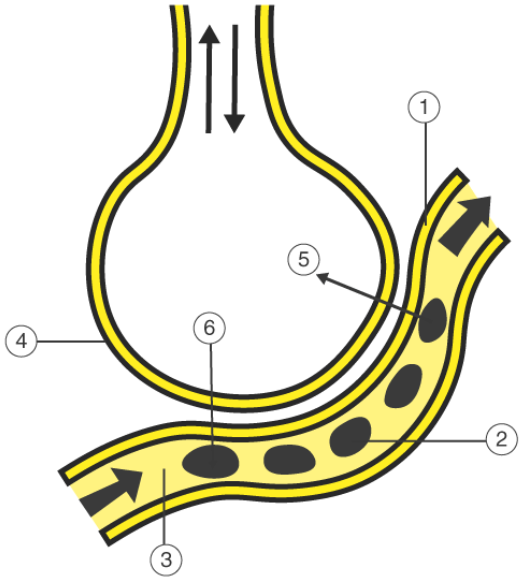
Given alongside is a diagrammatic sketch of a part in human lungs.
i) Name the parts numbered \[1 - 4\].
ii) What do the arrows \[5\] and 6 indicate?
Answer
 Verified
576.6k+ views
Hint: Gases are exchanged over a pressure/concentration gradient. Gases are exchanged between alveoli and blood, as well as between blood and tissues. Diffusion of gases through membranes is caused by a differential in partial pressures of \[C{O_2}\] \[\left( {pC{O_2}} \right)\] and \[{O_2}\] \[\left( {p{O_2}} \right)\] in alveolar tissues, blood, and other bodily tissues. At the end of the process, oxygen is transferred from the blood to the tissue fluid, while carbon dioxide is transferred from the tissue fluid to the blood.
Complete answer:
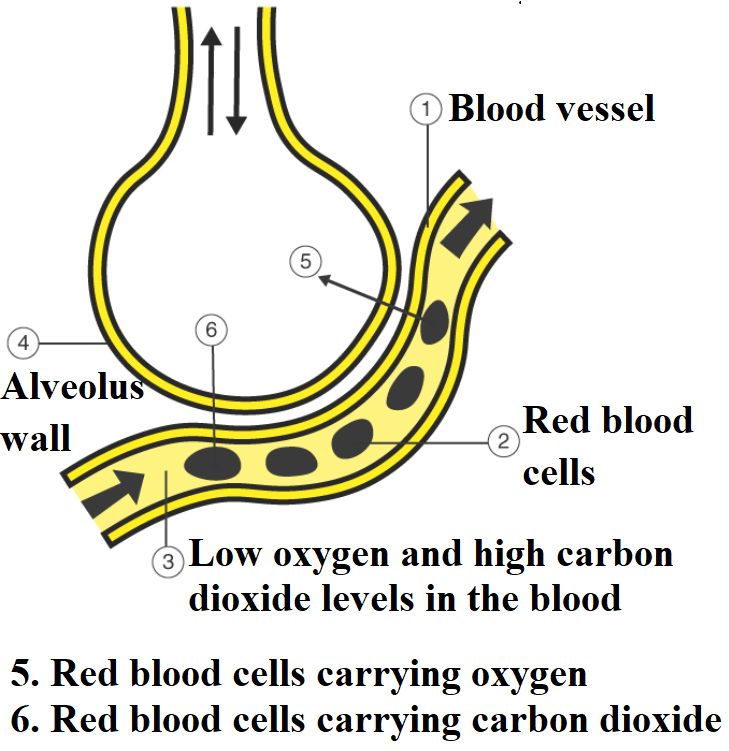
Part A: 1. Blood vessel(capillary)
2. Red blood cells
3. Low oxygen and high carbon dioxide levels in the blood.
4. Alveolus wall
Part B: Arrow \[5\] indicates red blood cells carrying oxygen and arrow \[6\] indicates red blood cells carrying carbon dioxide.
Additional information:
Gas is exchanged between the millions of alveoli in the lungs, as well as the capillaries that surround them. Inhaled oxygen travels from the alveoli to the capillaries, whereas carbon dioxide travels from the blood in the capillary to the air in the alveoli.
Process of respiration:
Pulmonary respiration (inhalation of ambient oxygen and exhalation of \[C{O_2}\]-rich alveolar air) $ \to $ \[{O_2}\] and \[C{O_2}\] diffusion across the alveolar membrane $ \to $ Gas transportation via blood $ \to $ Oxygen and \[C{O_2}\] diffusion between blood and alveoli $ \to $ Cellular respiration (catabolism of food using \[{O_2}\] to release energy and \[C{O_2}\]).
Note:
Gas transportation is a highly efficient method. Because haemoglobin has a high affinity for oxygen, oxygen is carried by red blood cells' haemoglobin. Each molecule of haemoglobin binds to four molecules of oxygen. The blood transports the oxygen that haemoglobin has gathered up to various tissues. Carbon dioxide is more soluble in water than oxygen, hence it is carried in dissolved form in human blood, though it is also carried by haemoglobin.
Complete answer:
Part A: 1. Blood vessel(capillary)
2. Red blood cells
3. Low oxygen and high carbon dioxide levels in the blood.
4. Alveolus wall
Part B: Arrow \[5\] indicates red blood cells carrying oxygen and arrow \[6\] indicates red blood cells carrying carbon dioxide.
Additional information:
Gas is exchanged between the millions of alveoli in the lungs, as well as the capillaries that surround them. Inhaled oxygen travels from the alveoli to the capillaries, whereas carbon dioxide travels from the blood in the capillary to the air in the alveoli.
Process of respiration:
Pulmonary respiration (inhalation of ambient oxygen and exhalation of \[C{O_2}\]-rich alveolar air) $ \to $ \[{O_2}\] and \[C{O_2}\] diffusion across the alveolar membrane $ \to $ Gas transportation via blood $ \to $ Oxygen and \[C{O_2}\] diffusion between blood and alveoli $ \to $ Cellular respiration (catabolism of food using \[{O_2}\] to release energy and \[C{O_2}\]).
Note:
Gas transportation is a highly efficient method. Because haemoglobin has a high affinity for oxygen, oxygen is carried by red blood cells' haemoglobin. Each molecule of haemoglobin binds to four molecules of oxygen. The blood transports the oxygen that haemoglobin has gathered up to various tissues. Carbon dioxide is more soluble in water than oxygen, hence it is carried in dissolved form in human blood, though it is also carried by haemoglobin.
Recently Updated Pages
If x a + bt + ct2 where x is in meters and t is in class 11 physics CBSE

A car covers the first half distance between two places class 11 physics CBSE
The resultant of two vectors overrightarrow P and overrightarrow class 11 physics CBSE
Find the value of cos 135 class 11 maths CBSE
A mass M is held in place by an applied force F and class 11 physics CBSE
A solution of glucose in water is labelled as 10 dfracwv class 11 chemistry CBSE
Trending doubts
One Metric ton is equal to kg A 10000 B 1000 C 100 class 11 physics CBSE
Find the value of the expression given below sin 30circ class 11 maths CBSE
Draw a diagram of nephron and explain its structur class 11 biology CBSE
10 examples of friction in our daily life
Proton was discovered by A Thomson B Rutherford C Chadwick class 11 chemistry CBSE
Bond order ofO2 O2+ O2 and O22 is in order A O2 langle class 11 chemistry CBSE