




Given a triangle with unequal sides, if P is the set of all points which are equidistant from B and C, and Q is the set of all points which are equidistant from sides AB and AC, then what is the P intersection with Q equal to?
Answer
 Verified
596.4k+ views
Hint- In order to deal with this question first we will make the clean diagram of the given problem further we will use the definition as the incenter I of triangle ABC is equidistant from all 3 sides AB, AC, & BC and we will find the intersection point according to it.
Complete step-by-step answer:
We will first make the correct diagram of the given problem, as shown below
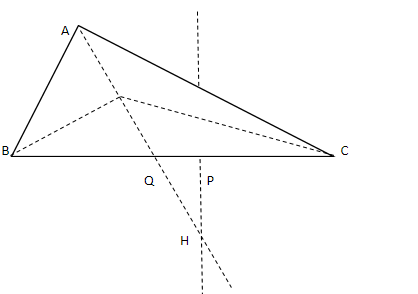
Here H is the intersection point of P and Q.
Since ABC scalene triangle.
And P is a group of points that are equidistant from B & C
The perpendicular bisector of BC lies in any point belonging to Set P. Can extend this perpendicular bisector to infinity.
Cardinal (Set P) = Infinite elements
Now, P is equidistant from all three sides of AB, AC, & BC
Since set Q, contains elements, which are equidistant from side AB & AC.
Thus locus Q is the angle bisector of < A.
So, every point of angle bisector of ∠A , will be equidistant from AB, & AC.
So, cardinal (Set Q) = endless elements
Now we'll consider both sets in common
Therefore, the common element(point) is the intersection point of the perpendicular bisector of BC & angle bisector of BA
Therefore, PnQ = the point of intersection of BC's perpendicular bisector & angle bisector of affordable A. And since triangle is triangle with scalene,
Consequently, Cardinal (PnQ) =1
Note- The triangle inequality states that the sum of the lengths of a triangle on any two sides must be greater than or equal to the length of the third side.
Complete step-by-step answer:
We will first make the correct diagram of the given problem, as shown below
Here H is the intersection point of P and Q.
Since ABC scalene triangle.
And P is a group of points that are equidistant from B & C
The perpendicular bisector of BC lies in any point belonging to Set P. Can extend this perpendicular bisector to infinity.
Cardinal (Set P) = Infinite elements
Now, P is equidistant from all three sides of AB, AC, & BC
Since set Q, contains elements, which are equidistant from side AB & AC.
Thus locus Q is the angle bisector of < A.
So, every point of angle bisector of ∠A , will be equidistant from AB, & AC.
So, cardinal (Set Q) = endless elements
Now we'll consider both sets in common
Therefore, the common element(point) is the intersection point of the perpendicular bisector of BC & angle bisector of BA
Therefore, PnQ = the point of intersection of BC's perpendicular bisector & angle bisector of affordable A. And since triangle is triangle with scalene,
Consequently, Cardinal (PnQ) =1
Note- The triangle inequality states that the sum of the lengths of a triangle on any two sides must be greater than or equal to the length of the third side.
Recently Updated Pages
Master Class 10 Computer Science: Engaging Questions & Answers for Success

Master Class 10 General Knowledge: Engaging Questions & Answers for Success
Master Class 10 English: Engaging Questions & Answers for Success
Master Class 10 Social Science: Engaging Questions & Answers for Success
Master Class 10 Maths: Engaging Questions & Answers for Success
Master Class 10 Science: Engaging Questions & Answers for Success
Trending doubts
What is the median of the first 10 natural numbers class 10 maths CBSE
Which women's tennis player has 24 Grand Slam singles titles?
Who is the Brand Ambassador of Incredible India?
Why is there a time difference of about 5 hours between class 10 social science CBSE
Write a letter to the principal requesting him to grant class 10 english CBSE
A moving boat is observed from the top of a 150 m high class 10 maths CBSE