




Given a triangle PQR in which ($\angle PQR = {90^o}$), S and T are the points of trisection of QR.
Prove that: $8{\left( {PT} \right)^2} = 3{\left( {PR} \right)^2} + 5{\left( {PS} \right)^2}$
Answer
 Verified
636.6k+ views
Hint: In this particular question use the concept that if a line is trisected then the line is divided into three equal parts, and later on in the solution use the concept of Pythagoras theorem so use these concepts to reach the solution of the question.
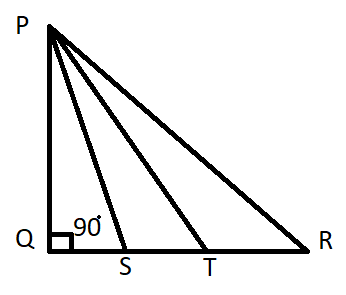
The pictorial representation of the above problem is shown above.
Consider the triangle PQR In which ($\angle PQR = {90^o}$) as shown above in the diagram.
S and T are the points of trisections of line QR.
Therefore, from the figure, QS = ST = TR.
Therefore, QS + ST + TR = QR
$ \Rightarrow QR = 3QS$..................... (1)
Now we have to prove that $8{\left( {PT} \right)^2} = 3{\left( {PR} \right)^2} + 5{\left( {PS} \right)^2}$
In triangle PQS apply Pythagoras theorem we have,
$ \Rightarrow {\left( {{\text{Hypotenuse}}} \right)^2} = {\left( {{\text{perpendicular}}} \right)^2} + {\left( {{\text{base}}} \right)^2}$
Now substitute the variables we have,
$ \Rightarrow {\left( {{\text{PS}}} \right)^2} = {\left( {{\text{PQ}}} \right)^2} + {\left( {{\text{QS}}} \right)^2}$................ (2)
Now in triangle PQT apply Pythagoras theorem we have,
$ \Rightarrow {\left( {{\text{Hypotenuse}}} \right)^2} = {\left( {{\text{perpendicular}}} \right)^2} + {\left( {{\text{base}}} \right)^2}$
Now substitute the variables we have,
$ \Rightarrow {\left( {{\text{PT}}} \right)^2} = {\left( {{\text{PQ}}} \right)^2} + {\left( {{\text{QT}}} \right)^2}$..................... (3)
Now in triangle PQR apply Pythagoras theorem we have,
$ \Rightarrow {\left( {{\text{Hypotenuse}}} \right)^2} = {\left( {{\text{perpendicular}}} \right)^2} + {\left( {{\text{base}}} \right)^2}$
Now substitute the variables we have,
$ \Rightarrow {\left( {{\text{PR}}} \right)^2} = {\left( {{\text{PQ}}} \right)^2} + {\left( {{\text{QR}}} \right)^2}$..................... (4)
Now consider R.H.S of the above equation we have,
$ \Rightarrow 3{\left( {PR} \right)^2} + 5{\left( {PS} \right)^2}$
Now substitute the value of ${\left( {PR} \right)^2}{\text{ and }}{\left( {PS} \right)^2}$from equation (2) and (4) in the above equation we have,
$ \Rightarrow 3\left[ {{{\left( {{\text{PQ}}} \right)}^2} + {{\left( {{\text{QR}}} \right)}^2}} \right] + 5\left[ {{{\left( {{\text{PQ}}} \right)}^2} + {{\left( {{\text{QS}}} \right)}^2}} \right]$
$ \Rightarrow 8{\left( {{\text{PQ}}} \right)^2} + 3{\left( {{\text{QR}}} \right)^2} + 5{\left( {{\text{QS}}} \right)^2}$
Now from equation (1) $\left( {QR = 3QS} \right)$ we have,
$ \Rightarrow 8{\left( {{\text{PQ}}} \right)^2} + 3{\left( {{\text{3QS}}} \right)^2} + 5{\left( {{\text{QS}}} \right)^2}$
$ \Rightarrow 8{\left( {{\text{PQ}}} \right)^2} + 3 \times 9{\left( {{\text{QS}}} \right)^2} + 5{\left( {{\text{QS}}} \right)^2}$
$ \Rightarrow 8{\left( {{\text{PQ}}} \right)^2} + 32{\left( {{\text{QS}}} \right)^2}$
Now from figure, QT = QS + ST = QS + QS = 2QS
$ \Rightarrow QS = \dfrac{{QT}}{2}$
Now substitute this value in the above equation we have,
$ \Rightarrow 8{\left( {{\text{PQ}}} \right)^2} + 32{\left( {\dfrac{{{\text{QT}}}}{2}} \right)^2}$
$ \Rightarrow 8{\left( {{\text{PQ}}} \right)^2} + \dfrac{{32}}{4}{\left( {{\text{QT}}} \right)^2}$
$ \Rightarrow 8{\left( {{\text{PQ}}} \right)^2} + 8{\left( {{\text{QT}}} \right)^2}$
$ \Rightarrow 8\left[ {{{\left( {{\text{PQ}}} \right)}^2} + {{\left( {{\text{QT}}} \right)}^2}} \right]$
Now from equation (3) ${\left( {{\text{PT}}} \right)^2} = {\left( {{\text{PQ}}} \right)^2} + {\left( {{\text{QT}}} \right)^2}$we have,
$ \Rightarrow 8{\left( {PT} \right)^2}$
= L.H.S
Hence proved.
Note: In such types of questions it is advised to simplify the LHS or the RHS according to their complexity of the given functions. Sometimes proving LHS = RHS needs simplification on both sides of the equation. Remember to convert dissimilar functions to get to the final result, and check whether R.H.S is equal to L.H.S or not if yes then it is the required answer.
The pictorial representation of the above problem is shown above.
Consider the triangle PQR In which ($\angle PQR = {90^o}$) as shown above in the diagram.
S and T are the points of trisections of line QR.
Therefore, from the figure, QS = ST = TR.
Therefore, QS + ST + TR = QR
$ \Rightarrow QR = 3QS$..................... (1)
Now we have to prove that $8{\left( {PT} \right)^2} = 3{\left( {PR} \right)^2} + 5{\left( {PS} \right)^2}$
In triangle PQS apply Pythagoras theorem we have,
$ \Rightarrow {\left( {{\text{Hypotenuse}}} \right)^2} = {\left( {{\text{perpendicular}}} \right)^2} + {\left( {{\text{base}}} \right)^2}$
Now substitute the variables we have,
$ \Rightarrow {\left( {{\text{PS}}} \right)^2} = {\left( {{\text{PQ}}} \right)^2} + {\left( {{\text{QS}}} \right)^2}$................ (2)
Now in triangle PQT apply Pythagoras theorem we have,
$ \Rightarrow {\left( {{\text{Hypotenuse}}} \right)^2} = {\left( {{\text{perpendicular}}} \right)^2} + {\left( {{\text{base}}} \right)^2}$
Now substitute the variables we have,
$ \Rightarrow {\left( {{\text{PT}}} \right)^2} = {\left( {{\text{PQ}}} \right)^2} + {\left( {{\text{QT}}} \right)^2}$..................... (3)
Now in triangle PQR apply Pythagoras theorem we have,
$ \Rightarrow {\left( {{\text{Hypotenuse}}} \right)^2} = {\left( {{\text{perpendicular}}} \right)^2} + {\left( {{\text{base}}} \right)^2}$
Now substitute the variables we have,
$ \Rightarrow {\left( {{\text{PR}}} \right)^2} = {\left( {{\text{PQ}}} \right)^2} + {\left( {{\text{QR}}} \right)^2}$..................... (4)
Now consider R.H.S of the above equation we have,
$ \Rightarrow 3{\left( {PR} \right)^2} + 5{\left( {PS} \right)^2}$
Now substitute the value of ${\left( {PR} \right)^2}{\text{ and }}{\left( {PS} \right)^2}$from equation (2) and (4) in the above equation we have,
$ \Rightarrow 3\left[ {{{\left( {{\text{PQ}}} \right)}^2} + {{\left( {{\text{QR}}} \right)}^2}} \right] + 5\left[ {{{\left( {{\text{PQ}}} \right)}^2} + {{\left( {{\text{QS}}} \right)}^2}} \right]$
$ \Rightarrow 8{\left( {{\text{PQ}}} \right)^2} + 3{\left( {{\text{QR}}} \right)^2} + 5{\left( {{\text{QS}}} \right)^2}$
Now from equation (1) $\left( {QR = 3QS} \right)$ we have,
$ \Rightarrow 8{\left( {{\text{PQ}}} \right)^2} + 3{\left( {{\text{3QS}}} \right)^2} + 5{\left( {{\text{QS}}} \right)^2}$
$ \Rightarrow 8{\left( {{\text{PQ}}} \right)^2} + 3 \times 9{\left( {{\text{QS}}} \right)^2} + 5{\left( {{\text{QS}}} \right)^2}$
$ \Rightarrow 8{\left( {{\text{PQ}}} \right)^2} + 32{\left( {{\text{QS}}} \right)^2}$
Now from figure, QT = QS + ST = QS + QS = 2QS
$ \Rightarrow QS = \dfrac{{QT}}{2}$
Now substitute this value in the above equation we have,
$ \Rightarrow 8{\left( {{\text{PQ}}} \right)^2} + 32{\left( {\dfrac{{{\text{QT}}}}{2}} \right)^2}$
$ \Rightarrow 8{\left( {{\text{PQ}}} \right)^2} + \dfrac{{32}}{4}{\left( {{\text{QT}}} \right)^2}$
$ \Rightarrow 8{\left( {{\text{PQ}}} \right)^2} + 8{\left( {{\text{QT}}} \right)^2}$
$ \Rightarrow 8\left[ {{{\left( {{\text{PQ}}} \right)}^2} + {{\left( {{\text{QT}}} \right)}^2}} \right]$
Now from equation (3) ${\left( {{\text{PT}}} \right)^2} = {\left( {{\text{PQ}}} \right)^2} + {\left( {{\text{QT}}} \right)^2}$we have,
$ \Rightarrow 8{\left( {PT} \right)^2}$
= L.H.S
Hence proved.
Note: In such types of questions it is advised to simplify the LHS or the RHS according to their complexity of the given functions. Sometimes proving LHS = RHS needs simplification on both sides of the equation. Remember to convert dissimilar functions to get to the final result, and check whether R.H.S is equal to L.H.S or not if yes then it is the required answer.
Recently Updated Pages
Master Class 11 English: Engaging Questions & Answers for Success

Master Class 11 Social Science: Engaging Questions & Answers for Success
Master Class 11 Maths: Engaging Questions & Answers for Success
Master Class 11 Biology: Engaging Questions & Answers for Success
Master Class 11 Physics: Engaging Questions & Answers for Success
Master Class 11 Chemistry: Engaging Questions & Answers for Success
Trending doubts
Explain the Treaty of Vienna of 1815 class 10 social science CBSE
What is the Total Duration of Football Match?
The shortest day of the year in India
In which year voting age was reduced from 21 to 18?
10 examples of evaporation in daily life with explanations
What planets have no moons Which one has only one moon class 10 physics CBSE