




When given a square, the construction of an angle bisector at any vertex will create the diagonal of the square.
(A) True
(B) False
Answer
 Verified
565.5k+ views
Hint :Square is the closed figure with four equal sides. Square has equal sides and equal angles. Diagonals bisect each other at right angles. Here we will use the properties of the square and will draw the diagram with given specifications to check for the given conditions.
Complete Step By Step Answer:
Draw the diagram of the square with given specifications.
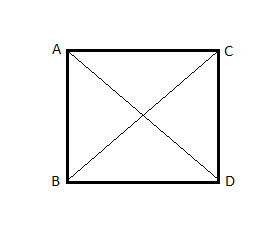
By the property of the square, the diagonals of square bisect the angle and so the angle bisector will be diagonal.
From the given multiple choices – the option A is the correct answer.
Additional Information:
Follow the properties of the parallelogram properly. Always remember that the opposite two sides of the parallelogram are always equal. Quadrilateral is the closed figure with four sides and the four vertices. It is also known as “quadrangle”. Basically, there are six types of quadrilaterals such as rectangle, square, kite, rhombus, trapezium and parallelogram. Refer the properties and know the difference among them.
Note :
Know the difference between the square and the parallelogram. Square and parallelogram both are quadrilateral. A parallelogram is the simple quadrilateral with its two opposite sides parallel to each other. The opposite sides of the parallelogram are of same length and never intersect each other.
Complete Step By Step Answer:
Draw the diagram of the square with given specifications.
By the property of the square, the diagonals of square bisect the angle and so the angle bisector will be diagonal.
From the given multiple choices – the option A is the correct answer.
Additional Information:
Follow the properties of the parallelogram properly. Always remember that the opposite two sides of the parallelogram are always equal. Quadrilateral is the closed figure with four sides and the four vertices. It is also known as “quadrangle”. Basically, there are six types of quadrilaterals such as rectangle, square, kite, rhombus, trapezium and parallelogram. Refer the properties and know the difference among them.
Note :
Know the difference between the square and the parallelogram. Square and parallelogram both are quadrilateral. A parallelogram is the simple quadrilateral with its two opposite sides parallel to each other. The opposite sides of the parallelogram are of same length and never intersect each other.
Recently Updated Pages
Master Class 11 Social Science: Engaging Questions & Answers for Success

Master Class 11 English: Engaging Questions & Answers for Success
Master Class 11 Maths: Engaging Questions & Answers for Success
Master Class 11 Chemistry: Engaging Questions & Answers for Success
Master Class 11 Biology: Engaging Questions & Answers for Success
Master Class 11 Physics: Engaging Questions & Answers for Success
Trending doubts
One Metric ton is equal to kg A 10000 B 1000 C 100 class 11 physics CBSE
Difference Between Prokaryotic Cells and Eukaryotic Cells
How many of the following diseases can be studied with class 11 biology CBSE
Draw a diagram of a plant cell and label at least eight class 11 biology CBSE
Two of the body parts which do not appear in MRI are class 11 biology CBSE
Which gas is abundant in air class 11 chemistry CBSE