



Given a quadrilateral ABCD, where AC and BD intersect at point O, $BM\bot AC$ and $DN\bot AC$. If $BM=DN$, prove that AC bisects BD.
Answer
 Verified
597k+ views
Hint: We will prove that triangle DNO is congruent to triangle BMO by AAS congruence, where AAS means Angle, Angle, Sides congruency. From this we will get that OD = OB which will show that AC bisects BD at O.
Complete step-by-step answer:
It is given in the question that ABCD is a quadrilateral, where AC and BD intersect at point O, $BM\bot AC$ and $DN\bot AC$. If $BM=DN$ and $BM=DN$ and we have to prove that AC bisects BD. We will first draw the figure as per the given conditions as below,
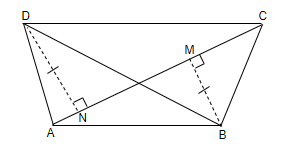
We can see in triangle DNO and triangle BMO, we get the sides,
$BM=DN\ldots \ldots \ldots \left( i \right)$
We know that vertically opposite angles are equal, so we have,
$\angle DON=\angle BOM\ldots \ldots \ldots \left( ii \right)$
It is given in the question that $BM\bot AC$ and $DN\bot AC$, so we can say that,
$\angle DNO=\angle BMO=90{}^\circ \ldots \ldots \ldots \left( iii \right)$
So, as we can see from the equations (i), (ii) and (iii), we get that $\Delta DON\cong \Delta BOM$ by AAS congruency, where AAS stands for Angle, Angle and Side.
Thus, we get that side OD = OB because OD is a side of triangle DON and OB is a side of triangle BOM and all the sides of the congruent triangle are equal with the corresponding part of the congruent triangle. Thus, OD = OB by CPCT, which means Corresponding Parts of a Congruent Triangle.
Therefore, AC bisects BD at O.
Hence it is proved.
Note: Many students get stuck in the last step of the solution and they think that the congruency of the triangle does not prove that OA = OC, which means that BD is not bisected by AC. But this is a wrong concept because it is not necessary that in a quadrilateral, if one diagonal bisects the other, then it must bisect itself also.
Complete step-by-step answer:
It is given in the question that ABCD is a quadrilateral, where AC and BD intersect at point O, $BM\bot AC$ and $DN\bot AC$. If $BM=DN$ and $BM=DN$ and we have to prove that AC bisects BD. We will first draw the figure as per the given conditions as below,
We can see in triangle DNO and triangle BMO, we get the sides,
$BM=DN\ldots \ldots \ldots \left( i \right)$
We know that vertically opposite angles are equal, so we have,
$\angle DON=\angle BOM\ldots \ldots \ldots \left( ii \right)$
It is given in the question that $BM\bot AC$ and $DN\bot AC$, so we can say that,
$\angle DNO=\angle BMO=90{}^\circ \ldots \ldots \ldots \left( iii \right)$
So, as we can see from the equations (i), (ii) and (iii), we get that $\Delta DON\cong \Delta BOM$ by AAS congruency, where AAS stands for Angle, Angle and Side.
Thus, we get that side OD = OB because OD is a side of triangle DON and OB is a side of triangle BOM and all the sides of the congruent triangle are equal with the corresponding part of the congruent triangle. Thus, OD = OB by CPCT, which means Corresponding Parts of a Congruent Triangle.
Therefore, AC bisects BD at O.
Hence it is proved.
Note: Many students get stuck in the last step of the solution and they think that the congruency of the triangle does not prove that OA = OC, which means that BD is not bisected by AC. But this is a wrong concept because it is not necessary that in a quadrilateral, if one diagonal bisects the other, then it must bisect itself also.
Recently Updated Pages
Master Class 9 General Knowledge: Engaging Questions & Answers for Success

Master Class 9 Social Science: Engaging Questions & Answers for Success
Master Class 9 English: Engaging Questions & Answers for Success
Master Class 9 Maths: Engaging Questions & Answers for Success
Master Class 9 Science: Engaging Questions & Answers for Success
Class 9 Question and Answer - Your Ultimate Solutions Guide
Trending doubts
Difference Between Plant Cell and Animal Cell
Fill the blanks with the suitable prepositions 1 The class 9 english CBSE
Who is eligible for RTE class 9 social science CBSE
Which places in India experience sunrise first and class 9 social science CBSE
What is pollution? How many types of pollution? Define it
Name 10 Living and Non living things class 9 biology CBSE