




Give the schematic representation of glycolysis.
Answer
 Verified
561.8k+ views
Hint: Glucose is a six-ring molecule present in the blood which typically comes from the sugar breakdown of carbohydrates. It enters cells by specific transporter proteins that transfer them into the cytosol of the cell from outside the cell.
Complete answer:
Glycolysis is the first of the major cellular respiration metabolic pathways to generate ATP energy. Glycolysis is a sequence of reactions in which two three-carbon molecules called pyruvates, are separated to derive energy from glucose. To break down sugar, there are 10 enzymes involved. The 10 stages of glycolysis are ordered by the order in which the mechanism operates on specific enzymes.
1.Glucose undergoes partial oxidation in this process to form two pyruvic acid molecules.
2.This glucose in plants is derived from sucrose, which is converted by the enzyme, invertase, into glucose and fructose, and these two monosaccharides quickly join the glycolytic pathway.
3.This glucose in plants is derived from sucrose, which is converted by the enzyme, invertase, into glucose and fructose, and these two monosaccharides quickly join the glycolytic pathway.
4.The action of the enzyme hexokinase allows glucose and fructose to be phosphorylated to give rise to glucose-6-phosphate.
5.In order to produce fructose-6-phosphate, this phosphorylated source of glucose then isomerises.
6.A series of ten reactions take place to generate pyruvate from glucose, under the influence of various enzymes.
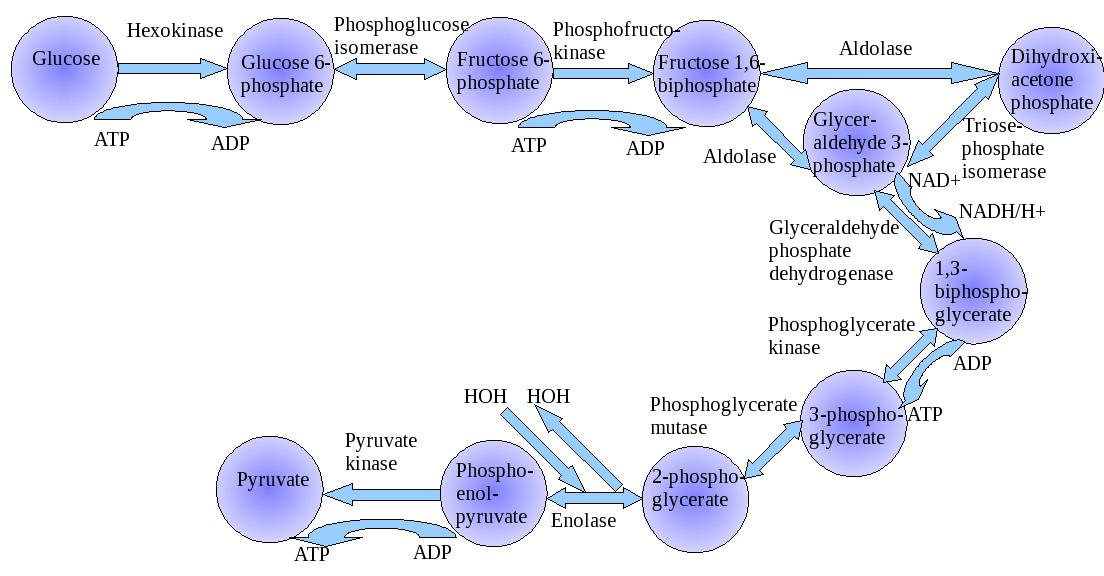
Note: With or without oxygen, glycolysis can occur. In the presence of oxygen, the first step of cellular respiration is glycolysis. Glycolysis helps cells to make small quantities of ATP by a fermentation process in the absence of oxygen.
Complete answer:
Glycolysis is the first of the major cellular respiration metabolic pathways to generate ATP energy. Glycolysis is a sequence of reactions in which two three-carbon molecules called pyruvates, are separated to derive energy from glucose. To break down sugar, there are 10 enzymes involved. The 10 stages of glycolysis are ordered by the order in which the mechanism operates on specific enzymes.
1.Glucose undergoes partial oxidation in this process to form two pyruvic acid molecules.
2.This glucose in plants is derived from sucrose, which is converted by the enzyme, invertase, into glucose and fructose, and these two monosaccharides quickly join the glycolytic pathway.
3.This glucose in plants is derived from sucrose, which is converted by the enzyme, invertase, into glucose and fructose, and these two monosaccharides quickly join the glycolytic pathway.
4.The action of the enzyme hexokinase allows glucose and fructose to be phosphorylated to give rise to glucose-6-phosphate.
5.In order to produce fructose-6-phosphate, this phosphorylated source of glucose then isomerises.
6.A series of ten reactions take place to generate pyruvate from glucose, under the influence of various enzymes.
Note: With or without oxygen, glycolysis can occur. In the presence of oxygen, the first step of cellular respiration is glycolysis. Glycolysis helps cells to make small quantities of ATP by a fermentation process in the absence of oxygen.
Recently Updated Pages
Master Class 12 Economics: Engaging Questions & Answers for Success

Master Class 12 English: Engaging Questions & Answers for Success
Master Class 12 Social Science: Engaging Questions & Answers for Success
Master Class 12 Maths: Engaging Questions & Answers for Success
Master Class 12 Physics: Engaging Questions & Answers for Success
Master Class 11 Social Science: Engaging Questions & Answers for Success
Trending doubts
One Metric ton is equal to kg A 10000 B 1000 C 100 class 11 physics CBSE
Difference Between Prokaryotic Cells and Eukaryotic Cells
Two of the body parts which do not appear in MRI are class 11 biology CBSE
1 ton equals to A 100 kg B 1000 kg C 10 kg D 10000 class 11 physics CBSE
Draw a diagram of nephron and explain its structur class 11 biology CBSE
10 examples of friction in our daily life