




Give the product of oxidation with $Mn{{O}_{2}}$of ${{C}_{6}}{{H}_{5}}CH(OH)C{{H}_{2}}C{{H}_{2}}OH$.
Answer
 Verified
547.8k+ views
Hint: As we know that allylic and benzylic alcohol can be readily oxidized under mild conditions. Also manganese (IV) dioxide is a mild oxidizing agent which selectively oxidizes primary or secondary allylic alcohols. We will use this information of reagent in the given question.
Complete answer:
Let us first understand the oxidation of allylic and benzylic alcohol with the help of manganese (IV) dioxide:-
-The allylic and benzylic alcohols are oxidized specifically and selectively by a suspension of activated manganese (IV) dioxide ($Mn{{O}_{2}}$). Aldehydes are formed by the oxidation of primary allylic alcohols and ketones are formed by the oxidation of secondary allylic alcohols.
-For this reaction, we require an “activated$Mn{{O}_{2}}$” which is obtained by the oxidation – reduction reaction of potassium permanganate and it is also a mild oxidizing agent. The oxidation of alcohols takes place on the surface of manganese (IV) dioxide ($Mn{{O}_{2}}$) which is insoluble in the solvents used for this reaction.
-The reaction is highly chemoselective because allylic and benzylic alcohols react more rapidly than the ordinary alcohols.
The oxidation reaction of ${{C}_{6}}{{H}_{5}}CH(OH)C{{H}_{2}}C{{H}_{2}}OH$with the help of $Mn{{O}_{2}}$ is shown below:-
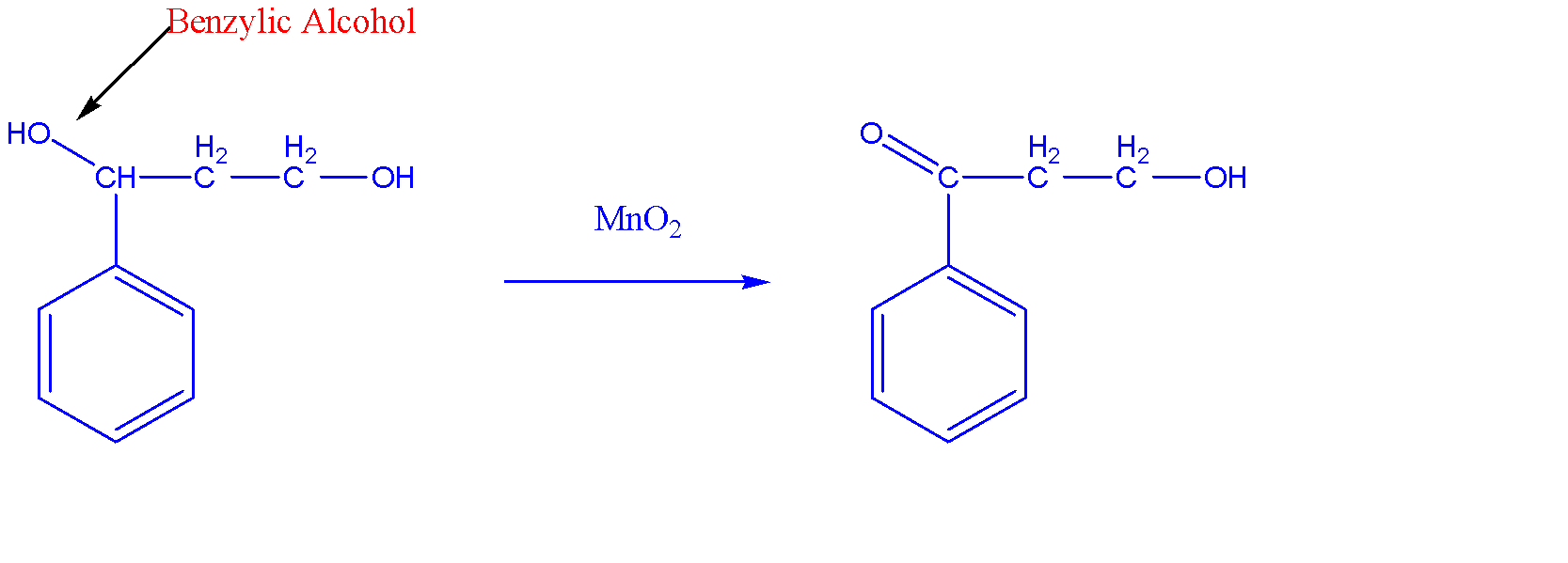
We can see that there are two alcohols in the reactant among which $Mn{{O}_{2}}$have selective nature towards benzylic alcohol and hence it will get oxidized to become a carbonyl compound. Since it is a secondary benzylic alcohol, we obtain ketone as a product.
Note:
The other reagents that can be specially used to oxidize allylic and benzylic alcohol are $Mn{{(OAc)}_{2}}$and $Mn{{(OAc)}_{3}}$.
-Remember that water competes with the alcohol for the sites on the $Mn{{O}_{2}}$surface and therefore it must be removed by drying to produce an active oxidant.
Complete answer:
Let us first understand the oxidation of allylic and benzylic alcohol with the help of manganese (IV) dioxide:-
-The allylic and benzylic alcohols are oxidized specifically and selectively by a suspension of activated manganese (IV) dioxide ($Mn{{O}_{2}}$). Aldehydes are formed by the oxidation of primary allylic alcohols and ketones are formed by the oxidation of secondary allylic alcohols.
-For this reaction, we require an “activated$Mn{{O}_{2}}$” which is obtained by the oxidation – reduction reaction of potassium permanganate and it is also a mild oxidizing agent. The oxidation of alcohols takes place on the surface of manganese (IV) dioxide ($Mn{{O}_{2}}$) which is insoluble in the solvents used for this reaction.
-The reaction is highly chemoselective because allylic and benzylic alcohols react more rapidly than the ordinary alcohols.
The oxidation reaction of ${{C}_{6}}{{H}_{5}}CH(OH)C{{H}_{2}}C{{H}_{2}}OH$with the help of $Mn{{O}_{2}}$ is shown below:-
We can see that there are two alcohols in the reactant among which $Mn{{O}_{2}}$have selective nature towards benzylic alcohol and hence it will get oxidized to become a carbonyl compound. Since it is a secondary benzylic alcohol, we obtain ketone as a product.
Note:
The other reagents that can be specially used to oxidize allylic and benzylic alcohol are $Mn{{(OAc)}_{2}}$and $Mn{{(OAc)}_{3}}$.
-Remember that water competes with the alcohol for the sites on the $Mn{{O}_{2}}$surface and therefore it must be removed by drying to produce an active oxidant.
Recently Updated Pages
Master Class 11 Social Science: Engaging Questions & Answers for Success

Master Class 11 Physics: Engaging Questions & Answers for Success
Master Class 11 Maths: Engaging Questions & Answers for Success
Master Class 11 Economics: Engaging Questions & Answers for Success
Master Class 11 Computer Science: Engaging Questions & Answers for Success
Master Class 11 Chemistry: Engaging Questions & Answers for Success
Trending doubts
One Metric ton is equal to kg A 10000 B 1000 C 100 class 11 physics CBSE
There are 720 permutations of the digits 1 2 3 4 5 class 11 maths CBSE
1 Quintal is equal to a 110 kg b 10 kg c 100kg d 1000 class 11 physics CBSE
State and prove Bernoullis theorem class 11 physics CBSE
Difference Between Prokaryotic Cells and Eukaryotic Cells
Which among the following are examples of coming together class 11 social science CBSE