




Give the magnitude and direction of the net force acting on a stone of mass 0.1 kg.
(a) Just after it is dropped from the window of a stationary train.
(b) Just after it is dropped from the window of a train running at a constant velocity of 36 km/h.
(c) Just after it is dropped from the window of a train accelerating with $1m{{s}^{-2}}$
(d) Lying on the floor of a train which is accelerating with $1m{{s}^{-2}}$, the stone being at rest relative to the train. Neglect air resistance throughout.
Answer
 Verified
645.3k+ views
Hint: We will focus on the motion of the train as well as on the motion of the stone. It is important to get to know the forces that are acting on the stone. Also, we will notice the forces acting on it while the stone is in the train. Acceleration due to gravity and acceleration due to train are important.
Formula used:
$F=ma$, $F=mg$ where F is the force, m is the mass and a is the acceleration whereas g is the acceleration due to gravity.
Complete answer:
We will consider the following diagram for the question.
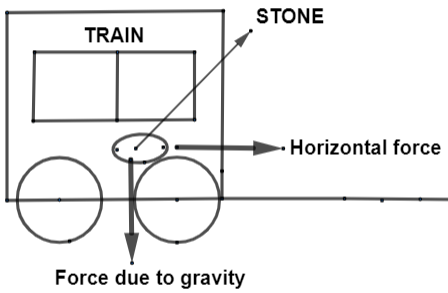
(a) According to the question we are given the mass of the stone and the condition that it is dropped from the stationary train.
Here, the acceleration and gravity will be the same as $a=g=10m/{{s}^{2}}$. The total force acting on it will be,
$\begin{align}
& F=ma \\
& \Rightarrow F=0.1kg\times 10m/{{\sec }^{-2}} \\
& \Rightarrow F=1N \\
\end{align}$
The magnitude will be 1 Newton and due to the force of gravity acting on it, the direction of the force will be downwards.
Hence, the force is 1 Newton and the direction is downwards.
(b) The condition here is that the stone is now dropped from the train when the train was at a velocity of 36km/h. Because of gravitation acceleration will be zero. So, only gravitational force will act on the stone so,
$\begin{align}
& F=mg \\
& \Rightarrow F=0.1kg\times 10m/{{\sec }^{-2}} \\
& \Rightarrow F=1N \\
\end{align}$
The direction of the force is downwards due to gravity.
Hence, the force is 1 Newton and the direction is downwards.
(c) Now, the train is accelerating with $1m{{s}^{-2}}$, but still if the stone is dropped from the train so, after leaving its contact with the train no force will be acting on it except the gravitational force. So, the force here also, is 1N and acting downwards.
Hence, the force is 1 Newton and the direction is downwards.
(d) Clearly, as the train is at rest and on the floor of the train, train and stone will have the same velocity and acceleration. So, force here will be,
$\begin{align}
& F=ma \\
& \Rightarrow F=0.1kg\times 1m/{{\sec }^{-2}} \\
& \Rightarrow F=0.1N \\
\end{align}$
Hence, the force is 0.1 Newton and the direction is downwards.
Note:
It is important to always note the forces acting on an object, when it is at rest and when it is in motion. This is because there are several forces which are basic like acceleration due to gravity which is always present on the objects and acceleration which is exerted by other objects. We should check the units before solving because if not then, the answer may get wrong. Actually, the value of g is taken to be $9.8m/{{s}^{2}}$ but here we took it as $g=10m/{{s}^{2}}$. This is for the solution to make it less complex. We will not do this in other questions, but here we did because of the presence of the number 0.1 which gives an easy number after multiplying.
Formula used:
$F=ma$, $F=mg$ where F is the force, m is the mass and a is the acceleration whereas g is the acceleration due to gravity.
Complete answer:
We will consider the following diagram for the question.
(a) According to the question we are given the mass of the stone and the condition that it is dropped from the stationary train.
Here, the acceleration and gravity will be the same as $a=g=10m/{{s}^{2}}$. The total force acting on it will be,
$\begin{align}
& F=ma \\
& \Rightarrow F=0.1kg\times 10m/{{\sec }^{-2}} \\
& \Rightarrow F=1N \\
\end{align}$
The magnitude will be 1 Newton and due to the force of gravity acting on it, the direction of the force will be downwards.
Hence, the force is 1 Newton and the direction is downwards.
(b) The condition here is that the stone is now dropped from the train when the train was at a velocity of 36km/h. Because of gravitation acceleration will be zero. So, only gravitational force will act on the stone so,
$\begin{align}
& F=mg \\
& \Rightarrow F=0.1kg\times 10m/{{\sec }^{-2}} \\
& \Rightarrow F=1N \\
\end{align}$
The direction of the force is downwards due to gravity.
Hence, the force is 1 Newton and the direction is downwards.
(c) Now, the train is accelerating with $1m{{s}^{-2}}$, but still if the stone is dropped from the train so, after leaving its contact with the train no force will be acting on it except the gravitational force. So, the force here also, is 1N and acting downwards.
Hence, the force is 1 Newton and the direction is downwards.
(d) Clearly, as the train is at rest and on the floor of the train, train and stone will have the same velocity and acceleration. So, force here will be,
$\begin{align}
& F=ma \\
& \Rightarrow F=0.1kg\times 1m/{{\sec }^{-2}} \\
& \Rightarrow F=0.1N \\
\end{align}$
Hence, the force is 0.1 Newton and the direction is downwards.
Note:
It is important to always note the forces acting on an object, when it is at rest and when it is in motion. This is because there are several forces which are basic like acceleration due to gravity which is always present on the objects and acceleration which is exerted by other objects. We should check the units before solving because if not then, the answer may get wrong. Actually, the value of g is taken to be $9.8m/{{s}^{2}}$ but here we took it as $g=10m/{{s}^{2}}$. This is for the solution to make it less complex. We will not do this in other questions, but here we did because of the presence of the number 0.1 which gives an easy number after multiplying.
Recently Updated Pages
Master Class 11 Social Science: Engaging Questions & Answers for Success

Master Class 11 English: Engaging Questions & Answers for Success
Master Class 11 Accountancy: Engaging Questions & Answers for Success
Master Class 11 Physics: Engaging Questions & Answers for Success
Master Class 11 Computer Science: Engaging Questions & Answers for Success
Master Class 11 Business Studies: Engaging Questions & Answers for Success
Trending doubts
Find the value of the expression given below sin 30circ class 11 maths CBSE
One Metric ton is equal to kg A 10000 B 1000 C 100 class 11 physics CBSE
Draw a diagram of nephron and explain its structur class 11 biology CBSE
10 examples of friction in our daily life
Proton was discovered by A Thomson B Rutherford C Chadwick class 11 chemistry CBSE
The teeth used for biting and cutting food are called class 11 biology CBSE